

Changes to Universal Credit in 2026: New Rates, Rules and What Claimants Need to Know?
Universal Credit has gone through another significant round of changes in 2026.
From 6 April, the standard allowance increased, a new two-tier system was introduced for the Limited Capability for Work and Work-Related Activity element, and the two-child limit was removed.
Universal Credit can now include a child element for every eligible child rather than generally restricting support to two children.
The system has also reached an important point in the migration from older benefits. By May 2026, around 8.4 million people were receiving Universal Credit and approximately 1.7 million had entered the system through the formal Move to Universal Credit programme.
However, the phrase changes to Universal Credit covers more than annual benefit increases. Universal Credit has been repeatedly revised since its introduction in 2013.
Payment waiting periods, deductions, migration arrangements, child support rules, work incentives and health-related support have all been altered at different stages.
Understanding these changes is therefore important for both existing claimants and people making a new claim.
How Often Are Changes Made to Universal Credit?
There is no single timetable covering every Universal Credit change.
The most predictable changes generally happen around April at the start of a new financial year. Benefit rates can be uprated annually, meaning the standard allowance and various additional elements may change.
However, Universal Credit can also change at other times following:
- New Legislation passed by Parliament
- Government Budgets and spending decisions
- Economic Conditions such as inflation or major financial disruption
- Court Decisions affecting how existing rules operate
- Operational Reviews identifying problems with how Universal Credit is administered
- Emergency Measures such as those introduced during the COVID-19 pandemic
For example, the temporary £20-a-week increase to the Universal Credit standard allowance began during the pandemic and continued until October 2021.
The Minimum Income Floor for affected self-employed claimants was also temporarily suspended between April 2020 and July 2021.
Universal Credit should therefore not be viewed as a benefit with rules that only change once a year. Claimants should check their Universal Credit account and current guidance whenever their circumstances change.
What Do Universal Credit Changes Mainly Focus On?
Although individual reforms can be very different, most Universal Credit changes concern a relatively small number of areas.
One is the amount of financial support available. This includes annual changes to the standard allowance, child elements, carer support, disability-related elements and work allowances.
Another major area is employment. Universal Credit was designed to operate for people both in and out of work, with payments adjusting as earnings change.

Changes to work allowances, the earnings taper and claimant commitments can therefore directly affect working claimants.
Health and disability support has also become an increasingly important part of Universal Credit reform. From April 2026, the LCWRA element has two main rates.
Most people newly determined to have LCWRA receive the lower rate of £217.26 per assessment period, while qualifying protected groups can receive the higher amount.
Other Universal Credit reforms have focused on:
- Children And Families
- Housing Costs
- Benefit Deductions
- Debt Recovery
- Migration From Legacy Benefits
- Reporting Changes In Circumstances
- Work Capability Assessments
- Fraud And Error Prevention
The overall system therefore continues to change in response to policy decisions as well as practical experience of running a benefit used by millions of people.
How Has Universal Credit Changed Since It Was Introduced?
Universal Credit was created under the Welfare Reform Act 2012 and first introduced through pathfinder areas in April 2013.
Its original purpose was to bring several means-tested benefits and tax credits into one system.
These included income-based Jobseeker’s Allowance, income-related Employment and Support Allowance, Income Support, Housing Benefit, Working Tax Credit and Child Tax Credit. The original objectives included simplifying the system and improving financial incentives to work.
The original plan was considerably faster than what eventually happened.
Universal Credit was initially expected to be substantially implemented by 2017. Early difficulties with management and technology resulted in the programme being reset in 2013 and its timetable being extended.
Further major developments included the introduction of the Full Service digital system, expansion across Great Britain, changes to waiting periods, work allowances and deductions, temporary pandemic measures and the later managed migration of people receiving legacy benefits.
The formal managed migration process was itself interrupted when its initial pilot was suspended in March 2020 because of the pandemic.
The Department for Work and Pensions resumed the process in selected areas in May 2022.
The exercise of contacting remaining legacy benefit claimants was completed in late March 2026, although a relatively small number of more complex cases could remain in the process.
Universal Credit in 2026 is therefore significantly different from both the original 2013 system and the system operating only a few years ago.
Which Universal Credit Changes Did Not Work as Originally Intended?
Some parts of Universal Credit were changed because implementation produced practical difficulties or because the original approach was reconsidered.
One of the clearest examples is the early Universal Credit rollout.
The programme originally had an ambitious timetable, but problems involving programme management and technology led to a major reset in 2013.
The National Audit Office subsequently reported that the Department for Work and Pensions had extended the timetable and adopted a more expensive twin-track approach involving both the older Live Service and development of a new digital service.
Payment waiting arrangements were another area later revised.
Universal Credit originally included seven waiting days before entitlement began for many new claimants.
Changes announced in 2017 removed those seven days from February 2018, reducing the expected wait for the first regular payment from six weeks to five weeks. Advance payment arrangements were also expanded.
Deductions have been repeatedly revised as well.
The overall maximum deduction level eventually fell to 15% of the standard allowance, compared with a previous maximum of 25%. For 2026/27, the 15% limit remains reflected in the Universal Credit rates.
These examples show how Universal Credit has operated under a continuing “test and learn” model rather than remaining fixed in its original design.
Which Universal Credit Policies Were Later Changed, Reversed or Removed?
Several Universal Credit measures have either been removed completely, substantially revised or introduced only temporarily.
Two-Child Limit
The two-child limit was introduced from April 2017. It generally prevented Universal Credit from including an additional child element for a third or subsequent child born on or after 6 April 2017 unless an exception applied.
The policy ended on 6 April 2026.
Universal Credit can now include an eligible child amount for every child, regardless of family size.
The Benefit Cap remains separate, so some households may not receive the full financial increase if their total benefit entitlement reaches the cap.
Official statistics for April 2026 showed that 478,120 households were not receiving a child element for at least one child because of the previous limit, with 436,780 of those households expected to see their Universal Credit award increase following its removal.
Original Six-Week Waiting Arrangement
The original waiting structure was later changed by abolishing the seven waiting days.
This reduced the normal period between entitlement beginning and the first regular Universal Credit payment from around six weeks to five weeks.
The five-week structure remains significant because Universal Credit is calculated using monthly assessment periods and is normally paid after the assessment period ends.
Temporary £20 Universal Credit Uplift
During the COVID-19 pandemic, the standard allowance was temporarily increased by approximately £20 per week.
The increase was initially intended to last for 12 months, was later extended for another six months and ended in October 2021.
Unlike the two-child limit, this was not a permanent policy that was subsequently abolished. It was introduced explicitly as temporary emergency support.
Managed Migration Pilot
The initial managed migration pilot was suspended in March 2020 because of the pandemic.
Migration restarted in May 2022, after which the approach was expanded progressively across different groups receiving legacy benefits.
This illustrates how operational changes can be paused and redesigned without the overall Universal Credit system itself being abandoned.
How Much Has Universal Credit Increased in 2026?
The Universal Credit standard allowance increased for the 2026/27 financial year.
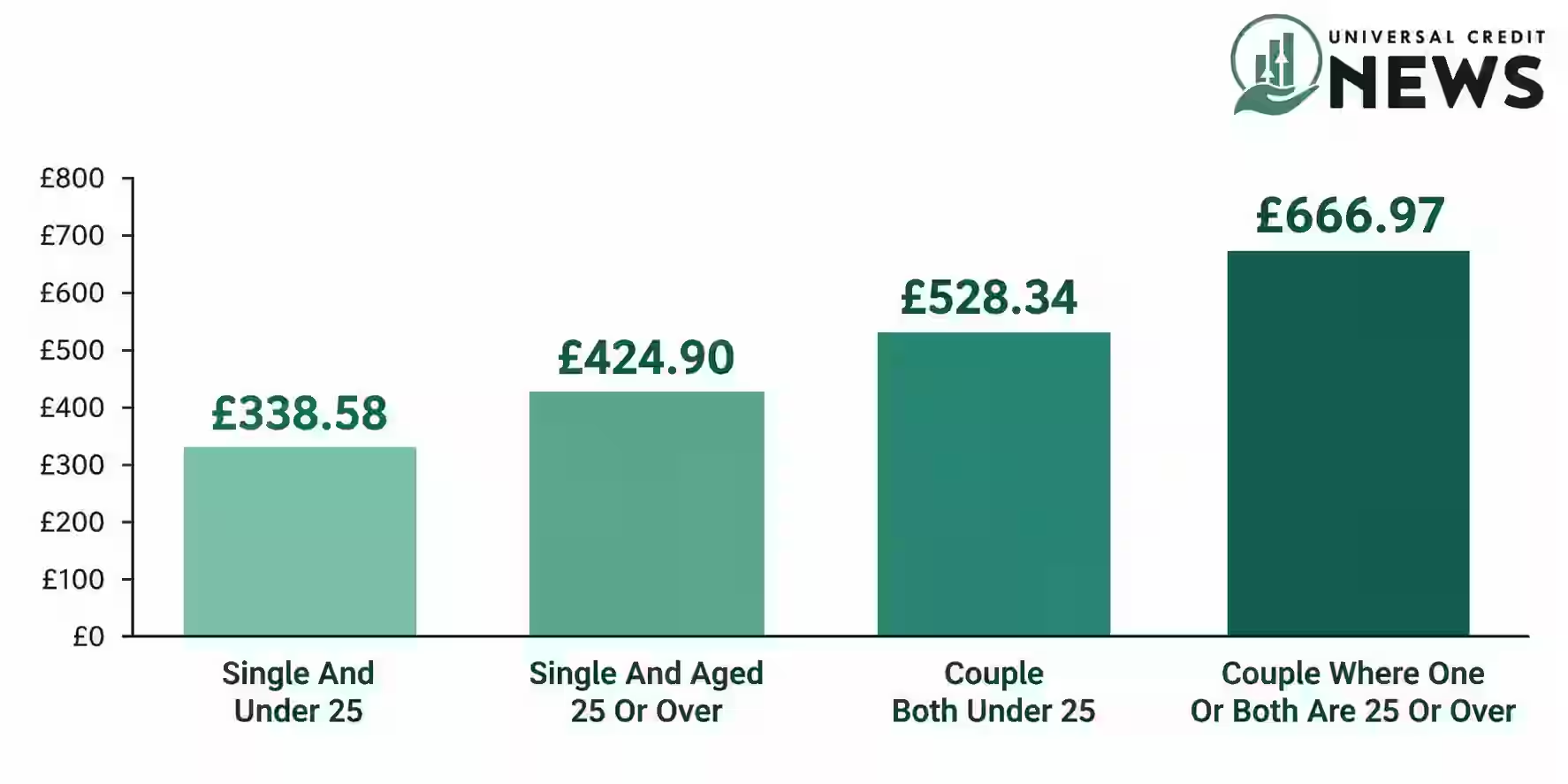
For assessment periods covered by the new rates, the monthly standard allowances are:
Claimant Circumstances 2026/27 Monthly Standard Allowance
Single And Under 25 £338.58
Single And Aged 25 Or Over £424.90
Couple Both Under 25 £528.34
Couple Where One Or Both Are 25 Or Over £666.97
The increases form part of a wider policy under the Universal Credit Act 2025 providing for increases to the standard allowance through 2029/30.
Other Universal Credit amounts have also changed, meaning the effect on an individual household depends on which elements are included in its award.
People should therefore look at the complete Universal Credit statement rather than applying the standard allowance increase alone to their previous payment.
How Has The LCWRA Health Element Changed In 2026?
One of the most significant structural changes in 2026 concerns the Limited Capability for Work and Work-Related Activity element.
From 6 April 2026, Universal Credit operates with two LCWRA rates.
Most claimants newly determined to have LCWRA from that date receive the lower LCWRA element of £217.26 per assessment period during 2026/27.
A higher rate continues for specified groups, including qualifying pre-2026 claimants, terminally ill claimants and people meeting the Severe Conditions Criteria.
The Severe Conditions Criteria are intended for people whose condition meets specific requirements, including where an applicable functional descriptor is expected to apply throughout the person’s life.
Protection for existing claimants is more complicated than simply saying that closing a claim automatically removes the higher rate.
Legislation allows certain short periods of non-entitlement caused by the financial condition not being met to be disregarded where entitlement resumes within six months.
Claimants affected by health conditions should therefore consider their individual entitlement rather than assuming that every new or restarted Universal Credit award automatically receives the same LCWRA rate.
How Has Removing The Two-Child Limit Changed Universal Credit?
The removal of the two-child limit represents one of the largest family-related Universal Credit changes in 2026.
Before 6 April 2026, Universal Credit generally provided the child element for only the first two children where later children were born on or after 6 April 2017, subject to specified exceptions.
That restriction has now ended.
Universal Credit can provide the additional amount for each eligible child or qualifying young person in the household.
Families affected by the previous restriction generally began seeing increased payments from May or June 2026 depending on the dates of their monthly assessment periods.
However, ending the two-child limit did not remove the Benefit Cap.
Child elements continue to count towards the total amount considered under the Benefit Cap.
A household already subject to the cap may therefore receive only part of the potential increase, or in some cases no increase in its final payment.
What Changes In Circumstances Must Universal Credit Claimants Report?
Changes made by government are only one meaning of “changes to Universal Credit”. Claimants must also report relevant changes in their own circumstances.
These can include:
- Starting Or Finishing A Job
- Having A Child
- Moving In With A Partner
- Starting To Care For Someone
- Changes To A Child’s Education Or Training
- Moving Home
- Changes To Rent
- Changes To A Health Condition
- Becoming Too Ill To Work
- Changing Bank Details
- Changing Contact Details
- Going Abroad
Changes should generally be reported as soon as they happen. A delay can result in a claimant receiving too much Universal Credit and having to repay the overpayment.
A circumstance change can also affect entitlement for the whole assessment period rather than only from the exact day on which the change is reported.
Most changes can be reported through the claimant’s online Universal Credit account.
What Has Changed With The Move From Legacy Benefits To Universal Credit?
The transition from older means-tested benefits to Universal Credit has been one of the longest-running changes in the UK benefits system.
Universal Credit has been available across the country for new eligible claims since December 2018.
People could also move through natural migration after certain circumstance changes or voluntarily in some situations.
People remaining on relevant legacy benefits were subsequently contacted through the Move to Universal Credit programme and issued with instructions to make a Universal Credit claim.
The managed migration exercise involving contact with remaining legacy benefit claimants concluded in late March 2026.
By May 2026, around 1.7 million of the 8.4 million people receiving Universal Credit had joined through Move to Universal Credit.
Migration is important because entitlement under Universal Credit is calculated differently from legacy benefits.
A person’s Universal Credit entitlement cannot therefore be assumed to equal the total amount previously received through older benefits.
How Does Transitional Protection Work?
Transitional protection was created to protect certain people who move to Universal Credit through the managed migration process from an immediate cash reduction solely because the new Universal Credit calculation is lower.
Where the relevant conditions are met, a transitional element can be added to the Universal Credit award.
The protection does not necessarily remain at the same value indefinitely. As other Universal Credit elements increase or circumstances change, the transitional element can reduce.
Eligibility also depends on the way the claimant moved to Universal Credit.
A person who independently makes a Universal Credit claim before being required to migrate may not receive the same protection available to someone moving through the formal managed migration process.
This is one reason people receiving a Migration Notice should follow the instructions and claim within the required timeframe rather than assuming that voluntarily changing benefits earlier will produce the same result.
Who Is Most Affected By The Universal Credit Changes In 2026?
The effect of the 2026 changes varies considerably between households.
Families with three or more eligible children are among the groups most directly affected by the removal of the two-child limit.
Government statistics indicate that hundreds of thousands of households were expected to receive increased awards following that reform.
Most claimants also benefit from the higher 2026/27 standard allowance.
The position is different for some people qualifying for LCWRA for the first time after the April 2026 reforms. Unless they fall within one of the protected categories, they may receive the lower £217.26 LCWRA element rather than the higher rate available to protected claimants.
Households affected by the Benefit Cap may also find that increases to child-related entitlement do not produce an equivalent increase in the amount actually paid.
The effect of any reform therefore depends on the claimant’s age, family, earnings, housing costs, health status, savings, benefit cap position and other circumstances.
What Could Change Next For Universal Credit?
Universal Credit is unlikely to remain completely unchanged after 2026.
The Universal Credit Act 2025 already provides a framework for standard allowance increases extending through the 2029/30 tax year, so further annual changes are built into the current system.
Future governments can also change benefit rates, eligibility conditions, work requirements, health-related support, deductions and other Universal Credit rules through legislation and regulations.
Annual uprating decisions will remain important because inflation affects the real value of payments.
Changes may also result from reviews of employment support, disability benefits, housing costs and the effectiveness of existing Universal Credit rules.
For claimants, the practical point is that the amount and rules applying in one financial year should not automatically be assumed to apply in the next.
Frequently Asked Questions
How Often Does Universal Credit Change?
Universal Credit rates are commonly updated around April each year, but rules can also change at other times following legislation, Budgets, operational decisions or exceptional events.
Why Does Universal Credit Usually Change In April?
April marks the beginning of the new tax and financial year, when revised benefit rates and many social security changes normally take effect.
What Was The Biggest Universal Credit Change In 2026?
There were several major changes rather than one single change.
These include higher standard allowances, the new LCWRA rate structure and removal of the two-child limit from 6 April 2026.
Which Universal Credit Rules Have Been Removed?
Examples include the seven waiting days that previously contributed to a six-week wait for the first regular payment and, from April 2026, the two-child limit on child elements.
Why Was The Two-Child Limit Removed?
The policy was removed through legislation that took effect on 6 April 2026.
The government’s published impact assessment projected that removing the limit would reduce the number of children living in relative poverty compared with retaining the policy, while opponents of the change raised concerns about higher welfare expenditure.
Have Universal Credit Reforms Ever Been Paused?
Yes. The initial managed migration pilot was suspended in March 2020 during the COVID-19 pandemic before migration activity resumed in May 2022.
Is Universal Credit Still Replacing Legacy Benefits?
The large-scale Move to Universal Credit exercise is now close to completion.
DWP says the exercise of contacting remaining legacy benefit claimants concluded in late March 2026, with mainly more complex cases remaining afterward.
Could Universal Credit Rules Change Again In 2027?
Yes. Benefit rates and other rules can be amended in future financial years, while legislation already provides for further changes to the standard allowance through 2029/30.