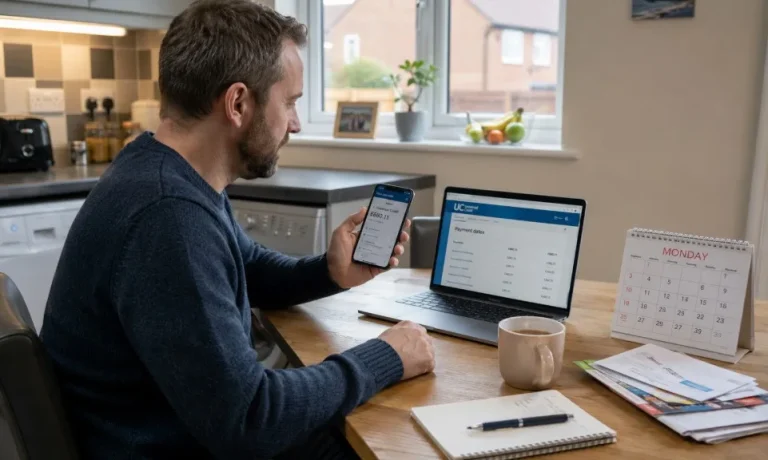

Which Banks Can DWP Not Check Online? 2026 Rules Explained
If you receive Universal Credit or another DWP benefit, you may wonder which banks can DWP not check online and whether using a particular bank, building society or digital account prevents the Department for Work and Pensions from seeing financial information.
The short answer is that there is no published list of UK banks that the DWP cannot check.
The DWP does not have unrestricted access to your online banking account, password or everyday spending. However, under its legal information-gathering and eligibility-verification powers, banks and certain other financial institutions can be required to provide specified information in particular circumstances.
This means switching from a traditional high-street bank to an online or app-based provider should not be treated as a way of keeping savings invisible to the DWP.
It is also important to distinguish between:
- The DWP directly accessing online banking
- A bank supplying limited eligibility information
- A claimant being asked to provide bank statements
- A formal investigation involving additional financial information
These are different processes with different legal rules.
Which Banks Can DWP Not Check Online?
There is no confirmed UK bank that can be described as a bank the DWP is unable to check.
The rules are not based on a public list of individual bank names. Instead, the legislation looks at whether an organisation meets the definition of an eligible financial institution and whether the account falls within the scope of the relevant DWP power.
This can potentially include organisations authorised to accept deposits as well as qualifying electronic-money institutions.
Therefore, people should not assume that an account is outside DWP checks simply because it is:
- With a smaller bank
- With an online-only provider
- Managed entirely through an app
- With a building society
- With an electronic-money provider
- Separate from their main current account
There is more detail on the difference between financial verification and direct account access in our explanation of whether the DWP can check your bank account without permission.
Can DWP Log Into Your Online Banking?

No. The DWP’s financial verification powers do not mean a DWP employee can simply log into someone’s online banking.
The department does not receive your:
- Online banking username
- Password
- Banking app login
- PIN
- Card security number
- Full unrestricted banking dashboard
The Eligibility Verification Measure works differently.
Where the legal conditions are met, the DWP can issue an Eligibility Verification Notice to an appropriate financial institution. The institution checks its own data against criteria specified in the notice and returns the information it is legally required to provide.
That is very different from giving the DWP direct access to your bank account.
What Information Can Banks Give the DWP?
Under the Eligibility Verification Measure, a financial institution may be required to supply specified information about an account that meets the conditions in a notice.
This can potentially include:
| Information | Can It Potentially Be Shared Under an Eligibility Check? |
|---|---|
| Account holder's name | Yes |
| Date of birth | Yes |
| Account number or equivalent details | Yes |
| Sort code | Yes |
| Information showing an eligibility indicator has been met | Yes |
| Details relating to linked accounts in scope | Potentially |
| Full bank statements through an EVN | No |
| Individual purchase history through an EVN | No |
| What you bought in shops | No |
| Your online banking password | No |
An important distinction is that transaction information is specifically outside the Eligibility Verification Notice process.
That means the new verification system should not be confused with the DWP routinely watching where a claimant shops or what they buy.
Other legal processes can apply separately, including benefit reviews, fraud investigations and certain debt-recovery procedures.
Which Accounts Can Be Included in DWP Eligibility Checks?
The account matters just as much as the name of the bank.
Personal accounts potentially within the Eligibility Verification Measure include:
- Current accounts
- Savings accounts
- Investment accounts
- Certain qualifying electronic-money accounts
- Some linked accounts
- Certain joint accounts
If a relevant benefit is paid into one account, other accounts held by the same person with that financial institution can potentially become relevant where the legal conditions for linked accounts are met.
Having several accounts therefore does not automatically mean only the account receiving the benefit matters.
For Universal Credit claimants in particular, the wider issue is total capital rather than simply the balance of one account. Our article on what counts as savings for Universal Credit explains the different forms of capital that can affect entitlement.
Are Any Account Types Outside the New DWP Eligibility Verification Measure?
Yes. There is a difference between saying an account type is outside this particular verification measure and saying the DWP can never obtain information about it.
Under the current Eligibility Verification Measure framework, the following are outside its definition of relevant accounts:
| Account Type | Eligibility Verification Measure |
|---|---|
| Personal current account | Potentially in scope |
| Personal savings account | Potentially in scope |
| Personal investment account | Potentially in scope |
| Credit card account | Out of scope |
| Current account mortgage | Out of scope |
| Account held outside the UK | Out of scope |
| Business account | Out of scope |
| Charity account | Out of scope |
These exclusions should not be interpreted as ways of hiding savings or capital.
For example, an overseas account being outside this particular automated verification framework does not mean overseas savings can simply be ignored when making a Universal Credit claim.
Claimants are still responsible for correctly declaring capital that the benefit rules require them to report.
Can DWP Check Online-Only and App-Based Banks?
Potentially, yes.
There is no general exemption simply because a financial service operates without branches.
The relevant question is whether the provider falls within the legal definition of a financial institution covered by the DWP power and whether the account itself is an account covered by the rules.
An app-based account therefore should not automatically be considered more private from the DWP than an account held with a traditional bank.
The same principle applies to electronic-money providers. The legislation specifically allows qualifying institutions that issue electronic money to fall within the framework.
Can DWP Check Savings Accounts?
Savings accounts are among the personal account types that can fall within the eligibility-verification framework.
This matters particularly for means-tested benefits.
For Universal Credit, savings and other forms of capital can affect entitlement even when the money is held separately from the account into which Universal Credit is normally paid.
You can read more about the process in can Universal Credit check my savings account?.
The key principle is that claimants are expected to report relevant capital accurately rather than relying on whether a particular account is likely to be checked.
Can DWP Check an Account That Does Not Receive Universal Credit?
Under the Eligibility Verification Measure, the starting point is generally an account receiving a relevant benefit payment.
However, the rules can also extend to qualifying linked accounts.
For example, if the person holding the benefit-receiving account also holds another qualifying personal account with the same financial institution, information relating to that linked account may potentially fall within the process where the required conditions are met.
This is why moving money from the benefit-receiving account into another account should not be regarded as making the money irrelevant.
For Universal Credit, capital is generally assessed across the claimant’s relevant savings and assets rather than only the bank account receiving the monthly UC payment.
What About Joint Bank Accounts?
Joint accounts can also be relevant.
If a benefit payment goes into a joint account, the financial institution may have to consider accounts linked to the people who hold that account, depending on the conditions specified in the notice.
Universal Credit itself is also assessed at household level for couples.
Someone making a joint Universal Credit claim therefore cannot normally disregard savings simply because money is held in their partner’s account.
Can DWP Check an Overseas Bank Account?

Accounts held outside the UK are outside the current scope of the Eligibility Verification Measure.
However, this does not mean overseas savings are automatically excluded from Universal Credit.
Universal Credit capital rules can take account of money, investments, property and other relevant assets held abroad.
Therefore:
Out of scope of an automated bank verification measure does not mean exempt from benefit rules.
If a claimant is asked about overseas savings or assets during a review or investigation, they may still need to provide appropriate evidence.
Attempting to move savings overseas simply to avoid the effect of benefit capital rules can also create much more serious problems.
Can DWP Check Business Bank Accounts?
Business accounts are not personal accounts and are outside the specific Eligibility Verification Measure described above.
However, that does not create a general exemption from Universal Credit rules.
Self-employed claimants have separate rules covering business assets, business income and capital.
Money should therefore be classified according to the actual Universal Credit rules rather than simply according to which bank account it is stored in.
Moving personal savings into a business account does not automatically change what the money represents or remove a claimant’s obligation to provide accurate information.
How Much Savings Can You Have on Universal Credit?
For most Universal Credit claimants, the main capital thresholds are:
| Total Relevant Capital | General Effect on Universal Credit |
|---|---|
| £6,000 or less | Normally does not reduce UC because of capital |
| More than £6,000 up to £16,000 | UC is normally reduced |
| More than £16,000 | Usually prevents entitlement |
Between £6,000 and £16,000, Universal Credit normally assumes £4.35 of monthly income for every £250, or part of £250, above £6,000.
There are exceptions and capital disregards, so an account balance alone does not always determine entitlement.
Our detailed explanation of the Universal Credit savings limit covers the £6,000 and £16,000 thresholds in more detail.
Does Having Several Bank Accounts Affect Universal Credit?
It can.
Universal Credit does not normally assess only your main bank account.
Relevant capital can be spread across:
- Current accounts
- Savings accounts
- Joint accounts
- ISAs
- Investments
- Premium Bonds
- Cash
- Certain digital balances
- Property interests
- Overseas savings
- Other relevant financial assets
If someone has £4,000 in one account and £5,000 in another, they should not assume they have only £4,000 for Universal Credit purposes.
Where both sums count as capital, the relevant figure may be £9,000.
Does DWP See Every Transaction You Make?
Not through the Eligibility Verification Measure.
Banks are not supposed to provide transaction information through an Eligibility Verification Notice.
That includes information that could reveal:
- What you bought
- The amount of an individual purchase
- Who you paid
- Which shop or business received a payment
This is an important safeguard.
However, there are circumstances outside the Eligibility Verification Measure where bank statements can become relevant.
For example, the DWP may ask a claimant to provide statements during a benefit review. More extensive financial information may also be sought using other lawful information-gathering powers where the required conditions are satisfied.
Therefore, saying “DWP cannot see transactions through an EVN” is not the same as saying “DWP can never obtain bank statements.”
Can DWP Ask You to Send Bank Statements?
Yes.
Universal Credit claimants can be asked to provide bank statements or other financial evidence during a claim review.
This may be used to verify matters including:
- Savings
- Income
- Account ownership
- Transfers
- Household circumstances
- Changes in capital
A request for statements does not automatically mean that someone is suspected of fraud.
Reviews are also used to identify ordinary mistakes and ensure claimants are receiving the correct amount.
If financial information appears inconsistent with information already held by the DWP, further questions may be asked.
You can find more information about circumstances that may lead to further enquiries in what triggers a DWP investigation?.
Which Benefits Are Covered by the New Eligibility Verification Framework?
The legislation currently specifies three relevant benefits for the Eligibility Verification Measure:
- Universal Credit
- State Pension Credit
- Employment and Support Allowance
The State Pension itself is different.
State Pension is not currently one of the relevant benefits covered by this eligibility-verification power, and the legislation prevents State Pension from simply being added to the scheme in the same way as other benefits.
Someone receiving State Pension and Pension Credit, however, should distinguish between the two because Pension Credit is specifically within the framework.
Are All Banks Already Being Automatically Checked in 2026?
It would be misleading to say that every benefit claimant’s accounts at every bank are continuously being checked.
The legislation and DWP Code of Practice establish the framework for Eligibility Verification Notices, but implementation is being developed and rolled out operationally.
The system is also not designed as unrestricted real-time surveillance of everyone’s bank account.
Financial institutions respond to legally defined notices and eligibility indicators.
The DWP has also chosen not to publish every precise eligibility indicator used in the system. This is intended to prevent the verification process from being deliberately circumvented.
What Happens If a Bank Account Is Flagged?
A match does not automatically mean benefit fraud.
Information returned through an Eligibility Verification Notice may indicate that further checks are appropriate.
The DWP must then consider the information alongside the claimant’s circumstances and other evidence.
There may be a perfectly legitimate explanation.
For example, some money is subject to a temporary or permanent capital disregard. A claimant could therefore appear to hold a relatively high balance without necessarily being over the relevant benefit limit.
Further checks may result in:
- No change
- A request for additional information
- A correction to the benefit award
- Identification of an overpayment
- Identification of an underpayment
- A compliance investigation
- A fraud investigation where there is evidence suggesting deliberate wrongdoing
The bank’s automated response itself does not decide benefit entitlement.
A human decision-making process remains necessary.
Can You Avoid DWP Checks by Changing Banks?
Changing banks does not remove the obligation to report financial circumstances accurately.
There is no official list showing that one mainstream UK bank is invisible to the DWP while another is not.
Trying to structure accounts specifically to conceal capital can also cause additional problems.
For Universal Credit, deliberately transferring, giving away or reducing assets in order to obtain or increase benefit can potentially fall under deprivation of capital rules.
The DWP can sometimes treat a claimant as still possessing money they deliberately deprived themselves of. This is known as notional capital.
The safer approach is therefore to understand what needs to be declared and whether any legitimate capital disregard applies.
What Should Universal Credit Claimants Do?
Claimants do not need to panic simply because the DWP has greater financial-verification powers.
The main practical steps are straightforward:
- Declare relevant savings accurately
- Report significant changes in capital
- Include relevant joint and overseas assets
- Keep records explaining large incoming payments
- Retain evidence where money qualifies for a capital disregard
- Respond to legitimate Universal Credit review requests
- Check your Universal Credit journal regularly
- Correct an error promptly if you realise information previously supplied was inaccurate
A high bank balance does not automatically mean someone is breaking the rules. What matters is what the money represents, whether it counts as capital and whether the claimant has reported their circumstances correctly.
Frequently Asked Questions
Which Banks Can DWP Not Check Online?
There is no official list of UK banks that the DWP cannot check. The eligibility-verification rules apply according to the type of financial institution and account rather than a published list of individual bank brands.
Does DWP Have Access to My Online Banking?
No. DWP staff do not receive unrestricted access to your online banking account, login credentials or banking app.
Can DWP Check Digital Bank Accounts?
Potentially. Being an online-only or app-based financial provider does not automatically put an account outside DWP financial-verification rules.
Can DWP See What I Spend Money on?
Not through an Eligibility Verification Notice. Transaction information revealing individual purchases is specifically excluded from that process. Bank statements may, however, be requested through other benefit-review or lawful investigation processes.
Can DWP Check My Savings Account?
Savings accounts can fall within the Eligibility Verification Measure, and savings are also relevant to means-tested benefits such as Universal Credit.
Can DWP Find Accounts I Have Not Declared?
The DWP has several verification and information-gathering mechanisms. Claimants should therefore declare relevant accounts and capital rather than assuming an undeclared account cannot be identified.
Can DWP Check Overseas Bank Accounts?
Overseas accounts are outside the specific Eligibility Verification Measure, but overseas money and assets can still count towards Universal Credit. Claimants are still required to declare relevant overseas capital.
Are business accounts checked by DWP?
Business accounts are outside the specific Eligibility Verification Measure because it focuses on personal accounts. This does not mean money can be transferred into a business account to avoid Universal Credit reporting rules.
Can DWP Check a Second Bank Account?
Potentially. Linked personal accounts held by the person receiving the relevant benefit may fall within the eligibility-verification framework where the statutory conditions are met.