

Universal Credit Increase 2026: New Payment Dates, Rates and Changes
The Universal Credit increase for 2026 took effect on 6 April 2026, with higher standard allowances and several changes to additional payments. Most existing claimants started receiving the increased amounts in May or June 2026, depending on when their monthly assessment period began.
The standard allowance for a single person aged 25 or over increased from £400.14 to £424.90 per month, while couples where at least one person is aged 25 or over now receive a standard allowance of £666.97.
However, the increase is not the same for everyone. Changes to child payments, disability-related support, earnings and deductions can affect the final amount deposited into a claimant’s bank account.
When Will the Increased Universal Credit Payments Arrive?
The Department for Work and Pensions (DWP) introduced the new Universal Credit rates from 6 April 2026. However, claimants did not all receive the increased payment on the same date.
Universal Credit is calculated through individual monthly assessment periods rather than using one national payment date.
The higher rates apply from the first assessment period beginning on or after 6 April 2026.
Official Universal Credit Increase Date
The main dates for the 2026 increase were:
Event Date
New Universal Credit Rates Took Effect 6 April 2026
First Higher Payments Began May 2026
Other Claimants Received Higher Payments June 2026
New Rates Remain Applicable Throughout the 2026/27 Rate Period
The timing depends on the claimant’s existing payment cycle. Universal Credit is normally paid in arrears, meaning each payment covers the assessment period that has already ended.
How Assessment Periods Affect Payment Dates?
An assessment period normally lasts one calendar month, and Universal Credit is usually paid seven days after that period ends.
For example:
- Claimant A: An assessment period beginning on 6 April and ending on 5 May would normally be paid on 12 May, including the new rates.
- Claimant B: An assessment period beginning on 3 April and ending on 2 May would still use the previous rates. Their next period, from 3 May to 2 June, would use the increased rates, normally paid on 9 June.
If the usual payment date falls on a weekend or bank holiday, the money is normally paid on the preceding working day.
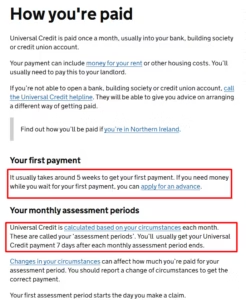
GOV.UK confirms that Universal Credit is calculated through monthly assessment periods and normally paid seven days after each period ends.
How Much Has Universal Credit Increased in 2026?
Universal Credit standard allowances increased above inflation in April 2026, providing additional monthly support to eligible single claimants and couples.
The amount of the increase depends on the claimant’s age and whether they make a single or joint claim.
Updated Standard Allowance Rates for 2026/27
The confirmed standard allowances are:
Claimant Category 2025/26 Monthly Rate 2026/27 Monthly Rate Monthly Increase
Single Under 25 £316.98 £338.58 £21.60
Single Aged 25 or Over £400.14 £424.90 £24.76
Couple Both Under 25 £497.55 £528.34 £30.79
Couple, One or Both Aged 25 or Over £628.10 £666.97 £38.87
These figures represent the standard allowance before additional elements, earnings reductions and other deductions.
For example, a single claimant aged 25 or over who qualifies for the full standard allowance could receive £297.12 more over 12 months than under the previous rate, assuming their circumstances remain unchanged.
Similarly, a couple with at least one partner aged 25 or over could receive £466.44 more over 12 months from their standard allowance alone.
The overall Universal Credit payment increase can be larger where the household also qualifies for additional child, carer or disability-related amounts.
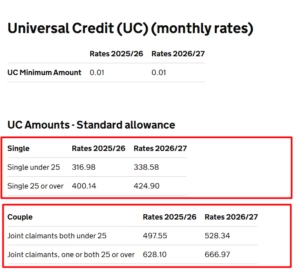
The DWP’s official 2026/27 benefit-rate table confirms the new monthly Universal Credit standard allowances and their previous rates.
What Percentage Has Universal Credit Increased in 2026?
The Universal Credit standard allowance increased by approximately 6.2% for most claimant categories, while the single-under-25 rate increased by approximately 6.8%.
This was higher than the 3.8% inflation-linked uprating applied to most other Universal Credit elements.
The changes followed the Universal Credit Act 2025, which established a programme of above-inflation increases to standard allowances.
Claimant Category Approximate Percentage Increase
Single Under 25 6.8%
Single Aged 25 or Over 6.2%
Couple Both Under 25 6.2%
Couple, One or Both Aged 25 or Over 6.2%
Most Other Uprated UC Elements 3.8%
The difference matters because the percentage increase should not be applied automatically to a claimant’s entire Universal Credit payment.
For example, a household receiving housing support, child elements and LCWRA may have several different rates and rules affecting its overall entitlement.
What Has Changed in the 2026 Universal Credit Increase Compared to Previous Years?
The April 2026 increase introduced more than higher monthly standard allowances.
Previous annual increases were mainly based on inflation, but the 2026 reforms also changed how families with three or more children and some claimants with health conditions receive financial support.
Universal Credit Increase Rates From 2023 to 2026
Year Increase Main Change
April 2023 10.1% Inflation-linked increase following sharp rises in living costs
April 2024 6.7% Standard allowances and most additional elements increased
April 2025 1.7% Smaller inflation-linked increase
April 2026 Approximately 6.2%–6.8% for standard allowances Above-inflation increases alongside major child and health-element reforms
The 2026 standard allowance increase was significantly higher than the 1.7% uprating in 2025.
However, it was lower than the 10.1% rise introduced in April 2023, when inflation had reached particularly high levels.
The latest reforms are also intended to change the balance between the standard allowance and additional health-related payments.
Changes to Child Elements and the Two-Child Limit
One of the most significant changes was the removal of the Universal Credit two-child limit on 6 April 2026.
Previously, families were generally restricted to receiving the additional child element for their first two children, subject to exceptions.
Following the change, Universal Credit can include a child element for every eligible child.
The updated monthly rates are:
Child Element 2025/26 2026/27
First Child Born Before 6 April 2017 £339.00 £351.88
Standard Child Element £292.81 £303.94
Lower Disabled Child Addition £158.76 £164.79
Higher Disabled Child Addition £495.87 £514.71
For example, a family previously unable to receive the child element for a third child could now qualify for an additional £303.94 per month for that child, before any relevant deductions or Benefit Cap restrictions.
Although the two-child limit has ended, the Benefit Cap remains in place. Some households may therefore receive less than the full additional amount.
LCWRA Payment Changes
Universal Credit also introduced two rates for the Limited Capability for Work and Work-Related Activity (LCWRA) element from April 2026.
LCWRA Category 2026/27 Monthly Amount
Lower LCWRA Rate £217.26
Higher LCWRA Rate £429.80
The lower rate generally applies to many claimants reporting a health condition from 6 April 2026 who do not meet the conditions for the higher rate.
The higher amount is available to qualifying protected claimants, including people who reported their condition before 6 April 2026, certain people with severe lifelong conditions and those nearing the end of life.
Existing recipients of the former LCWRA amount are not automatically reduced to £217.26.
These changes form part of wider reforms to Universal Credit, which also removed the two-child limit and increased standard allowances.
Who Is Eligible for the Universal Credit Increase?
Existing Universal Credit claimants generally qualify for the updated standard allowance corresponding to their household circumstances.
The changes apply to eligible households receiving Universal Credit, whether they are working or currently unemployed.
Groups affected include:
- Single Claimants: People under and over 25 receive higher standard allowances.
- Couples: Joint claimants receive an increased household standard allowance.
- Low-Income Workers: Eligible employed claimants may receive higher support, subject to earnings calculations.
- Families With Children: Increased child elements and removal of the two-child limit can raise entitlement.
- Claimants With Health Conditions: The applicable LCWRA rate depends on the claimant’s circumstances and protection rules.
- Unpaid Carers: The Universal Credit carer element increased from £201.68 to £209.34 per month.
Qualifying claimants do not need to submit a new application simply to receive the annual increase to an existing allowance.
However, new circumstances that create entitlement to additional elements, such as becoming a carer or having a child, must be reported to the DWP.
The amount actually received may still differ from the new standard allowance because Universal Credit is means-tested.
Why Has My Universal Credit Payment Not Increased?
Some claimants may notice that their payment has stayed the same, increased by less than expected or even fallen despite the introduction of higher rates.
This does not necessarily mean the annual increase has been missed.
Universal Credit payments are calculated individually, taking account of income, household circumstances, deductions and other relevant factors.
Assessment Periods and Payment Delays
The first reason is the timing of assessment periods.
Because the new rates only applied from assessment periods beginning on or after 6 April 2026, some claimants continued receiving older rates during May before receiving their increase in June.
Claimants should review the statement for the relevant assessment period to establish whether the new rates have been included.
Earnings, Deductions and Changes in Circumstances
Several other factors can affect the final payment.
Possible Reason How It Can Affect Universal Credit
Higher Earnings Earnings can reduce the amount received
Advance Repayments Money may be deducted to repay a previous advance
Benefit Overpayments Recovery deductions may reduce the payment
Sanctions Failure to meet applicable requirements can reduce payments
Changes in Household Circumstances Moving in with a partner or changes involving children can affect entitlement
Benefit Cap The cap may limit how much of an increase is received
For working households, the earnings taper remains at 55%.
This means Universal Credit normally reduces by 55p for each £1 of counted earnings above any applicable work allowance.
In 2026/27, the monthly work allowances are £427 for qualifying households receiving housing support and £710 for qualifying households without housing support.
Not every claimant qualifies for a work allowance. The amount someone can earn while receiving Universal Credit depends on their household’s entitlement and circumstances.
For example, someone entitled to the £427 work allowance with £1,000 in counted monthly earnings would have £573 subject to the taper, producing an earnings reduction of £315.15.
Understanding how much you can earn and still get Universal Credit can help explain why the final payment does not match the standard allowance shown in official tables.
If a payment appears incorrect, claimants should check their Universal Credit statement and report the issue through their online journal.
Does Universal Credit Increase Every Year?
Universal Credit rates are normally reviewed annually, with most increases taking effect in April.
Historically, many benefit rates have been adjusted using the Consumer Prices Index (CPI) inflation figure recorded in the previous September.
However, an annual review does not guarantee that every element will increase every year.
The Universal Credit Act 2025 introduced a specific programme of increases to standard allowances through the 2029/30 financial year.
Under the legislation, standard allowances are set to rise above the level they would otherwise reach through inflation-linked uprating alone.
The planned additional uplift relative to that inflation-only baseline is:
Financial Year Standard Allowance Above Inflation-Only Baseline
2026/27 2.3%
2027/28 3.1%
2028/29 4.0%
2029/30 4.8%
These percentages are not separate annual increases to be added to inflation each year. They indicate how much higher the standard allowance is intended to be than it would have been under inflation-only uprating.
Certain other payments follow different rules. In particular, the lower LCWRA element is scheduled to remain frozen at £217.26 through 2029/30.
Therefore, claimants should not assume that every part of their Universal Credit award will increase by the same percentage each April.
Will Universal Credit Increase Again in April 2027?
Yes. Further increases are planned for April 2027, and the government provided an update on the next uprating on 28 October 2026.
According to the parliamentary announcement, most working-age benefits covered by the annual review will increase by 3.5%, reflecting September 2026 CPI inflation.
The Universal Credit standard allowance follows a separate above-inflation formula under the Universal Credit Act 2025.
The government indicated that the standard allowance for a single claimant aged 25 or over would increase by approximately £219 annually, while couples with at least one partner aged 25 or over would see an increase of approximately £344 annually.
Most 2027/28 benefit-rate changes are expected to take effect from 12 April 2027, with Universal Credit changes applied according to the relevant assessment-period rules.
The full official 2027/28 monthly rate table had not yet been published as of 4 November 2026.
Although another increase is planned, the amount paid into each claimant’s bank account will continue to depend on their income, additional elements, deductions and household circumstances.
Conclusion
The Universal Credit increase took effect on 6 April 2026, with most existing claimants receiving the higher standard allowances from May or June, depending on their assessment periods.
The changes introduced higher payments for single claimants and couples, increased child-related support, removed the two-child limit and established separate LCWRA payment rates.
While standard allowances rose by approximately 6.2% for most claimant categories, the actual increase varied according to household circumstances.
Further increases are planned for April 2027, but claimants should continue checking their monthly statements to understand exactly how changing rates, earnings and deductions affect their payments.
Frequently Asked Questions
When Will I Get My Universal Credit Increase in 2026?
The new rates took effect on 6 April 2026. Most existing claimants received their first increased payment in May or June, depending on their monthly assessment period.
How Much Extra Universal Credit Will I Receive?
The monthly standard allowance increased by between £21.60 and £38.87, depending on age and whether the claim is made individually or jointly. Additional elements can affect the total increase.
Will Everyone on Universal Credit Get an Increase?
The standard allowances increased for all claimant categories, but not everyone saw a higher final payment. Earnings, deductions and the Benefit Cap can affect the amount received.
Why Has My Universal Credit Not Increased Yet?
Your assessment period, earnings, deductions or household circumstances may explain the difference. Check your online payment statement and contact the DWP if the calculation appears incorrect.
Will the Universal Credit Increase Be Backdated?
The annual increase is applied from the first assessment period beginning on or after 6 April 2026. It is not generally backdated to earlier periods, although arrears may be due if an eligible payment was calculated incorrectly.
Does the Increase Affect Housing Payments?
Housing support continues to be calculated using eligible housing costs and applicable rules. A higher standard allowance does not automatically mean the housing element will increase by the same percentage.
Do I Need to Apply for the Universal Credit Increase?
No. Existing claimants receive the annual rate increase automatically where applicable. However, they must report any new circumstances that could qualify them for additional support.