
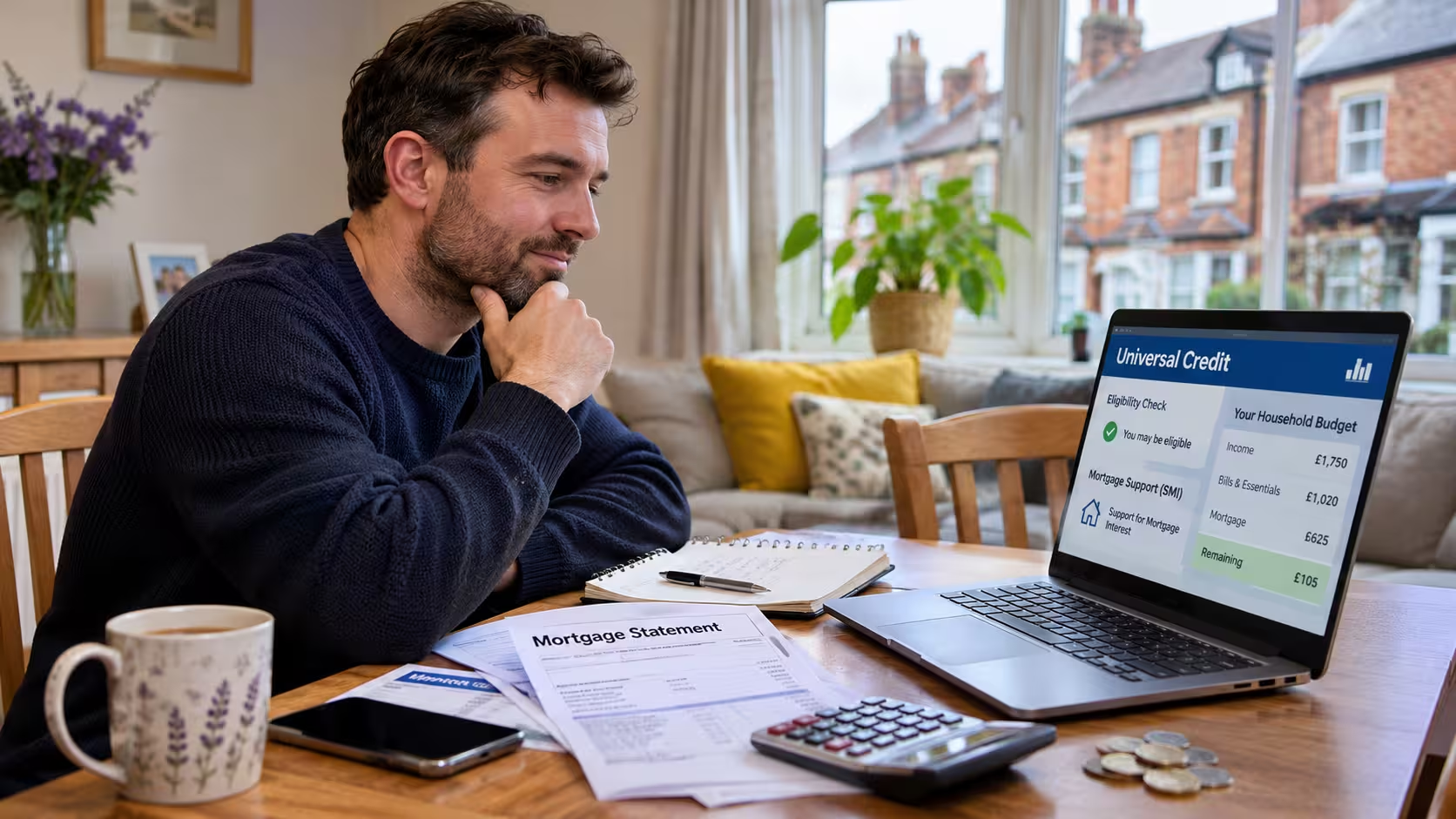
Can You Get Universal Credit if You Have a Mortgage? Eligibility, Payments and Support
Yes, you can get Universal Credit if you have a mortgage in 2026, provided you meet the usual eligibility requirements relating to income, savings, age and household circumstances.
Having an outstanding mortgage does not automatically prevent you from receiving financial support.
However, Universal Credit does not normally pay your monthly mortgage repayments. Eligible homeowners can instead apply for Support for Mortgage Interest (SMI), a government-backed loan that contributes towards mortgage interest payments.
Under the current rules, Universal Credit claimants can qualify for SMI after receiving the benefit for three consecutive months.
The assistance is repayable with interest when the property is sold or ownership is transferred, subject to the scheme’s repayment rules.
Does Owning a House Affect Universal Credit Eligibility?
Owning the property you live in does not normally affect your entitlement to Universal Credit because the Department for Work and Pensions (DWP) disregards the value of your main home when assessing your capital.
This means someone with substantial equity in their home may still receive Universal Credit if their income and other assessable financial resources fall within the permitted limits.
What Are the Eligibility Requirements for Homeowners?
Homeowners must meet the same general Universal Credit conditions as other applicants.
These normally include:
- Age Requirement: You must be at least 18, although certain 16- and 17-year-olds can qualify.
- Residency Requirement: You must live in the UK and satisfy the relevant residence and immigration conditions.
- Income Requirement: You must have a sufficiently low household income to qualify for a payment.
- Savings Requirement: Your combined assessable savings and capital must normally be £16,000 or less.
- Pension Age Requirement: You must generally be below State Pension age, although mixed-age couples may qualify.
- Joint Claim Requirement: Couples living together must make a joint Universal Credit claim, with both partners’ circumstances considered.
Homeownership itself does not reduce the standard Universal Credit allowance.
Does Your Home’s Value or Equity Affect Universal Credit?
The value of the property you own and occupy as your main residence is excluded from the Universal Credit capital assessment.
For example, a homeowner whose property is worth £300,000, with £120,000 remaining on the mortgage, would have £180,000 in equity.
That £180,000 would not normally count towards their Universal Credit savings limit while the property remains their main home.
However, other property interests can affect entitlement. A second home, holiday property or buy-to-let investment may count as capital unless a specific disregard applies.
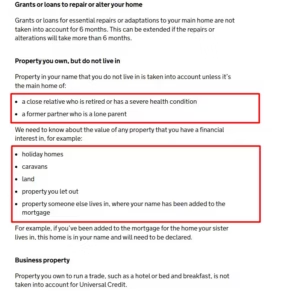
GOV.UK confirms that the value of a property someone owns and lives in is not included when calculating their Universal Credit capital.
How Do Savings and Additional Properties Affect Your Claim?
The DWP assesses savings, investments and other countable assets separately from the home you occupy.
The normal thresholds for 2026 are:
Total Assessable Savings Effect on Universal Credit
£6,000 or Less No reduction because of savings
More Than £6,000 up to £16,000 Monthly Universal Credit payment is reduced
More Than £16,000 Usually not eligible
When savings exceed £6,000, Universal Credit normally decreases by £4.35 per month for every £250, or part of £250, above that threshold.
For example, someone with £8,000 in savings would normally have their monthly payment reduced by £34.80.
Additional properties may also affect eligibility because their assessable value can be included in capital calculations. Certain exceptions apply, including some properties occupied by qualifying relatives or former partners.
Understanding the Universal Credit savings limit is particularly important for homeowners who hold investments, inherited property or money from a previous house sale.
How Much Universal Credit Can You Get if You Have a Mortgage?
The amount of Universal Credit a homeowner receives depends on their household circumstances rather than the size of their mortgage.
The DWP calculates entitlement using the standard allowance and any additional amounts available for children, childcare, caring responsibilities, health conditions or eligible housing costs.
How Is Universal Credit Calculated for Homeowners?
For the 2026/27 financial year, the monthly standard allowances are:
Household Circumstances Monthly Standard Allowance
Single and Under 25 £338.58
Single and Aged 25 or Over £424.90
Couple Both Under 25 £528.34
Couple Where Either Person Is 25 or Over £666.97
These are starting amounts before additions and deductions.
A single homeowner aged 30 who is unemployed and has no other income or deductions could therefore receive £424.90 monthly under the standard allowance.
Additional amounts may apply if they have dependent children, qualifying health conditions or caring responsibilities.
The actual award may be lower because of earnings, savings, other income or applicable deductions.
The Universal Credit payment rates for 2026/27 also help households compare their monthly entitlement with an equivalent weekly budget.
Can You Claim Universal Credit While Working and Paying a Mortgage?
Yes. Employed and self-employed homeowners can qualify for Universal Credit if their household income remains low enough.
Universal Credit does not impose a fixed maximum number of working hours.
Instead, earnings normally reduce entitlement by 55p for every £1 of counted income above any applicable work allowance.
A work allowance may apply where the claimant or their partner has responsibility for a child or has been assessed as having limited capability for work.
For homeowners who are eligible for a work allowance, whether they receive qualifying housing-cost support can affect the allowance used.
The wider rules on how much you can earn and still get Universal Credit are therefore particularly relevant to households balancing employment income with mortgage commitments.
Importantly, earning money from work no longer automatically prevents an otherwise eligible Universal Credit claimant from receiving SMI.
What Is Support for Mortgage Interest (SMI) and How Does It Work?
Support for Mortgage Interest is a government-backed loan designed to help qualifying benefit claimants meet part of the interest charged on their mortgage or eligible home loan.
Unlike Universal Credit’s standard allowance, SMI is not paid as ordinary benefit income. It is usually paid directly to the mortgage lender.
The loan helps reduce immediate housing costs, but the money borrowed and the interest added to it must normally be repaid when the property is sold or transferred.
Who Is Eligible for Support for Mortgage Interest?
An applicant must have a qualifying mortgage or home loan relating to the property they occupy and receive an eligible benefit.
These include:
- Universal Credit: Claimants who satisfy the three-month qualifying period.
- Pension Credit: Eligible recipients who may receive SMI without the Universal Credit waiting period.
- Income-Related ESA: Eligible recipients subject to the applicable qualifying conditions.
Applicants must also agree to the loan terms.
For most working-age claimants, SMI calculations are limited to interest on up to £200,000 of eligible borrowing.
A £100,000 limit generally applies to Pension Credit recipients and certain longstanding benefit claims, although exceptions exist.
What Does SMI Cover and What Does It Not Cover?
SMI is intended to contribute towards the interest on eligible borrowing secured against the claimant’s home.
Costs Does SMI Provide Support?
Interest on an Eligible Mortgage Yes
Interest on Certain Qualifying Home Loans Yes
Mortgage Capital Repayments No
Existing Mortgage Arrears No
Home Insurance No
General Household Bills No
Mortgage Arrangement Fees Not Normally
The actual amount paid is calculated using a standard government interest rate rather than the rate charged by the claimant’s lender.
As a result, SMI may not cover all the interest due each month.
How Long Must You Wait Before Receiving SMI?
Universal Credit claimants can normally start receiving SMI after three consecutive months of entitlement to Universal Credit.
This waiting period was reduced from nine months to three months in April 2023.
Applicants do not need to wait until the three months have passed before starting the application. They can apply when they begin receiving their qualifying benefit.
The DWP will assess eligibility and arrange payments once the qualifying conditions have been met and the loan has been accepted.
Claimants moving from another qualifying benefit to Universal Credit may have their previous period of entitlement counted under certain conditions.
How Much Mortgage Interest Will SMI Pay in 2026?
In 2026, the standard interest rate used to calculate SMI payments is 3.66% per year.
The amount a claimant receives depends on their eligible outstanding mortgage balance and the applicable borrowing limit.
The government uses this standard rate even when the lender charges a different interest rate.
How Is SMI Calculated?
The basic calculation is:
Eligible Mortgage Balance × 3.66% ÷ 12 = Estimated Monthly SMI Payment
For example, a homeowner with £150,000 remaining on an eligible mortgage would receive:
£150,000 × 3.66% = £5,490 annually.
£5,490 ÷ 12 = £457.50 per month.
The following table illustrates different eligible mortgage balances.
Eligible Mortgage Balance Annual SMI Amount Monthly SMI Payment
£50,000 £1,830 £152.50
£100,000 £3,660 £305.00
£150,000 £5,490 £457.50
£200,000 £7,320 £610.00
£250,000 Outstanding £7,320 £610.00
The final example assumes the usual £200,000 borrowing cap applies.
These figures illustrate payments calculated using the published 3.66% rate. They are not guaranteed individual awards, and the standard rate may change.
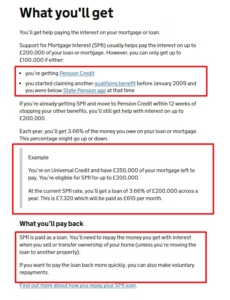
GOV.UK confirms the 3.66% SMI calculation rate and illustrates a £610 monthly payment based on £200,000 of eligible borrowing.
Can Universal Credit Help With Leasehold Service Charges?
Some homeowners living in leasehold properties may receive additional Universal Credit housing-cost support towards eligible service charges.
Qualifying charges can include:
- Communal Maintenance: Costs associated with maintaining shared areas.
- Shared Facilities: Charges for communal lifts or rubbish collection.
- Cleaning Services: Certain window-cleaning and shared-property cleaning costs.
- Building Repairs: Eligible maintenance and repair charges.
This support is different from SMI because it is part of Universal Credit rather than an SMI loan.
The rules are also different.
Homeowners normally need to have received Universal Credit for nine months before becoming eligible for this service-charge support. Certain types of earnings or statutory payments can prevent entitlement.
Shared ownership households may have separate housing costs, including rent on the share they do not own and mortgage interest on the share they have purchased.
Eligible rent may be supported through Universal Credit’s housing element, while mortgage interest may qualify for SMI. Each component must be assessed separately.
How Do You Apply for Mortgage Interest Support Through Universal Credit?
Homeowners who receive Universal Credit can request SMI through their online account or by contacting the Universal Credit helpline.
The application involves confirming mortgage details, completing the required paperwork and agreeing to the loan conditions.
The main steps are:
- Check Eligibility: Confirm that you receive Universal Credit and have a qualifying mortgage or home loan.
- Contact the DWP: Send a message through your Universal Credit journal or contact the helpline.
- Complete the Application: Fill in and sign the SMI loan form provided.
- Arrange Lender Verification: Ask your mortgage lender to complete its section of the paperwork.
- Review the Loan Offer: Consider the repayment conditions and interest charges before accepting.
- Receive Confirmation: Once approved, payments can normally be arranged directly with the lender.
Applicants can choose to accept or decline an SMI loan offer.
If an eligible claimant initially declines the offer, they may later accept it while they remain eligible. Payments can be backdated to the date they first became entitled to the loan, subject to the relevant arrangements.
Documents Required for an SMI Application
Applicants should have the following information available:
- Mortgage Statement: Showing the outstanding loan balance.
- Mortgage Interest Details: Confirming the lender’s interest charges.
- Lender Information: Including the mortgage account and lender details.
- Property Information: Confirming the address of the home concerned.
- Partner’s Agreement: Where a partner is required to sign the loan documents.
- Additional Loan Details: Where support is requested for another qualifying secured loan.
Processing times vary depending on the information supplied and how quickly the lender completes the necessary checks.
New Universal Credit claimants should also account for the normal wait before their first benefit payment.
Understanding how long the initial Universal Credit payment process takes can help them make financial arrangements while their claim is being assessed.
What Happens if You Cannot Afford Your Mortgage Payments?
Homeowners struggling with repayments should contact their mortgage lender as early as possible rather than waiting until payments have been missed.
SMI can help with eligible interest costs, but it cannot clear existing mortgage arrears or guarantee that repossession will be avoided.
Can You Get Help With Mortgage Arrears?
Mortgage lenders may offer temporary payment arrangements to borrowers experiencing financial difficulties.
Depending on the lender and the borrower’s circumstances, possible options include:
- Temporary Interest-Only Payments: Reducing payments by temporarily suspending capital repayments.
- Mortgage Term Extension: Spreading the remaining mortgage balance over a longer period.
- Payment Arrangement: Agreeing an affordable plan for outstanding arrears.
- Temporary Payment Holiday: Suspending or reducing payments where the lender agrees.
- Mortgage Deal Review: Exploring whether a different available mortgage product could reduce costs.
Under the government’s Mortgage Charter, participating lenders also provide certain options for eligible customers who are up to date with their mortgage payments.
These can include temporarily switching to interest-only payments for six months or extending the mortgage term with an option to revert within six months.
However, these arrangements can increase the total amount of interest paid over the mortgage’s lifetime.
What Other Financial Support Is Available?
Alongside lender assistance, homeowners may be able to access support with other living costs.
Potential options include:
- Council Tax Reduction: Help with Council Tax bills for eligible low-income households.
- Local Welfare Assistance: Emergency assistance offered by some local councils.
- Universal Credit Advances: Repayable support for eligible claimants awaiting their first regular payment.
- MoneyHelper: Free guidance about mortgages, debt and household finances.
- Citizens Advice: Advice about benefit entitlement, financial difficulties and available support.
- StepChange: Free debt advice and assistance with affordable repayment arrangements.
Reducing other household expenses may help homeowners maintain their mortgage payments while their income is limited.
When Must You Repay a Support for Mortgage Interest Loan?
SMI is a secured, interest-bearing loan rather than a non-repayable benefit.
Under the current rules, the interest charged on the SMI loan balance is 4.5%, although this rate can change.
This is different from the 3.66% rate used to calculate the amount of mortgage support provided.
Interest continues to accumulate on the outstanding SMI loan until it is repaid or written off.
What Happens if You Sell Your Home or Your Universal Credit Stops?
Selling or transferring ownership of the property normally triggers repayment of the SMI loan.
The amount repayable includes the original support received and accumulated interest.
However, repayment from a property sale is limited by the equity available after the mortgage and other qualifying secured debts have been paid.
For example, if a homeowner sells their property and only £4,000 remains after paying the relevant secured borrowing, but the outstanding SMI loan is £5,000, they would normally repay the available £4,000 and the remaining £1,000 would be written off.
Homeowners purchasing another property may also be permitted to transfer their SMI loan to the new home, subject to the required arrangements.
If Universal Credit stops, further SMI payments will generally stop because the claimant no longer receives the qualifying benefit.
However, claimants who restart Universal Credit within six months of stopping may be able to resume SMI immediately without completing another three-month qualifying period, provided the relevant conditions are met.
An interruption in Universal Credit does not automatically make the existing SMI loan immediately repayable.
Conclusion
Having a mortgage does not prevent someone from claiming Universal Credit in 2026.
Eligibility depends mainly on income, savings and household circumstances, while the value of the property occupied as the claimant’s main home is normally disregarded.
Homeowners who need help with mortgage interest may qualify for SMI after three consecutive months of Universal Credit.
However, SMI is a repayable loan, not a grant, and it does not cover mortgage capital repayments or existing arrears.
Before accepting support, homeowners should understand the amount available, the repayment obligations and whether additional help from their mortgage lender could improve their financial position.
Frequently Asked Questions
Can I Claim Universal Credit if I Own My House Outright?
Yes. Owning your home outright does not automatically affect Universal Credit eligibility, but you would not qualify for SMI mortgage interest support without an eligible outstanding loan.
Can Universal Credit Pay My Full Mortgage Repayments?
No. Universal Credit does not normally cover full mortgage repayments. Eligible claimants may receive an SMI loan towards interest costs, but capital repayments remain their responsibility.
Can I Get Universal Credit if My Partner Pays the Mortgage?
Yes, potentially. Couples must normally claim jointly, and the DWP considers both partners’ income and savings. Mortgage ownership and liability are assessed separately for SMI.
Does Having a Large Mortgage Affect Universal Credit?
The size of your mortgage does not directly determine your Universal Credit allowance. However, SMI support is normally calculated using no more than £200,000 of eligible borrowing for working-age claimants.
Can I Claim Universal Credit With a Shared Ownership Mortgage?
Yes. Eligible shared ownership homeowners may receive Universal Credit housing support towards qualifying rent and may separately qualify for an SMI loan towards mortgage interest.
Can I Receive SMI if I Am Self-Employed?
Yes. Self-employed claimants can receive SMI if they remain eligible for Universal Credit and satisfy the SMI requirements. Earnings from self-employment do not automatically prevent SMI entitlement.
Do I Have to Repay SMI if I Never Sell My Home?
Usually, you do not have to repay the SMI loan simply because you finish paying your mortgage. However, repayment may become due if ownership is transferred, and different rules apply after death.