

How Much Is Universal Credit a Week in 2026/27? | Latest DWP Rates Explained
Universal Credit is worth approximately £78.13 to £153.92 a week in 2026/27, depending on your age and whether you are single or claiming as a couple. However, these figures cover only the standard allowance.
You could receive additional support for rent, children, childcare, caring responsibilities or a qualifying health condition.
The Department for Work and Pensions (DWP) introduced higher Universal Credit standard allowances on 6 April 2026.
A single claimant aged 25 or over now receives a standard allowance of £424.90 a month, equivalent to £98.05 a week, before any additional elements or deductions.
Unlike some other benefits, Universal Credit is normally paid monthly rather than weekly. Its value can nevertheless be converted into a weekly equivalent to help households plan their budgets.
For the 2026/27 financial year, the standard weekly equivalents are:
- Single under 25: £78.13
- Single aged 25 or over: £98.05
- Couple both under 25: £121.92 combined
- Couple where at least one person is 25 or over: £153.92 combined
These are not guaranteed payment amounts. Earnings, savings, housing support, benefit deductions and household circumstances can all affect the final amount received.
What Are the Universal Credit Weekly Rates for 2026/27?
The latest Universal Credit standard allowances apply from 6 April 2026. They are the same across the UK, although payment arrangements and some additional support differ between nations.
| Household circumstances | Monthly allowance | Weekly equivalent |
|---|---|---|
| Single, under 25 | £338.58 | £78.13 |
| Single, 25 or over | £424.90 | £98.05 |
| Couple, both under 25 | £528.34 | £121.92 |
| Couple, one or both 25 or over | £666.97 | £153.92 |
Weekly figures are calculated from the monthly standard allowance multiplied by 12 and divided by 52. They are rounded estimates, not weekly DWP payment rates.
The DWP awards one standard allowance per eligible household. Couples claiming together do not each receive the full single-person allowance.
For example, two adults aged 28 and 30 would receive a combined standard allowance of £666.97 per month, rather than £424.90 each.
You can verify these figures against the official Universal Credit payment rates.
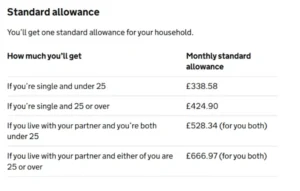
Official DWP Universal Credit standard allowance rates for 2026/27, showing the monthly amounts for single claimants and couples.
How Do You Convert Universal Credit From Monthly to Weekly?
Many people search for weekly Universal Credit rates because they manage food, transport, household spending and other essential costs on a weekly budget.
However, dividing a monthly Universal Credit payment by four does not give an accurate weekly average. There are 12 calendar months in a year but approximately 52 weeks.
The correct calculation is:
Weekly equivalent = Monthly Universal Credit amount × 12 ÷ 52
For example, a single claimant aged 25 or over receiving £424.90 per month would calculate:
£424.90 × 12 = £5,098.80 annually
£5,098.80 ÷ 52 = £98.05 per week
| Monthly UC payment | Approximate weekly value |
|---|---|
| £300 | £69.23 |
| £400 | £92.31 |
| £500 | £115.38 |
| £600 | £138.46 |
| £800 | £184.62 |
| £1,000 | £230.77 |
| £1,200 | £276.92 |
| £1,500 | £346.15 |
These conversions are useful for budgeting but do not represent fixed Universal Credit entitlements.
A claimant receiving £1,000 in one assessment period may receive less the following month if their earnings increase, or more if additional eligible housing or childcare costs are included.
How Much Universal Credit Can You Get With Children?
Parents and guardians may receive extra money through the Universal Credit child element.
From 6 April 2026, the government removed the two-child limit. Eligible households can now receive a child element for each qualifying child, including third and subsequent children.
The applicable 2026/27 rates are:
| Child-related support | Monthly amount | Weekly equivalent |
|---|---|---|
| First child born before 6 April 2017 | £351.88 | £81.20 |
| First child born on or after 6 April 2017 | £303.94 | £70.14 |
| Each additional eligible child | £303.94 | £70.14 |
| Disabled child addition, lower rate | £164.79 | £38.03 |
| Disabled child addition, higher rate | £514.71 | £118.78 |
These amounts are added to the standard household allowance, subject to eligibility and applicable reductions.
How Much Does a Single Parent Receive?
Consider a single parent aged 30 who has two eligible children born after April 2017, is not working and has no housing costs included in the calculation.
| Universal Credit component | Monthly amount |
|---|---|
| Standard allowance | £424.90 |
| First child element | £303.94 |
| Second child element | £303.94 |
| Total before deductions | £1,032.78 |
| Weekly equivalent | £238.33 |
This example assumes there are no earnings deductions, sanctions, benefit cap reductions or other adjustments.
If the parent is also entitled to help with rent, the total Universal Credit award could be higher.
What Changed When the Two-Child Limit Ended?
Before April 2026, most households could only receive the Universal Credit child element for their first two eligible children, although exceptions existed.
The removal of that restriction means families with three or more children may receive significantly more support.
For example, a couple where at least one partner is aged 25 or over, with three children all born after April 2017, could have the following maximum award before housing support and reductions:
- Combined standard allowance: £666.97 per month
- Three child elements: £911.82 per month
- Total: £1,578.79 per month
- Weekly equivalent: £364.34
However, the separate benefit cap may restrict the final amount payable.
Alison Garnham, Chief Executive of Child Poverty Action Group, welcomed the policy change on 6 April 2026, describing its removal as “a ray of hope for the families affected”.
Her published remarks emphasised how the previous restriction affected children’s access to everyday essentials and opportunities.
CPAG
Families can explore the wider implications of the reform through the Universal Credit changes introduced in 2026.
How Much Extra Universal Credit Can You Get Each Week?
Universal Credit includes additional elements designed to support households facing particular financial responsibilities or barriers to work.
These elements can substantially increase the amount payable above the standard allowance.
| Additional UC element | Monthly amount | Weekly equivalent |
|---|---|---|
| Carer element | £209.34 | £48.31 |
| LCWRA lower rate | £217.26 | £50.14 |
| LCWRA higher rate | £429.80 | £99.18 |
| Childcare maximum, one child | £1,071.09 | £247.17 |
| Childcare maximum, two or more children | £1,836.16 | £423.73 |
The childcare figures are maximum reimbursement amounts, not automatic additional payments. Eligible claimants can normally receive up to 85% of qualifying registered childcare costs, within the stated limits.
What Is the Universal Credit Health Element Worth?
Claimants assessed as having limited capability for work and work-related activity (LCWRA) may receive an additional payment.
The system changed on 6 April 2026, introducing different rates depending on a claimant’s circumstances.
The higher amount of £429.80 a month generally applies to protected existing claimants, certain people who reported their health condition before 6 April 2026, and those meeting specified severe-condition or end-of-life criteria.
The lower £217.26 monthly amount generally applies to claimants who report a health condition from 6 April 2026 and qualify for LCWRA without meeting the conditions for the higher rate.
For example, a single claimant aged 35 receiving the higher LCWRA element could have a maximum award of £854.70 monthly, equivalent to £197.24 weekly, before deductions and other applicable elements.
An LCW decision does not normally provide the same extra payment as an LCWRA decision, although some longstanding claims have different rules.
Economists Matthew Oulton and Tom Waters, in their April 2026 analysis for the Institute for Fiscal Studies, highlighted that the reforms shift support towards many families with children while reducing the health-related entitlement for some future claimants.
Their analysis also explained that the effects of the lower health rate would emerge gradually because of protections for existing recipients.
Institute for Fiscal Studies
How Much Can Unpaid Carers Receive?
Claimants providing at least 35 hours of care each week for a person receiving a qualifying disability-related benefit may be eligible for the Universal Credit carer element.
In 2026/27, it is worth £209.34 a month, equivalent to approximately £48.31 per week.
A single claimant aged 25 or over who qualifies for this element could therefore have a standard allowance and carer element totalling £634.24 per month before deductions.
Receiving Carer’s Allowance can reduce Universal Credit by a corresponding amount, so the two benefits should not simply be added together when estimating income.
How Much Universal Credit Can You Get for Rent?
Universal Credit may include a housing costs element to help eligible tenants pay rent and certain service charges.
Unlike the standard allowance, there is no fixed nationwide weekly housing payment.
The housing element depends on factors such as the property’s location, tenancy type, eligible rent and household composition.
For private renters, the amount is generally restricted by the relevant Local Housing Allowance (LHA) rate.
For example, if a claimant pays £900 monthly rent but the applicable LHA rate is £750, their eligible housing support may be limited to £750 before any other adjustments.
Social housing tenants may face reductions where they have more bedrooms than the rules allow. These are commonly 14% for one spare bedroom and 25% for two or more.
A housing costs contribution may also apply where another adult lives in the property. The standard non-dependant deduction for 2026/27 is £96.55 per month, subject to exceptions.
Consequently, two claimants with identical ages and earnings can receive very different Universal Credit awards because their housing circumstances differ.
How Much Universal Credit Will You Get if You Work?
Universal Credit is not restricted to unemployed people. Eligible claimants can continue receiving payments while working part-time or full-time.
The amount depends on their assessed earnings and total household entitlement.
For every £1 of earnings counted by the DWP above any applicable work allowance, Universal Credit normally decreases by 55p.
This is known as the 55% earnings taper.
What Is the Work Allowance in 2026/27?
A work allowance is the amount of earnings certain households can receive before the taper starts reducing their Universal Credit.
It generally applies where a claimant or their partner is responsible for a child or has been assessed as having limited capability for work.
| Circumstances | Monthly work allowance |
|---|---|
| Qualifying household receiving UC housing support | £427 |
| Qualifying household without UC housing support | £710 |
| Household not entitled to a work allowance | £0 |
For example, a qualifying claimant receiving housing support with £1,000 in assessed monthly earnings would have £573 of earnings above the £427 work allowance.
Applying the 55% taper gives a Universal Credit reduction of £315.15.
These thresholds are confirmed in the DWP guidance on how wages affect Universal Credit.
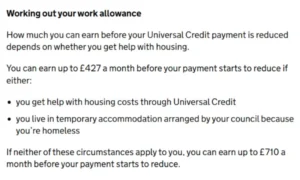
DWP work allowance rules for 2026/27, showing the £427 and £710 monthly thresholds and how the 55% earnings taper works.
Example: Working Parent Earning £900 a Month
Consider a single parent aged 30 with one eligible child born after April 2017, £900 in assessed monthly earnings and £600 in eligible housing costs.
| Calculation | Amount |
|---|---|
| Standard allowance | £424.90 |
| Child element | £303.94 |
| Illustrative housing element | £600.00 |
| Maximum UC before deductions | £1,328.84 |
| Monthly earnings | £900.00 |
| Work allowance | £427.00 |
| Earnings above allowance | £473.00 |
| Earnings deduction at 55% | −£260.15 |
| Estimated monthly Universal Credit | £1,068.69 |
| Weekly equivalent | £246.62 |
This is an illustrative calculation, not a confirmed entitlement. It excludes other income, capital, benefit cap restrictions and other deductions.
Including the £900 in earnings, the household’s combined monthly income would be £1,968.69 before paying rent and other living costs.
The important distinction is that Universal Credit is calculated using income and household eligibility, not simply the number of hours worked.
Claimants can explore further calculations in the explanation of how much you can earn and still get Universal Credit.
Why Might Your Universal Credit Be Less Than the Standard Weekly Rate?
The standard allowance is the starting point, not necessarily the amount that reaches your bank account.
Several factors can reduce a claimant’s monthly award.
Earnings and Other Income
Employment earnings normally reduce Universal Credit through the 55% taper.
Certain other income, such as New Style Employment and Support Allowance or Carer’s Allowance, can reduce Universal Credit pound for pound.
This means a person can qualify for additional benefit support without receiving the full combined amount of every benefit separately.
Savings Above £6,000
Universal Credit is means-tested.
Savings and other assessable capital below £6,000 normally do not reduce the award. Capital above that threshold can reduce payments, while savings exceeding £16,000 normally prevent entitlement, subject to exceptions.
For capital between £6,000 and £16,000, the DWP generally applies a monthly reduction of £4.35 for every £250, or part of £250, above £6,000.
For example, savings of £6,300 would normally reduce Universal Credit by £8.70 each month.
Advance Payments and Other Deductions
Universal Credit can also be reduced because a claimant is repaying an advance, an overpayment or certain debts.
The overall standard deduction limit is generally 15% of the standard allowance, although exceptions and separate rules apply.
The 15% limit should not be confused with the 55% earnings taper or with benefit sanctions. These operate under different rules.
Households experiencing financial difficulties may be able to request a review of certain deductions or seek support with repayments.
Does the Benefit Cap Affect Your Weekly Universal Credit?
The benefit cap restricts the total amount of certain benefits that some households can receive.
It is especially relevant to households with several children or substantial housing costs.
The 2026/27 monthly cap levels are:
| Household type | Outside Greater London | Greater London |
|---|---|---|
| Single adult without children | £1,229.42 | £1,413.92 |
| Couple, or single adult with dependent children | £1,835.00 | £2,110.25 |
These figures refer to the cap on specified benefits combined, not a guaranteed Universal Credit payment.
Certain households are exempt, including those meeting qualifying earnings thresholds or receiving particular disability or carer-related benefits.
For instance, the cap generally does not apply where a claimant or couple has combined earnings of at least £881 a month after tax, or where the household qualifies for specified exemptions.
The removal of the two-child limit has not removed the benefit cap. Therefore, some larger families may gain less than the full value of their additional child elements.
This matters when estimating a weekly amount because a household’s total calculated entitlement can be higher than the amount finally paid.
When Is Universal Credit Paid?
Most claimants in England and Wales receive Universal Credit once a month.
Payments are normally made into a bank, building society or credit union account.
A claimant’s assessment period begins on the date of their claim and repeats monthly. Payment is normally made seven days after the assessment period ends.
For a new claim, the first regular Universal Credit payment usually arrives around five weeks after the application date.
Claimants who cannot manage financially during this period can request an advance, although it is generally repayable.
Scotland and Northern Ireland have different payment-frequency arrangements. Claimants in Scotland can choose monthly or twice-monthly payments, while Universal Credit in Northern Ireland is normally paid twice monthly.
Neither arrangement changes the underlying monthly benefit entitlement.
For more detail about monthly schedules, changes caused by weekends and bank holidays, see the explanation of October 2026 DWP payment dates.
How Can You Check Your Exact Universal Credit Payment?
The most reliable way to confirm how much Universal Credit you will receive is to inspect your monthly statement in your online account.
Your statement breaks down the calculation, including the standard allowance, additional elements and money taken off the payment.
To check your award:
- Sign in to your Universal Credit account.
- Open the Payments section.
- Select the statement for the relevant assessment period.
- Review the standard allowance and any additional elements.
- Check the earnings, other income and deduction figures.
- Compare the final award with the amount paid into your bank account.
If the amount looks incorrect, check whether the DWP has received accurate earnings information, whether your circumstances have changed and whether all relevant elements have been included.
If an element such as carer support is missing, report the relevant change through your online account or journal.
For this screenshot, use only a statement supplied with the account holder’s permission and fully remove identifying information, including names, addresses, account details and claimant references. Do not use someone else’s private Universal Credit account.
How Can You Estimate Your Universal Credit Before Applying?
An online benefits calculator can help estimate your potential entitlement before you make a claim.
The estimate will be more accurate if you have information about your household and finances available.
Useful details include:
- Your age and relationship status
- Your monthly take-home pay and your partner’s earnings, if applicable
- Your rent and eligible housing costs
- The number and ages of dependent children
- Registered childcare expenses
- Savings, investments and other benefits
- Qualifying disabilities, health assessments or caring responsibilities
A calculator can combine the relevant elements and apply the main reductions.
However, it cannot guarantee that the DWP will award the precise amount shown. Your final payment depends on the information accepted for your claim and the circumstances of the relevant assessment period.
Frequently Asked Questions
How Much Universal Credit Does a Single Person Get a Week?
A single claimant under 25 receives a standard allowance equivalent to £78.13 a week, while someone aged 25 or over receives £98.05, before additions and deductions.
How Much Universal Credit Does a Couple Get a Week?
Couples both under 25 have a combined standard allowance equivalent to £121.92 weekly. If either partner is 25 or over, the equivalent is £153.92.
Is Universal Credit Paid Weekly or Monthly?
Universal Credit is normally paid monthly in England and Wales. Twice-monthly arrangements are available in Scotland and are normally used in Northern Ireland.
How Much Universal Credit Can I Get With One Child?
A single parent aged 25 or over with one eligible child born after April 2017 could have a maximum standard and child-element entitlement of £728.84 a month, or approximately £168.19 weekly, before housing support and reductions.
Can I Get Universal Credit if I Work 20 Hours a Week?
Yes. There is no fixed 20-hour restriction. Entitlement depends on income, household circumstances and applicable Universal Credit rules.
Does Universal Credit Increase When You Turn 25?
The standard allowance normally increases when a single claimant turns 25. For 2026/27, the monthly single-person allowance rises from £338.58 to £424.90.
Can I Receive Universal Credit and PIP Together?
Yes. Personal Independence Payment (PIP) can be received alongside Universal Credit, subject to the rules of each benefit. PIP is not normally deducted as income from Universal Credit.
Why Is My Universal Credit Different Every Month?
Changes in earnings, assessment periods, household circumstances, housing costs, additional elements and deductions can affect the amount payable each month.