Do You Get Free Dental Treatment on Universal Credit? Eligibility and NHS Rules
Yes, you can get free NHS dental treatment while receiving Universal Credit, but Universal Credit does not automatically make all claimants eligible.
In England, you normally qualify if you receive a Universal Credit payment and your household’s total take-home pay in the relevant assessment period is £435 or less.
The limit increases to £935 or less if your Universal Credit includes an element for a child, or if you or your partner have Limited Capability for Work (LCW) or Limited Capability for Work and Work-Related Activity (LCWRA).
For couples claiming Universal Credit together, the earnings of both partners are considered against the relevant limit.
This article focuses mainly on NHS dental treatment in England, as dental charging arrangements differ across England, Scotland and Wales.
When Universal Credit Can Cover Your NHS Dental Costs?
Receiving Universal Credit by itself is not enough to qualify for free NHS dental treatment.
The NHS Business Services Authority looks at the amount of take-home pay recorded for the relevant Universal Credit assessment period.
The current thresholds are:
| Universal Credit Circumstances | Maximum Take-Home Pay |
|---|---|
| No Child Element And No LCW Or LCWRA | £435 Or Less |
| Universal Credit Includes A Child Element | £935 Or Less |
| You Or Your Partner Have LCW Or LCWRA | £935 Or Less |
| Joint Universal Credit Claim | Combined Earnings Must Be Within The Relevant £435 Or £935 Limit |
The higher £935 threshold should not simply be treated as a general “disability threshold”. The official NHSBSA rule refers specifically to Universal Credit claimants who have a child element, LCW or LCWRA.
People who are unsure whether their health circumstances fall within LCW or LCWRA may want to understand how a Work Capability Assessment under Universal Credit determines these classifications.
Rules For Couples And Joint Claims
If you claim Universal Credit as a couple, the NHS does not give each partner a separate £435 or £935 earnings allowance.
Instead, the relevant threshold applies to the combined take-home pay of both partners.
For example, suppose a couple receive Universal Credit with a child element:
- Partner A Take-Home Pay: £500
- Partner B Take-Home Pay: £300
- Combined Take-Home Pay: £800
- Relevant Limit: £935
Their combined £800 earnings would be below the £935 threshold.
However, a couple without a child element, LCW or LCWRA would normally be compared against the lower £435 threshold.
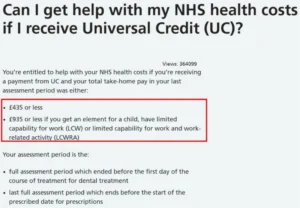
NHSBSA confirms the £435 and £935 Universal Credit earnings limits and the rules for joint claims.
Which Universal Credit Earnings Count?
The figure that matters is not necessarily your salary, Universal Credit payment or total household income from every source.
NHSBSA tells Universal Credit claimants to look at the figure shown on their statement as “Your total take-home pay for this period”.
Take-home pay generally means earnings after deductions such as Income Tax, National Insurance and pension contributions. NHSBSA describes this as the household’s net earned income after these deductions.
This distinction matters because someone may have a gross monthly salary above £935 while their relevant take-home figure is lower.
Which Assessment Period Is Used?
For NHS dental treatment, the relevant Universal Credit assessment period is the full assessment period that ended before the first day of the course of dental treatment.
For example, imagine your Universal Credit assessment periods run from the 10th of one month to the 9th of the next.
If your course of dental treatment starts on 20 October, the assessment period ending on 9 October would normally be the relevant period.
Universal Credit is calculated through monthly assessment periods, which is also why earnings can vary when overtime, bonuses or an extra payday fall into one period.
Claimants dealing with fluctuating wages can see how earnings affect Universal Credit during different assessment periods.
What Happens If Your Earnings Change?
Eligibility can change as your earnings change.
You may qualify during one period and fail to qualify during another if overtime, a bonus, additional work or another wage payment pushes your take-home pay above the applicable threshold.
NHSBSA advises people whose working hours or earnings change to check their entitlement regularly.
You should therefore check the relevant Universal Credit statement rather than assuming that a previous free dental treatment claim means all future NHS dental treatment will also be free.
What If Your Universal Credit Is Sanctioned?
A sanction does not automatically answer the dental eligibility question.
NHSBSA specifically states that you cannot claim help with NHS health costs through Universal Credit if you are not receiving a Universal Credit payment because of a sanction.
If a sanction has affected your award, check your statement carefully. Understanding how to tell if you have been sanctioned on Universal Credit can also help if your payment unexpectedly falls or stops.
How To Claim Free NHS Dental Treatment?
If you meet the Universal Credit conditions, tell the dental practice that you believe you are entitled to free NHS dental treatment.
Dental teams in England should ask patients making an exemption claim to provide evidence of eligibility and complete the relevant exemption reason on the FP17PR patient declaration form. The patient must read and sign the declaration.
Your Universal Credit statement is particularly useful because it can show your take-home pay for the assessment period.
You should check your entitlement before signing. Responsibility for making a correct exemption claim rests with the patient, and NHSBSA may verify the information.
NHS Treatment Vs Private Treatment
Free dental treatment through Universal Credit applies to qualifying NHS dental treatment.
It does not make private treatment free.
If your course of treatment contains both NHS and private services, you may still need to pay for the private part even if you qualify for free NHS dental treatment.
NHSBSA advises patients to confirm with their dentist whether treatment is being provided privately or through the NHS.
This can be particularly important when you are offered different treatment options. Ask whether each proposed treatment will be provided under NHS arrangements before agreeing to it.
What If You Do Not Qualify For Free Dental Treatment?
Going over the £435 or £935 Universal Credit threshold does not necessarily mean you have no access to help.
You may have to pay the normal NHS charge, qualify for help through another exemption, or receive full or partial assistance through the NHS Low Income Scheme.
NHS Dental Charges In England For 2026
From 1 April 2026, the NHS dental charges in England are:
| NHS Dental Treatment | Charge |
|---|---|
| Band 1 | £27.90 |
| Band 2 | £76.60 |
| Band 3 | £332.10 |
| Unscheduled Care | £27.90 |
Band 1 can include an examination, diagnosis, advice, X-rays where clinically necessary and preventative care.
Band 2 includes Band 1 treatment plus procedures such as fillings, root canal treatment and extractions.
Band 3 includes Bands 1 and 2 plus more complex treatment such as crowns, dentures and bridges.
If you need several treatments within one course of treatment, you normally pay the charge for the highest applicable band rather than paying every band charge separately.
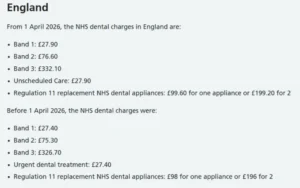
NHSBSA confirms the NHS dental charges in England applying from 1 April 2026.
NHS Low Income Scheme
If your Universal Credit earnings are too high for automatic help through UC, you may still qualify through the NHS Low Income Scheme.
The scheme can provide either full or partial help depending on your financial circumstances.
There are three terms worth knowing:
- HC1 Application: Used to apply to the NHS Low Income Scheme
- HC2 Certificate: Gives full help with qualifying NHS health costs, including free NHS dental treatment
- HC3 Certificate: Provides partial help and states how much you need to contribute towards treatment
NHSBSA confirms that an HC2 certificate can provide free NHS dental treatment, while an HC3 certificate can reduce the amount you have to pay.
This is different from claiming free treatment directly because of Universal Credit. You do not normally complete an HC1 form at the dentist simply to prove a Universal Credit dental exemption.
Refunds And Penalties For NHS Dental Treatment
If you are unsure whether you qualify for free treatment, do not guess when completing the exemption declaration.
NHSBSA says that if you are unsure about your entitlement, you should pay the NHS charge and ask for a receipt. If you later establish that you were entitled, you may be able to claim the money back.
How To Claim A Dental Refund?
In England, refunds of eligible NHS dental charges are normally claimed using an HC5(D) form.
The refund claim generally needs to be received within three months of the date you paid the charge, or within three months of the final instalment if you paid in instalments.
You should include the required receipt showing the payment date and amount.
NHSBSA says dental refund applications can take up to eight weeks from the date the application is received.
HC5(D) should not be confused with HC1. HC5(D) is specifically used for claiming back qualifying NHS dental charges that have already been paid.
NHS Penalty Charges For Wrong Claims
You should only declare that you qualify for free NHS dental treatment when you are satisfied that you meet the rules.
If an exemption claim is checked and you cannot show that you were entitled, you may have to pay:
- Original Treatment Charge: The NHS dental charge that should have been paid
- Penalty Charge: A penalty of up to £100
NHSBSA states that patients who incorrectly claim help can face a penalty charge of up to £100 in addition to the original treatment charge.
Checking your Universal Credit statement before your appointment is particularly important if your pay varies from month to month.
Other Ways To Get Free NHS Dental Treatment
Universal Credit is only one route to free NHS dental care.
In England, you can also qualify in certain other circumstances.
You may be eligible if you are:
- Under 18: NHS dental treatment is free
- Under 19 And In Full-Time Education: Free NHS dental treatment continues while you meet the education condition
- Pregnant: Qualifying NHS dental treatment is free during pregnancy
- Recently Had A Baby: You can qualify if you gave birth within the previous 12 months
Other benefit and exemption rules can also apply. A person with a valid HC2 certificate, for example, can receive free NHS dental treatment.
Dependants under 20 can also qualify in some circumstances where they are included in the award of a person receiving a qualifying benefit.
Under the Universal Credit rules, NHSBSA says dependants aged 19 and under who are included in the UC award receive the same help when the UC qualifying conditions are met.
Changes such as having a child can affect the wider calculation of Universal Credit as well as health-cost eligibility.
The wider Universal Credit changes and rules applying in 2026 explain how reporting household and health changes can affect a claim.
Qualifying for free treatment also does not guarantee that every dental practice will be accepting new NHS patients.
If you cannot find a practice, use the NHS dentist search service and contact practices directly about NHS availability.
If you need urgent dental treatment and cannot obtain an ordinary appointment, NHS guidance recommends seeking urgent dental help through a dentist or NHS 111 where appropriate.
Conclusion
You can get free NHS dental treatment on Universal Credit, but the benefit itself does not automatically qualify you.
For most claimants, the key test is whether household take-home pay in the relevant Universal Credit assessment period was £435 or less.
The threshold rises to £935 or less where the Universal Credit award includes a child element or where the claimant or their partner has LCW or LCWRA.
Joint claimants must consider their combined take-home pay.
Before signing an NHS dental exemption declaration, check the relevant Universal Credit statement and make sure you meet the conditions.
If you are unsure, paying the NHS charge and obtaining a receipt is safer than making an incorrect exemption claim because a refund may be available later if you prove that you qualified.
Claimants who do not meet the Universal Credit earnings limits may still get help through another exemption or the NHS Low Income Scheme.
Frequently Asked Questions
Do You Automatically Get Free Dental Treatment On Universal Credit?
No. Universal Credit alone does not automatically qualify you. Your take-home pay and Universal Credit circumstances must meet the NHSBSA conditions.
How Much Can You Earn And Still Get Free NHS Dental Treatment?
The limit is normally £435 or less in the relevant assessment period, rising to £935 or less if your UC includes a child element or you or your partner have LCW or LCWRA.
Does The £935 Limit Apply To Everyone With A Disability?
No. The NHSBSA Universal Credit rule specifically refers to having LCW or LCWRA, or receiving a child element. A disability by itself does not automatically trigger the £935 threshold.
Do Both Partners’ Earnings Count On A Joint Universal Credit Claim?
Yes. For couples claiming Universal Credit together, the relevant £435 or £935 threshold applies to their combined take-home pay.
Can You Get Free Dental Treatment If Universal Credit Is Sanctioned?
If a sanction means you receive no Universal Credit payment, NHSBSA says you cannot claim help with NHS health costs through Universal Credit for that reason.
Does Universal Credit Cover Private Dental Treatment?
No. The exemption applies to qualifying NHS dental treatment. You remain responsible for private dental treatment costs.
Can You Claim Back NHS Dental Charges?
Yes, if you paid but later establish that you were entitled to help, you may be able to claim a refund using HC5(D). The claim normally needs to be received within three months of payment.