Can Students Claim Universal Credit? Eligibility Rules and Exceptions Explained
Yes, students can claim Universal Credit in certain circumstances, although most full-time students are not eligible.
Students may qualify if they have children, receive qualifying disability benefits, lack parental support or live with a partner who is eligible for Universal Credit.
Part-time students may also qualify if they meet the normal eligibility conditions and any applicable work-related requirements.
However, receiving student finance can reduce Universal Credit payments, even when a student meets the eligibility rules.
The amount depends on maintenance loans, grants, earnings, household circumstances and the length of the academic year.
Who Is Eligible for Universal Credit While Studying?
Universal Credit eligibility depends on whether someone studies full-time or part-time, the type of course they attend and their personal circumstances.
Most full-time students cannot claim because student finance is generally expected to contribute towards living costs. However, the Department for Work and Pensions (DWP) recognises several exceptions.
Full-Time and Part-Time Students
The eligibility rules differ depending on the type of study.
Student Circumstances Can They Claim Universal Credit?
Full-Time University Student Usually No, Unless an Exception Applies
Part-Time Student Yes, If They Meet the Eligibility Conditions
Full-Time Student Responsible for a Child May Qualify
Disabled Student Receiving a Qualifying Benefit May Qualify If the Required Work Capability Conditions Are Met
Student Under 21 Without Parental Support May Qualify While Studying Non-Advanced Education
Student Living With an Eligible Partner May Qualify Through a Joint Claim
Postgraduate Student May Qualify If an Eligibility Exception Applies
Student Receiving a Qualifying Migration Notice May Qualify Under Transitional Rules
Part-time students generally have greater flexibility because their studies may allow them to meet work-related requirements.
However, students studying non-advanced courses for more than 12 hours weekly are subject to an additional age-related restriction.
The relevant route generally becomes available from 1 September following their 19th birthday.
Students must also meet the wider Universal Credit eligibility requirements, including the applicable income, savings and residence rules.
Exceptions for Disabled Students, Parents and Care Leavers
Certain circumstances allow students to receive Universal Credit despite attending full-time courses.
- Disabled Students: Students who receive qualifying disability benefits, such as Personal Independence Payment (PIP) or Disability Living Allowance (DLA), may qualify if they were assessed as having limited capability for work before starting their course.
- Students With Children: Students responsible for a child may qualify, including single parents and eligible couples with children.
- Care Leavers: Students aged 21 or under who lack parental support may qualify while attending full-time non-advanced education that began before they reached 21.
- Students Without Parental Support: Young people who cannot live with their parents may qualify under the same non-advanced education exception, subject to the relevant conditions.
Qualifying Scottish disability benefits include Adult Disability Payment, Scottish Adult Disability Living Allowance, Child Disability Payment and Pension Age Disability Payment. Attendance Allowance and Armed Forces Independence Payment are also recognised.
Importantly, receiving PIP alone does not automatically establish Universal Credit eligibility for a full-time student.
The timing and outcome of a Work Capability Assessment can be particularly important for disabled students.
For eligible young people without parental support, Universal Credit can generally continue until the end of the academic year in which they turn 21, or until their course ends if that happens earlier.
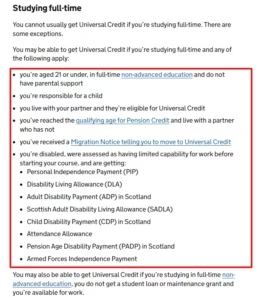
Official DWP guidance confirms the exceptions allowing certain full-time students to claim Universal Credit.
Students Living With an Eligible Partner
Students living with a partner who qualifies for Universal Credit may be able to receive financial support through a joint claim.
Both partners’ circumstances are considered when calculating entitlement, including earnings, savings and relevant student income.
For example, a full-time university student whose partner works part-time may qualify as part of a couple, even though the student would not qualify independently.
Special rules also apply to certain mixed-age couples where one partner has reached Pension Credit qualifying age and the other has not.
What Types of Education Affect Universal Credit Eligibility?
The level of education is important because Universal Credit distinguishes between advanced and non-advanced courses.
Advanced and Non-Advanced Education
Non-advanced education generally includes qualifications at or below A-level standard, while advanced education includes university-level qualifications.
Non-Advanced Education Advanced Education
GCSEs Undergraduate Degrees
A-Levels and AS-Levels Postgraduate Degrees
T-Levels Higher National Diplomas
BTEC Qualifications Up to Level 3 Higher National Certificates
NVQs Up to Level 3 Foundation Degrees
Scottish Highers Degree Apprenticeships
Students in non-advanced education may qualify under additional age-related or parental-support exceptions.
University and postgraduate students usually need to meet one of the specific full-time student exceptions.
The education provider normally determines whether a course is full-time.
A student attending a designated full-time course on a reduced timetable may still be treated as studying full-time for Universal Credit purposes.
Apprenticeships are not classified as non-advanced education for these rules.
Apprentices receiving wages should have their employment, course arrangements and earnings assessed under the relevant eligibility conditions.
How Much Universal Credit Can Students Receive?
There is no fixed Universal Credit payment specifically for students.
Eligible students receive an award based on their household circumstances, with any applicable additions and deductions.
The amount can depend on:
- Age and Relationship Status: Determines the applicable standard allowance.
- Dependent Children: May increase entitlement through child-related elements.
- Eligible Housing Costs: May increase the award where housing support is available.
- Health Circumstances: May affect entitlement to additional support.
- Student Finance: Maintenance income can reduce monthly payments.
- Employment Earnings: Earnings may reduce payments through the normal Universal Credit rules.
A student may qualify for Universal Credit but receive no payment during an assessment period if their countable income is high enough.
How Maintenance Loans, Grants and Postgraduate Loans Affect Payments?
Student maintenance loans are generally treated as income because they contribute towards everyday living expenses.
The DWP normally considers the maximum maintenance loan a student is eligible for, even when they choose not to borrow the full amount.
The different forms of student finance are treated as follows.
Student Finance Universal Credit Treatment
Maintenance Loan Generally Counted as Income
Tuition Fee Loan Disregarded
Special Support Loan or Grant Disregarded
Postgraduate Master's Loan Generally 30% Counted
Postgraduate Doctoral Loan Generally 30% Counted
Grants for Living Costs May Be Counted Depending on Their Purpose
Grants for Childcare or Disability-Related Study Costs Generally Disregarded Under Applicable Rules
The first £110 of calculated student income is disregarded in each relevant Universal Credit assessment period.
For a more detailed explanation, the treatment of student finance and Universal Credit also depends on the type of loan, grant and academic funding arrangements.
Example of Universal Credit Payments After Student Income Deductions
Consider an eligible student with a maintenance loan of £7,200.
Assume the amount is spread across eight relevant Universal Credit assessment periods.
Calculation Amount
Annual Countable Maintenance Loan £7,200
Relevant Assessment Periods 8
Monthly Student Income £900
Monthly Student Income Disregard £110
Monthly Universal Credit Deduction £790
In this example, £790 would be deducted from the student’s calculated Universal Credit entitlement in each relevant assessment period.
This does not mean the student automatically receives £790 or any particular payment. Their actual award depends on their standard allowance, additional elements, earnings and other deductions.
The number of relevant assessment periods must be established from the student’s actual course and Universal Credit assessment dates.
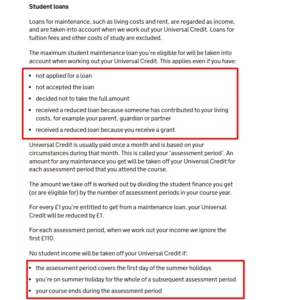
Official GOV.UK guidance explains how maintenance loans are divided across assessment periods and confirms the £110 monthly disregard.
Can Students Claim Universal Credit During Holidays or Study Breaks?
Students who already qualify for Universal Credit may continue receiving support during university holidays, although their payments can change.
The treatment of student finance depends on assessment-period dates rather than simply on when the student receives loan instalments.
Universal Credit During Summer Holidays
Maintenance-loan deductions normally stop for the assessment period containing the first day of the long summer holiday.
Student income is also disregarded during subsequent assessment periods falling entirely within that holiday.
For example, a student whose term finishes in June may receive a higher Universal Credit payment during relevant summer assessment periods because maintenance income is no longer deducted.
However, this does not automatically make an otherwise ineligible full-time student eligible for Universal Credit.
What Happens When Students Take a Break or Leave Their Course?
Students who temporarily interrupt their education because of illness or caring responsibilities may qualify under special rules.
These can apply where the educational establishment has agreed to the interruption, the illness or caring responsibilities have ended within the previous year, the student has not yet resumed the course and they are not eligible for a student loan or grant.
Students who permanently withdraw or complete their course may become eligible under the normal Universal Credit rules if they meet the required conditions.
Any change should be reported promptly, including:
- Temporary Study Breaks: Confirm the reason and expected return date.
- Course Withdrawal: Provide the official withdrawal date.
- Course Completion: Report the course end date.
- Changes in Student Finance: Provide updated loan or grant information.
A course interruption does not automatically end full-time student status, so students should obtain confirmation from their education provider before assuming their benefit eligibility has changed.
Can Students Work While Claiming Universal Credit?
Students can work while receiving Universal Credit, provided they meet the relevant eligibility conditions.
There is no universal maximum number of working hours for claimants. Instead, earnings can reduce payments.
For most claimants, Universal Credit is reduced by 55p for every £1 of assessed earnings above any applicable work allowance.
A student with children or an assessed limitation on their capability for work may qualify for a work allowance.
However, a work allowance does not remove the separate deduction for countable student maintenance income.
Work-related responsibilities also depend on the student’s circumstances.
Some qualifying full-time students have no work-search requirements. Others, particularly students who are not receiving maintenance funding or are returning after a study interruption, may need to meet agreed commitments.
Students should discuss study timetables, work availability and any health or caring restrictions with their work coach.
How Can Students Apply for Universal Credit?
Students who believe they meet an exception can apply through the official Universal Credit service on GOV.UK.
Required Documents and Application Process
Step 1: Check Eligibility
Confirm whether the course is full-time or part-time and identify the eligibility conditions that apply.
Step 2: Gather Supporting Evidence
Prepare documents such as:
- Proof of Identity: Passport, driving licence or other accepted identification.
- Course Information: Course dates, qualification level and full-time or part-time status.
- Student Finance Evidence: Loan and grant entitlement letters.
- Household Information: Partner’s income and details of dependent children.
- Disability Evidence: Qualifying benefit entitlement and relevant capability-for-work decisions.
- Housing Evidence: Tenancy agreement and eligible rent details where applicable.
Step 3: Submit the Application
Complete the online Universal Credit application and provide accurate information about education, income and living arrangements.
Step 4: Complete Verification
Attend any required appointments and respond to requests for supporting documents.
Step 5: Check the Decision
Review the Universal Credit decision and monthly payment statements to confirm how student income has been assessed.
How Long Does It Take to Receive Universal Credit?
The first Universal Credit payment usually arrives around five weeks after the claim is submitted.
The process includes a monthly assessment period followed by approximately seven days before payment.
Students who cannot cover essential expenses while waiting may be able to request a Universal Credit advance, which normally has to be repaid through future payments.
What Happens If a Student’s Universal Credit Claim Is Rejected?
A student may have their application refused because they do not qualify under an education exception or because other eligibility conditions are not satisfied.
Common reasons include:
- Full-Time Student Restrictions: No qualifying exception applies.
- Insufficient Disability Evidence: The required pre-course capability-for-work decision is missing.
- Student Income: Countable income reduces the award to zero.
- Missing Course Information: The DWP needs evidence of enrolment or course status.
- Household Circumstances: Savings, residence conditions or a partner’s income affect entitlement.
Students who believe a decision is incorrect can usually request a mandatory reconsideration within one month of the decision date.
They should identify the disputed decision, explain why it is incorrect and submit any relevant new evidence.
If the decision remains unchanged after reconsideration, the student can usually appeal to an independent tribunal.
What Other Financial Support Is Available to Students?
Students who do not qualify for Universal Credit may still have access to financial assistance through their university, college or other organisations.
Options include:
- Student Maintenance Loans: Help with everyday living expenses.
- University Hardship Funds: Provide support for students experiencing financial difficulties.
- Bursaries and Scholarships: Offer financial assistance based on eligibility, circumstances or academic achievement.
- Disabled Students’ Allowance: Helps with eligible additional study-related costs arising from disability.
- Parents’ Learning Allowance: May support eligible students with dependent children.
- Charitable Grants: Some charities and educational trusts provide financial help based on individual circumstances.
Eligible working parents may also qualify for Universal Credit childcare support.
However, students cannot receive overlapping help for the same childcare costs through the student Childcare Grant and the Universal Credit childcare element.
Students should check the conditions of each scheme before applying.
Conclusion
Students can claim Universal Credit in specific circumstances, particularly when they have dependent children, qualifying disabilities, limited parental support or an eligible partner.
Part-time students generally have more flexibility, while full-time university students must normally meet an exception.
Student loans, grants and earnings can significantly affect payment amounts, even when eligibility is established.
Checking course status, student finance and personal circumstances before applying can help students understand their entitlement and avoid incorrect payments.
Frequently Asked Questions
Can University Students Claim Universal Credit?
Yes, but most full-time university students must meet a qualifying exception, such as being responsible for a child or meeting the disabled-student conditions.
Can Students Claim Universal Credit If They Receive PIP?
Possibly. Full-time students generally need both a qualifying disability benefit and a determination of limited capability for work made before starting their course.
Can Students Claim Universal Credit During Summer Holidays?
Eligible students can continue claiming during summer holidays. Maintenance-loan deductions normally stop for assessment periods covered by the long-vacation rules.
Does a Student Loan Reduce Universal Credit Payments?
Yes. Maintenance loans are generally counted as income, with the first £110 disregarded in each relevant assessment period.
Can Students Claim Universal Credit While Working Part-Time?
Yes, if they meet the eligibility conditions. Earnings can reduce Universal Credit, but there is no universal maximum number of working hours.
Can Students Claim Universal Credit After Finishing University?
Yes. Once a course ends, former students may qualify under normal Universal Credit rules, depending on their income, savings and other circumstances.
Can Students Claim Universal Credit If They Live With Their Parents?
Possibly. Living with parents does not automatically prevent a claim, but it can affect whether a young person meets the exception for students without parental support.