
Universal Credit Payments Increase from 6 April 2026: New Standard Allowance and Child Element Rates
From 6 April 2026, Universal Credit (UC) payments will see significant changes, reshaping the financial landscape for millions of households across the UK. These updates will include above-inflation rises to the standard allowance, removal of the two-child limit, and reductions to the Limited Capability for Work and Work-Related Activity (LCWRA) element for most new claimants.
The adjustments are part of a wider reform to rebalance incentives within the system and align support more closely with work readiness.
Key changes include:
- Standard allowances to rise by up to 6.2%
- The two-child limit for child elements to be scrapped
- New, lower LCWRA rate for new claimants
- Protected groups to retain higher disability-related support
Let’s explore what these changes mean in practice, who stands to benefit, and how they will impact claimants across the UK.
Why Are Universal Credit Payments Changing in April 2026?

The changes introduced from April 2026 are the result of legislative and policy updates under the Universal Credit Act 2025. For several years, the government faced growing pressure to increase the basic standard allowance, which had failed to keep pace with rising living costs.
Economic data suggested that the previous system disproportionately incentivised claimants to be assessed as having limited capability for work, in order to receive the higher LCWRA element. In response, the Department for Work and Pensions (DWP) introduced a strategy to “rebalance” Universal Credit.
This rebalancing involves:
- Boosting the core (standard) allowance above inflation
- Reducing health-related additions for most new claimants
- Encouraging work participation through updated work allowances and lower disability additions
The underlying intention is to promote employment as the most sustainable route out of poverty, while still maintaining a level of support for those unable to work due to severe or terminal health conditions.
What Are the New Standard Allowance Rates for Universal Credit from April 2026?
Universal Credit’s standard allowance is the baseline monthly amount provided to adults, depending on age and household circumstances. From 6 April 2026, all standard allowances will increase by over 6% compared to 2025 rates.
Monthly Standard Allowance: April 2026
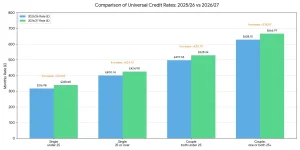
Claimant Type 2025/26 Rate 2026/27 Rate Increase
Single under 25 £316.98 £338.58 +£21.60
Single 25 or over £400.14 £424.90 +£24.76
Couple both under 25 £497.55 £528.34 +£30.79
Couple, one or both 25+ £628.10 £666.97 +£38.87
This increase applies universally to all claimants, including those in work, looking for work, or unable to work. For many low-income households, this adjustment provides much-needed breathing space amid ongoing cost of living challenges.
“This uplift to the standard allowance finally recognises how stretched families have been,” said one welfare advisor. “It’s not a cure-all, but it’s a step in the right direction.”
How Much Will Families Receive Under the New Universal Credit Child Elements?

For many households with children, the most anticipated change is the removal of the two-child limit. From April 2026, families will be able to claim the child element for every dependent child, regardless of birth order or date.
Monthly Child Element Rates from April 2026
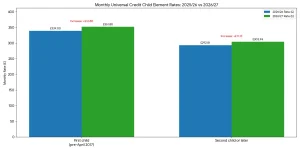
Child Type 2025/26 Rate 2026/27 Rate Increase
First child (pre-April 2017) £339.00 £351.88 +£12.88
Second child or later £292.81 £303.94 +£11.13
Previously, claimants were generally restricted to receiving the child element for two children only, unless qualifying under a specific exception. From April 2026, this restriction is lifted, meaning larger families will receive significantly more in support.
Example:
A couple with four children (all born after 2017) previously received support for just two. From April 2026, they’ll receive child element payments for all four, an increase of over £600 per month.
“The two-child limit never accounted for real-life family situations,” noted one claimant. “This change restores a level of fairness for parents of larger families.”
Who Will Gain or Lose the Most From the 2026 Universal Credit Changes?
The Universal Credit reforms create a mixed picture. While most claimants will benefit from higher standard allowances and expanded child element coverage, some groups will see reductions, particularly those newly eligible for disability-related elements.
Likely Gainers:
- Families with 3+ children
- Working households on low incomes
- Single parents with housing costs
- Young adults under 25 living independently
Likely to Lose or See Smaller Gains:
- New claimants with LCWRA from 6 April 2026
- People moving from legacy benefits into UC without protected status
For example, someone newly assessed as having limited capability for work and work-related activity after April 2026 will receive £217.26/month, compared to the current £423.27/month, a drop of over £2,400 per year.
While these changes don’t affect current recipients (who are protected), future claimants will see a substantially lower total award unless they fall into an exemption category.
What’s Happening to Disability-Related Payments Like LCWRA in April 2026?

The LCWRA (Limited Capability for Work and Work-Related Activity) element is undergoing a notable reduction in 2026. For most new claimants, the payment will fall by nearly half.
From 6 April 2026:
- New LCWRA award: £217.26 per month
- Current LCWRA award: £423.27 per month
- Protected cohort: Will continue to receive uprated higher amount (e.g. £429.80/month in 2026)
Only those already receiving LCWRA before April 2026, or those with terminal illnesses or lifelong conditions, will remain on the full rate, with future inflation-linked increases.
“It feels like we’re being punished for becoming ill after the deadline,” said one disabled jobseeker. “The new rate just doesn’t cover the real cost of disability.”
The government argues this change will reduce dependency and shift focus to supporting claimants into work. However, disability advocates have raised concerns that the policy may create financial hardship for those with fluctuating or hidden conditions.
How Are Work Allowances, Deductions, and Other Elements Affected?
In addition to core rates, several work-related and deduction thresholds are being adjusted from April 2026 to reflect inflation and policy changes.
Work Allowances
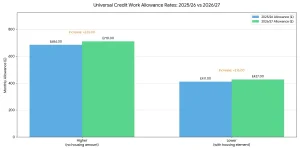
For those in work, the amount you can earn before UC begins to taper (your work allowance) will rise:
Type 2025/26 2026/27
Higher (no housing amount) £684.00 £710.00
Lower (with housing element) £411.00 £427.00
Deductions and Other Adjustments
Some standard deductions are also increasing, including:
- Non-dependant housing contributions: £93.02 → £96.55/month
- Third-party deductions for debts: Increased by 3–5%
- Fraud overpayment recovery: Now capped at 15% of UC standard allowance
These changes are relatively modest but could cumulatively impact disposable income for claimants with outstanding debts or housing costs.
What Do These Universal Credit Changes Mean for Legacy Benefit Claimants?

The end of legacy benefits marks a major turning point. From 31 March 2026, all remaining legacy benefits, including Income Support, income-based JSA, income-related ESA, and Working/Child Tax Credits, will end.
Claimants will be required to:
- Claim Universal Credit instead
- Undergo a new eligibility assessment
- Potentially receive transitional protection to prevent sudden income drops
While many may receive higher payments under UC (particularly with the standard allowance rise), others, particularly those with disabilities or caring responsibilities, may see lower awards.
Real-life example:
Angela, a 56-year-old full-time carer from Manchester, has been receiving income-related Employment and Support Allowance (ESA) for the past eight years due to her own health issues and caring responsibilities for her adult son with a disability.
From April 2026, she will be moved to Universal Credit as legacy benefits come to an end. While she will see a slight increase in her standard allowance under the new UC rates, she will lose access to the Severe Disability Premium she previously relied on.
Without transitional protection, Angela’s total monthly income will drop by approximately £85, impacting her ability to cover essential expenses.
How Can Claimants Prepare for the Universal Credit Increases in 2026?
With these sweeping changes on the horizon, claimants are encouraged to review their benefits and circumstances now to ensure they’re prepared for the transition.
Preparation tips:
- Use benefits calculators to estimate future entitlement
- Report changes in income, housing, or family structure promptly
- Seek advice from local welfare support or benefits advisors
- Apply for the LCWRA assessment early (before April) if eligible
Claimants who act early may qualify for higher protected rates, especially those with disabilities. In particular, submitting a Work Capability Assessment (WCA) before April 2026 can be crucial.
FAQs About the April 2026 Universal Credit Changes
Will my Universal Credit payment automatically update in April 2026?
Yes. All eligible claimants will see their payments updated automatically based on new rates. However, it’s wise to check your statements for accuracy.
Are Personal Independence Payments (PIP) affected by the April 2026 changes?
No. The PIP scheme remains unchanged. The 2026 updates only apply to Universal Credit components.
How will the UC update affect the self-employed?
Self-employed claimants may see updated calculations for their minimum income floor. However, the standard allowance increase applies equally.
Can I claim for more than two children from April 2026?
Yes. The two-child limit will be removed, allowing child element payments for all qualifying children.
Will existing LCWRA claimants lose their higher rate?
No. If you’re receiving the LCWRA element before April 2026, you will continue to receive the full, protected amount.
Will these changes reduce poverty in the UK?
Government forecasts suggest a modest decrease in relative poverty due to the standard allowance rise. However, some vulnerable groups may still face challenges.
What tools can I use to estimate my UC payments after April 2026?
Free online calculators and local benefits advice organisations can help model your entitlements based on household size, earnings, and circumstances.