
DWP Driving Licence Cancellation Powers: Who Could Lose Their Licence Under the New 2026 Rules?
The Department for Work and Pensions (DWP) has gained new legal powers that could result in people losing their driving licences if they repeatedly refuse to repay certain outstanding benefit debts.
The changes form part of the Public Authorities (Fraud, Error and Recovery) Act 2025, which introduced stronger enforcement measures to recover public money.
However, the powers are considerably more restricted than some headlines suggest.
DWP cannot independently cancel someone’s driving licence simply because they owe money. Instead, it must apply to a court, demonstrate that legal requirements have been satisfied, and establish that the individual had the means to repay the debt but failed to do so without reasonable excuse.
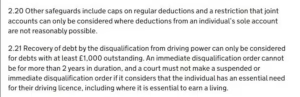
The outstanding debt must be at least £1,000, and driving disqualification is intended to be a last resort when alternative recovery methods have failed.
The main legislative powers commenced on 24 June 2026, while further operational regulations took effect on 29 October 2026.
We examined the published legislation, the government’s enforcement guidance and the concerns raised by the Social Security Advisory Committee to establish how the powers work and what protections are available.
What Are the DWP Driving Licence Cancellation Powers?
The DWP driving licence cancellation powers are legal debt-recovery measures that allow the department to ask a court to temporarily disqualify someone from driving when they persistently fail to repay qualifying debts despite having the financial means to do so.
These powers are not designed to punish people simply for being in debt or receiving benefits.
They primarily target individuals who are no longer receiving DWP benefits and whose debts cannot reasonably be recovered through existing methods, such as deductions from PAYE earnings or bank accounts.
The legal provisions are contained in Schedule 3ZB of the Social Security Administration Act 1992, introduced through the Public Authorities (Fraud, Error and Recovery) Act 2025.
According to the official DWP Direct Deduction and Disqualification from Driving Orders Code of Practice, the department must follow a structured enforcement process before requesting disqualification.
| Key rule | Position in November 2026 |
|---|---|
| Minimum outstanding debt | £1,000 |
| Who can authorise disqualification? | A court, following a DWP application |
| Maximum initial immediate disqualification | 2 years |
| First court order | Suspended disqualification order |
| People currently receiving DWP benefits | Excluded from this driving-disqualification power at the time of application |
| Essential need to drive | Court must refuse an order if an essential need is established |
| Alternative debt recovery | Must not be reasonably possible |
| Geographical coverage | England, Scotland and Wales |
| Operational regulations | In force from 29 October 2026 |
One particularly important distinction is that a suspended disqualification order does not immediately prevent someone from driving. It establishes repayment conditions that the individual must follow.
When Did the New DWP Driving Licence Powers Come Into Force?
The legislative changes were introduced in stages rather than becoming fully operational on a single date.
The timeline matters because earlier coverage sometimes treated the announcement of new powers as evidence that driving bans were already being imposed.
| Date | Development |
|---|---|
| 2 December 2025 | Public Authorities (Fraud, Error and Recovery) Act received Royal Assent |
| 24 June 2026 | Main debt-recovery and driving-disqualification provisions commenced |
| June 2026 | DWP began issuing warning letters about stronger recovery action |
| 23 September 2026 | Government confirmed that no driving-licence disqualifications had yet been issued |
| 26 October 2026 | Separate statutory provisions concerning recovery costs commenced |
| 29 October 2026 | Social Security (Further Methods of Recovery) Regulations 2026 came into force |
| November 2026 | The new regulatory framework is in force, with enforcement subject to statutory safeguards |
The supporting regulations are formally known as the Social Security (Further Methods of Recovery) Regulations 2026, SI 2026/1069.
In a parliamentary response on 23 September 2026, DWP minister Lilian Greenwood confirmed that no driving-licence disqualifications had yet been issued because the supporting operational regulations were not due to commence until October.
That was the government’s position on 23 September, not a confirmed total for November.
The introduction of these powers should therefore not be confused with evidence that large numbers of motorists have already lost their licences.
Who Could Have Their Driving Licence Cancelled by DWP?

The new powers focus on individuals with qualifying, recoverable DWP debts who have not made satisfactory repayment arrangements.
Several conditions must be met before DWP can successfully obtain a court order.
The department must establish that the individual:
- Has at least £1,000 in qualifying recoverable debt outstanding.
- Is not entitled to and receiving a DWP benefit at the time of the application.
- Cannot reasonably have the debt recovered through appropriate alternative methods.
- Has failed to repay despite having the means to do so, without reasonable excuse.
- Does not have an essential need to drive that prevents the court from making the order.
A debt of £1,000 or more is therefore only one part of the legal test.
Someone with £2,500 in outstanding benefit debt who is genuinely unable to afford repayment is in a different position from someone with substantial available resources who deliberately refuses to pay.
The court must examine the circumstances rather than relying on the amount owed alone.
What Types of Benefit Debt Could Be Involved?
The relevant recovery framework covers qualifying social security debts owed to DWP, which can include recoverable benefit overpayments and certain penalties.
Potential examples include recoverable overpayments connected with Universal Credit or other DWP-administered benefits.
A particularly important distinction is that an overpayment is not automatically proof of fraud.
Benefit overpayments can arise from incorrect information, changes in circumstances, administrative mistakes or deliberate deception.
Our explanation of DWP overpaid benefits by mistake covers how overpayment decisions arise and what recipients can do when they disagree with the calculation.
Universal Credit overpayments can generally be recoverable even where an official error contributed to the incorrect payment.
However, the question of whether a debt is legally recoverable is separate from whether a court can impose driving disqualification.
The latter requires considerably more restrictive conditions.
Can DWP Cancel Your Driving Licence If You Receive Universal Credit or PIP?
People who are currently entitled to and receiving a DWP-administered benefit are excluded from the new driving-disqualification power at the time DWP applies to the court.
This protection is explicitly stated in paragraph 6.3 of the Code of Practice.
It means that someone receiving Universal Credit does not face driving disqualification under this particular debt-recovery mechanism simply because they have an outstanding overpayment.
The same rule is relevant to people receiving DWP-administered disability benefits such as Personal Independence Payment (PIP).
However, this does not mean the underlying debt disappears.
DWP may still recover qualifying debts using other lawful methods, including deductions from benefit payments.
Anyone concerned about deductions should check how DWP Universal Credit deductions operate and what limits apply to ordinary recovery.
The distinction matters because driving disqualification and benefit deductions are different enforcement mechanisms, with different eligibility conditions.
How Does DWP Apply to Cancel Someone’s Driving Licence?
DWP cannot move directly from an unpaid debt to immediate licence cancellation.
The Code of Practice establishes a sequence of contact attempts, financial assessments, possible alternative recovery and court proceedings.
Step 1: DWP Identifies a Qualifying Outstanding Debt
The department first establishes that money is legally recoverable.
This normally follows a benefit overpayment decision or another relevant recovery decision.
The person should already have received notification explaining the debt and the opportunity to challenge the underlying decision.
Step 2: DWP Attempts to Agree Repayment
The Debt Management team will try to contact the individual to discuss repayment.
If the matter progresses to the Debt Management Enforcement team, its process includes a minimum of four further contact attempts using different methods, including at least two written notifications.
The objective is to agree an affordable repayment plan without requiring stronger enforcement.
Step 3: Alternative Recovery Methods Are Considered
Before driving disqualification can be pursued, DWP must assess whether repayment can reasonably be secured through alternative routes.
These may include deductions from PAYE income or a Direct Deduction Order (DDO) against a bank account.
Driving disqualification is reserved for cases in which those alternative recovery methods are not reasonably possible.
Step 4: DWP Applies to the Court
If the statutory conditions are met, DWP may apply for a suspended driving-disqualification order.
The individual must be notified in writing and provided with information about the court hearing.
The court examines their ability to repay, reasons for non-payment and whether driving is essential.
Step 5: The Court Sets Repayment Conditions
If the application succeeds, the first order is suspended.
The person can continue driving, provided they comply with the repayment conditions imposed by the court.
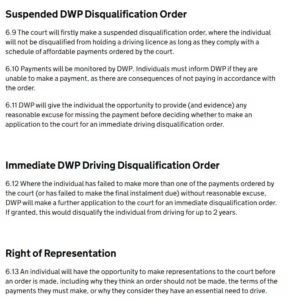
Step 6: An Immediate Ban May Follow Further Non-Payment
If the individual breaches the court-ordered repayment conditions without reasonable excuse, DWP can make another application.
The Code describes escalation where more than one scheduled payment has been missed, or the final instalment has not been paid, without reasonable excuse.
An immediate disqualification order can then prevent the person from driving for up to two years.
Can DWP Take Money Directly From Your Bank Account Before Cancelling Your Licence?
Yes. The same legislative framework introduced Direct Deduction Orders, allowing DWP to require banks to recover qualifying debts directly from certain accounts without first obtaining a court order for that deduction.
However, this power is also subject to safeguards.
DWP must assess the individual’s circumstances and affordability before making a deduction order.
The Code requires consideration of at least three months of recent bank statements.
The department must take account of whether deductions would cause hardship in meeting essential living expenses.
Depending on the circumstances, an order may involve a lump sum or regular payments.
There are also protections for jointly held accounts. DWP must consider the individual’s sole accounts first and cannot automatically treat all the money in a joint account as belonging to the debtor.
Affected account holders must be given opportunities to make representations and, where applicable, seek a review or appeal.
The distinction between financial information gathering and debt recovery is important. The DWP’s bank account checking powers do not mean every account is continuously monitored or that every financial discrepancy leads directly to enforcement.
An eligibility-verification check, a benefit investigation and a Direct Deduction Order have different purposes and legal conditions.
Who Is Protected From DWP Driving Licence Disqualification?

One of the most significant safeguards concerns people who have an essential need to drive.
The court must not make a suspended or immediate disqualification order if it considers that the person has an essential need for their driving licence.
This protection can extend beyond simply driving to work.
Examples include:
- Delivery drivers, couriers and other workers whose livelihoods depend on driving.
- Individuals who need a vehicle to meet essential caring responsibilities.
- People whose disability, health or personal circumstances establish an essential need for driving.
- Individuals whose particular circumstances make driving essential rather than merely convenient.
The court must consider the evidence in each case.
A delivery driver whose entire income depends on having a valid licence may be able to demonstrate that disqualification would remove their means of earning a living.
Similarly, someone responsible for transporting a dependent relative with significant care needs may have grounds to demonstrate an essential need.
However, simply owning a car, enjoying driving or preferring to travel by vehicle does not automatically establish the legal protection.
Documents such as employment contracts, delivery records, medical evidence and information about caring responsibilities may help demonstrate why the licence is essential.
Crucially, an essential need to drive must be made clear to the court.
What Happens If Someone Cannot Afford to Repay Their DWP Debt?
The legislation is intended to distinguish between individuals who refuse to pay and those genuinely unable to do so.
This distinction has attracted scrutiny from the Social Security Advisory Committee (SSAC), which examines social security regulations and their practical effects.
In a letter dated 7 September 2026 and published on 9 October, Dr Stephen Brien, Chair of the Social Security Advisory Committee, highlighted the importance of distinguishing people who cannot repay from those deliberately refusing to do so.
His analysis raised concerns about whether officials would always have enough information about individual circumstances, including vulnerability, housing instability, caring responsibilities and barriers to communication.
The Committee called for stronger assurance that the safeguards would work consistently in practice and recommended staged implementation with opportunities for review.
These concerns were set out in the officially published Social Security Advisory Committee assessment of the debt-recovery regulations.
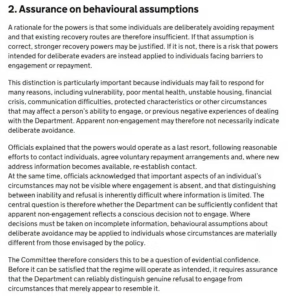
The Committee’s assessment highlights an important practical risk: failure to respond to a letter does not necessarily establish deliberate refusal to repay.
Someone may have moved home, experienced serious illness or faced circumstances that prevented them from understanding or responding to the correspondence.
In its subsequent written response, the DWP said it would not escalate cases on non-engagement alone and that senior officials would oversee decisions to apply to court.
For people facing financial hardship, providing evidence of income, essential expenditure, debt obligations or personal circumstances can help establish why proposed repayments are unaffordable.
In exceptional circumstances, DWP also has discretion to waive certain benefit overpayments, although a waiver is not automatic and must be considered under the relevant rules.
How Long Can DWP Driving Licence Disqualification Last?
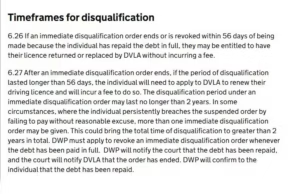
An immediate disqualification order can last for a maximum of two years.
However, that does not necessarily mean a person will be unable to drive for the entire period.
The legislation requires the order to end when the full outstanding debt has been repaid.
DWP must apply to the court to bring an immediate disqualification order to an end when payment has been completed.
If the debt is fully repaid and the order ends within 56 days of being made, the individual may be able to have their licence reinstated or returned by the Driver and Vehicle Licensing Agency (DVLA) without an additional fee.
Where disqualification lasts longer than 56 days, the individual will normally need to apply for a new licence and pay the relevant DVLA fee.
There is another important detail.
An initial immediate disqualification cannot exceed two years, but the Code allows further court applications in certain circumstances where the debt remains unpaid and the statutory conditions continue to be met.
Therefore, the two-year maximum applies to an individual immediate order, not necessarily the total time across every possible order.
Does a DWP Driving Ban Affect Your Criminal Record or Driving Penalty Points?
A driving-disqualification order made under these debt-recovery powers is a civil order.
It is not a criminal conviction for a road traffic offence.
The official Code confirms that an immediate DWP disqualification order does not create driving penalty points and does not indicate that the person is an unsafe driver.
However, the practical consequences remain serious.
Once an immediate order takes effect, DVLA records are updated to show that the person is disqualified and the licence has been revoked.
The police can access the relevant licensing information, even if the person still physically possesses their licence.
A person subject to an active disqualification order must not drive merely because they still have their plastic photocard.
The separate legal consequences of driving while disqualified can be serious.
The debt-recovery order also does not override or shorten any other existing driving disqualification.
What Should You Do If DWP Threatens to Cancel Your Driving Licence?
Receiving a warning about a possible driving-disqualification application does not mean the person’s licence has already been cancelled.
The appropriate response depends on whether the debt is correct, whether repayment is affordable and whether court proceedings have started.
1. Confirm that the correspondence is genuine.
Check the details through official DWP contact channels. Do not send sensitive personal information or payments to unverified contact details included in unexpected messages.
2. Check the amount and legal basis of the debt.
Request a breakdown showing the original amount, the benefit involved, payments already made and the outstanding balance.
If an overpayment decision is incorrect, ask about the appropriate challenge procedure.
3. Explain your actual financial circumstances.
Provide information about income, housing costs, childcare, essential bills and other relevant commitments.
A repayment offer should be realistic and sustainable.
4. Explain any essential need to drive.
If driving is necessary for employment, care or another essential purpose, gather supporting documents.
This becomes especially important if a court application is made.
5. Respond to any court notification.
Do not ignore a hearing notice. The court may be able to make an order even if the person does not attend or make representations.
6. Seek independent advice where necessary.
Citizens Advice, StepChange and other qualified welfare-rights or debt advisers may help explain repayment options and financial evidence.
Where court proceedings are involved, appropriate legal advice may also be necessary.
If the original debt relates to Universal Credit, understanding whether Universal Credit must be repaid can help distinguish ordinary benefit entitlement from recoverable advances, overpayments and other debts.
Can You Appeal or Challenge a DWP Driving Licence Cancellation?
There are several stages at which a person may be able to challenge a decision or provide further information.
These should not be confused with a single appeal process.
Challenging the Original Debt
A person who disputes a benefit overpayment may have rights to request a mandatory reconsideration and, where applicable, appeal to a tribunal.
The appropriate route and deadlines depend on the underlying benefit decision.
DWP expects disputes about the recoverability or amount of the original debt to have been addressed before the case reaches these more serious enforcement stages.
Making Representations to the Court
Before a driving-disqualification order is made, the individual has an opportunity to explain:
- Why the order should not be made.
- Whether they had the means to repay.
- Whether there was a reasonable excuse for non-payment.
- Why driving is essential.
- Whether the proposed repayment terms are affordable.
This is not merely an administrative formality. The court must consider the statutory requirements before granting an order.
Asking for a Court Order to Be Varied
If circumstances change after a suspended or immediate order has been made, the individual may apply to the court to vary the repayment conditions.
For example, a sudden reduction in household income could make previously affordable instalments unrealistic.
The court can consider whether changing the terms would make repayment more likely.
It is important to obtain advice promptly rather than simply stopping payments required by an existing court order.
How Could the Rules Affect Different People? Practical Examples
The following examples are hypothetical illustrations of how the statutory safeguards could apply. They are not actual DWP enforcement cases.
| Individual circumstances | Likely position under the rules |
|---|---|
| Owes £1,800 but currently receives Universal Credit | Excluded from this disqualification power at the time of application |
| Owes £2,500 but cannot afford repayment | Financial capacity and reasonable excuse must be examined; debt alone is insufficient |
| Owes £3,000, has a confirmed essential need to drive for work | Court must refuse an order if it accepts the essential need |
| Owes £4,000, can afford repayment, deliberately avoids paying and alternative recovery is not reasonably possible | Could face an application for a suspended disqualification order |
| Owes £750 in recoverable benefit debt | Below the £1,000 threshold for driving-disqualification applications |
| Subject to a suspended order and maintains court-ordered repayments | May continue driving |
| Subject to a suspended order and persistently breaches repayment conditions without reasonable excuse | Could face a further application for immediate disqualification |
These examples demonstrate why the minimum debt threshold should never be interpreted as an automatic driving ban.
Why Has the Government Introduced These DWP Driving Licence Powers?
The government argues that stronger enforcement is needed to recover public money from people who have the ability to repay their debts but deliberately avoid doing so.
The reforms form part of a wider programme addressing fraud, error and debt within the welfare system.
In the government’s June 2026 announcement, Andrew Western, then Work and Pensions Minister for Transformation, emphasised the importance of pursuing individuals who deliberately evade repayment while maintaining opportunities for affordable repayment arrangements.
The government connected the broader reforms to a commitment to deliver £14.6 billion in savings over five years through fraud, error and debt measures.
However, that figure relates to the wider programme rather than expected savings from driving-disqualification orders alone.
The financial argument is straightforward: outstanding recoverable debts represent money that could potentially be returned to the public purse.
Yet successful debt recovery cannot be judged solely by the amount collected.
The costs of enforcement, the accuracy of decisions, the treatment of vulnerable people and the consequences for individuals’ ability to work are also relevant.
For example, removing the licence of someone who needs to drive to earn a living could undermine their ability to repay.
This is one reason the essential-driving safeguard is important from both a legal and financial perspective.
The challenge for DWP will be demonstrating that stronger powers recover debts from genuinely non-compliant individuals without disproportionately affecting people already experiencing financial hardship.
Final Assessment
The DWP driving licence cancellation powers represent a significant change in how the government can pursue certain outstanding social security debts.
However, the legislation does not create a general power to remove driving licences from benefit claimants or everyone with unpaid DWP debt.
The £1,000 threshold, exclusion for current DWP benefit recipients, requirements concerning ability to repay, and court protection for essential drivers all limit the circumstances in which disqualification can occur.
The official Code of Practice also establishes that a suspended order must come before immediate driving disqualification.
For individuals who owe recoverable money to DWP, the most effective approach is to verify the debt, respond to correspondence and agree an affordable repayment arrangement wherever possible.
For the government, the longer-term test will be whether these powers can recover legitimate debts while protecting people whose circumstances make repayment or engagement genuinely difficult.
Frequently Asked Questions
Can DWP Cancel My Driving Licence for Owing £1,000?
Not automatically. An outstanding recoverable debt of at least £1,000 meets only the minimum financial threshold. DWP must satisfy the other legal conditions and obtain a court order.
Can DWP Take My Licence Without Going to Court?
No. DWP cannot independently impose this type of driving disqualification. It must apply to a court for an order under the relevant statutory provisions.
Can I Lose My Licence If I Refuse to Pay Back Universal Credit?
Potentially, but only where the debt qualifies and the statutory conditions are met. The power cannot be used against someone who is entitled to and receiving a DWP benefit at the time of the application.
Will DWP Cancel My Licence If I Need It for Work?
The court must not make a disqualification order if it finds that the individual has an essential need to drive, including where driving is essential to earn a living. The individual should provide evidence establishing that need.
Can I Keep Driving After Receiving a Suspended DWP Disqualification Order?
Yes, provided the order remains suspended and the person complies with the repayment conditions. An immediate disqualification is a separate stage.
Can I Get My Driving Licence Back After Paying DWP?
Yes. The order must end when the full debt has been repaid, and DWP must apply to the court to end an immediate disqualification order. Whether a DVLA application and fee are required depends partly on the duration of the disqualification.
Are These Powers Already in Force in November 2026?
Yes. The main legislative provisions commenced in June 2026 and the supporting Social Security (Further Methods of Recovery) Regulations came into force on 29 October 2026. Actual enforcement remains subject to the required legal processes.