
Universal Credit Rates 2027 to 2028: New DWP Payment Increases, Eligibility and Benefit Changes
Universal Credit rates for 2027 to 2028 are set to increase from April 2027, with the Department for Work and Pensions (DWP) confirming higher standard allowances, inflation-linked benefit increases and revised State Pension payments.
The changes were announced on 28 October 2026 following the government’s annual statutory benefit review.
Most new rates will take effect from 12 April 2027, although the date individual Universal Credit claimants see an increase will depend on their monthly assessment periods.
The government has confirmed that most benefits covered by the annual review will rise by 3.5%, reflecting September 2026 inflation.
Universal Credit standard allowances will receive a separate above-inflation increase under the Universal Credit Act 2025.
Our analysis of the latest government announcements shows that single claimants aged 25 or over will receive approximately £219 more annually, while qualifying couples will gain around £344 annually before deductions.
However, not every Universal Credit component will increase at the same rate. Health-related payments, housing support and the benefit cap follow different arrangements.
What Are the New Universal Credit Rates for 2027 to 2028?
Universal Credit is calculated using a monthly standard allowance, with additional elements available depending on a claimant’s circumstances.
The DWP has announced the approximate annual increases for two main adult claimant categories. The complete official schedule of monthly rates for 2027/28 has not yet been published.
The table below compares confirmed 2026/27 rates with indicative 2027/28 amounts.
| Claimant category | 2026/27 monthly rate | 2027/28 position |
|---|---|---|
| Single, under 25 | £338.58 | Final rate pending |
| Single, aged 25 or over | £424.90 | Approximately £443 per month |
| Couple, both under 25 | £528.34 | Final rate pending |
| Couple, one or both aged 25 or over | £666.97 | Approximately £696 per month |
Important: The 2027/28 monthly figures shown are indicative, calculated from the DWP’s announced annual increases and independent uprating analysis. They must not be treated as the final statutory payment rates.
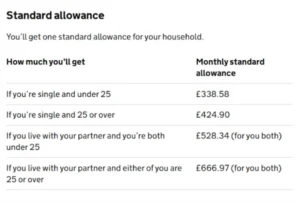
Official 2026/27 monthly Universal Credit standard allowances used as the comparison baseline for the 2027/28 increases.
How Much Extra Will Claimants Receive?
The latest DWP announcement identifies two significant annual improvements.
| Household | Approximate annual increase | Monthly equivalent | Increase above inflation-only uprating |
|---|---|---|---|
| Single person aged 25+ | £219 | £18.25 | Over £45 annually |
| Couple with at least one person aged 25+ | £344 | £28.67 | Around £71 annually |
These additional payments relate to the standard allowance rather than the claimant’s entire Universal Credit award.
For example, someone receiving support for rent, children or disability may have a higher total entitlement. Their final increase will depend on the treatment of each additional component.
For background, the 2026 Universal Credit increases explain how the previous year’s standard allowance changes affected different household categories.
Why Are Universal Credit Standard Allowances Increasing Above Inflation?
The government introduced a multi-year uprating framework through the Universal Credit Act 2025.
Unlike most benefit components, the standard allowance is subject to a separate statutory calculation designed to deliver increases above inflation.
The legislation specifies additional uplift percentages for four tax years.
| Financial year | Additional statutory uplift percentage |
|---|---|
| 2026/27 | 2.3% |
| 2027/28 | 3.1% |
| 2028/29 | 4.0% |
| 2029/30 | 4.8% |
These percentages are part of the statutory calculation, not simple increases to add to the immediately preceding year’s published monthly payment.
How the Statutory Calculation Works?
The law uses September CPI inflation and a specified additional uplift, with the calculation based on the previous year’s inflation-uprated amount.
Consequently, claimants should not assume their 2026/27 award will automatically increase by 3.5% plus 3.1%.
Independent calculations published in October 2026 indicate that the standard allowance for a single claimant aged 25 or over is expected to rise by approximately 4.3% compared with the current published rate.
In his parliamentary statement on 28 October 2026, Work and Pensions Secretary Pat McFadden explained the government’s intention:
“These changes narrow the gap between the standard rate of Universal Credit and the health-related element.”
The government presents the policy as an attempt to improve financial incentives for employment while adjusting support for claimants with health conditions.
Our assessment is that the distinction between statutory uprating calculations and actual payment increases is particularly important. Applying the wrong percentage to a household’s entire Universal Credit award can produce misleading estimates.
The wider changes to Universal Credit provide useful context on the benefit system’s restructuring and how earlier reforms continue into 2027.
How Will Universal Credit Health and LCWRA Payments Change in 2027?
Health-related Universal Credit payments operate under different rules from the standard allowance.
Since 6 April 2026, the Limited Capability for Work and Work-Related Activity (LCWRA) element has been divided into two main payment levels.
The amount awarded depends partly on when the claimant reported their condition and whether they meet the criteria for protected treatment.
| LCWRA category | Confirmed 2026/27 monthly rate | 2027/28 treatment |
|---|---|---|
| Lower LCWRA rate | £217.26 | Frozen under the existing rules |
| Protected higher LCWRA rate | £429.80 | Subject to separate statutory protection rules |
| Qualifying severe lifelong conditions | £429.80 | Higher-rate protection applies |
| Qualifying terminal illness | £429.80 | Higher-rate protection applies |
Protected and Lower Health Elements
The lower LCWRA amount is intended to remain frozen in cash terms through 2029/30 unless the legislation changes.
For protected higher-rate claimants, the legislation provides protection against inflation for the combined standard allowance and LCWRA element. This does not mean the health element itself automatically increases by 3.5% each year.
A claimant may qualify for the higher rate if they:
- Reported their relevant health condition before 6 April 2026 and meet the applicable transitional conditions.
- Were already receiving LCWRA before the reforms.
- Meet the severe conditions criteria.
- Are terminally ill under the relevant rules.
- Qualify through certain transitional arrangements involving Employment and Support Allowance.
People who reported a condition from 6 April 2026 onwards will generally receive the lower rate unless an exception applies.
Claimants can examine the LCWRA payment changes to understand how the reform affects different entitlement groups.
Which Other Benefits Will Increase by 3.5% in April 2027?
The annual DWP review confirmed that most benefits within its ordinary uprating framework will increase by 3.5%.
This percentage reflects the Consumer Prices Index for the 12 months to September 2026.
The increase covers several forms of working-age, disability and carer support.
| Benefit or payment category | Announced 2027/28 increase | Position |
|---|---|---|
| Personal Independence Payment (PIP) | 3.5% | Inflation-linked |
| Disability Living Allowance | 3.5% | Inflation-linked |
| Attendance Allowance | 3.5% | Inflation-linked |
| Carer's Allowance | 3.5% | Inflation-linked |
| Applicable Employment and Support Allowance rates | 3.5% | Subject to exceptions |
| Income Support and applicable legacy benefit amounts | 3.5% | Inflation-linked |
| Statutory Sick Pay | 3.5% | Annual uprating framework |
| Statutory Maternity Pay and applicable related payments | 3.5% | Annual uprating framework |
| Additional State Pension | 3.5% | CPI-linked |
These are announced uprating percentages. Exact monetary amounts for individual provisions remain subject to the detailed 2027/28 rate schedule and applicable statutory rounding.
Regional differences are important. The DWP announcement applies across Great Britain for most provisions, but disability benefits and Carer’s Allowance are devolved in Scotland. Northern Ireland operates its own social security administration.
The 3.5% increase should therefore not be applied automatically to every payment in every part of the UK.
Will the Benefit Cap and Local Housing Allowance Increase in 2027?
Two important parts of the benefit system will remain frozen for 2027/28.
The Work and Pensions Secretary confirmed that both the benefit cap and Local Housing Allowance (LHA) rates will be maintained at their existing levels.
The benefit cap places a maximum on the total amount of certain benefits that affected households can receive, unless they qualify for an exemption.
Current monthly benefit cap levels that will remain unchanged are:
| Household | Greater London | Outside Greater London |
|---|---|---|
| Couple or single parent household | £2,110.25 | £1,835.00 |
| Single adult without children | £1,413.92 | £1,229.42 |
Some households, including certain claimants receiving qualifying disability benefits or LCWRA, are exempt.
For private renters, Local Housing Allowance helps determine the maximum housing support available under the relevant rules.
A continued LHA freeze means that an increase in private rent does not automatically produce an equivalent increase in Universal Credit housing support.
This is particularly relevant in areas where rents are already considerably higher than applicable LHA rates.
On 21 October 2026, Greg Thwaites, Interim Chief Economist at the Resolution Foundation, warned of wider living-cost pressures, stating:
“Support with energy bills will be needed this winter.”
The Foundation also highlighted growing gaps between private rents and frozen housing support.
This illustrates why a higher standard allowance does not necessarily translate into an equivalent improvement in a household’s disposable income.
What Is Changing to the Universal Credit Surplus Earnings Threshold?
The government’s Autumn Budget 2026 confirmed that the £2,500 surplus earnings threshold will be retained for a further year, until the end of March 2028.
This measure is particularly relevant to self-employed people, seasonal workers and claimants who receive irregular or unusually large earnings.
Surplus earnings rules apply when income rises sufficiently to end Universal Credit entitlement for an assessment period.
Under the £2,500 threshold, earnings above the applicable entitlement limit can be carried forward where the excess meets the surplus earnings rules.
For example:
- A claimant receives an unusually large work payment or business profit.
- Their earnings reduce their Universal Credit entitlement to zero.
- If earnings exceed the relevant threshold by the required amount, surplus earnings are calculated.
- Those surplus earnings can affect Universal Credit entitlement in subsequent assessment periods.
The £2,500 threshold is not the maximum someone can earn while claiming Universal Credit. It is a specific figure used in the calculation of surplus earnings.
Ordinary wages continue to affect Universal Credit through the earnings calculation, including the 55% taper where applicable.
The decision to extend the threshold provides continuity for claimants whose income varies significantly from month to month.

Autumn Budget 2026 confirms that the Universal Credit £2,500 surplus earnings threshold will continue until the end of March 2028.
How Much Will State Pension and Pension Credit Increase in 2027?
Although State Pension is separate from Universal Credit, both were addressed in the October 2026 statutory review.
The government confirmed a 3.9% increase in the basic and new State Pension rates for 2027/28.
This reflects average weekly earnings growth between May and July 2026 and the government’s triple lock commitment.
The triple lock increases the relevant State Pension rates by the highest of:
- Average earnings growth.
- September CPI inflation.
- 2.5%.
For April 2027, earnings growth of 3.9% exceeded the other two measures.
State Pension Rates for 2027/28
| State Pension category | 2026/27 weekly rate | 2027/28 weekly rate |
|---|---|---|
| Full new State Pension | £241.30 | £250.70 |
| Full basic State Pension | £184.90 | Approximately £192.10 |
The full new State Pension increases by £9.40 weekly, equivalent to £488.80 across 52 weeks.
The basic State Pension increase is approximately £7.20 weekly, or £374.40 annually.
Actual individual payments can differ according to National Insurance records and pension entitlement.
Pension Credit Minimum Guarantee
Pension Credit provides additional income for eligible people who have reached State Pension age.
The Standard Minimum Guarantee is also increasing by 3.9%.
| Pension Credit category | 2026/27 weekly rate | 2027/28 weekly rate |
|---|---|---|
| Single pensioner | £238.00 | £247.30 |
| Couple | £363.25 | £377.40 |
These figures represent the standard guaranteed income levels rather than a fixed Pension Credit payment for everyone.
An individual award depends on other income, savings and circumstances.
The Savings Credit maximum will increase by 3.5%, rather than 3.9%, under the separate annual uprating arrangements.
How Will the New Rates Affect Actual Universal Credit Payments?
The increase in the standard allowance does not automatically mean that every claimant receives the full additional amount in their bank account.
Universal Credit is assessed by taking the maximum eligible award and accounting for income and applicable deductions.
The main factors include employment income, housing support, child elements, childcare costs, disability-related components, capital and repayments.
For working claimants, the earnings taper remains particularly important.
Under the existing rules, Universal Credit is generally reduced by 55p for every £1 of relevant earnings above any applicable work allowance.
Some claimants qualify for a work allowance because they have responsibility for children or have limited capability for work.
The applicable Universal Credit work allowance is therefore an important part of estimating what a working household will receive.
Example: Single Claimant Aged 25 or Over
Consider a single person with £600 in monthly earnings taken into account for Universal Credit, no applicable work allowance and no additional elements.
| Calculation | 2026/27 | Indicative 2027/28 |
|---|---|---|
| Standard allowance | £424.90 | Around £443.21 |
| Counted earnings | £600 | £600 |
| Earnings deduction at 55% | £330 | £330 |
| Amount before any other deductions | £94.90 | Around £113.21 |
This illustration assumes unchanged earnings, no housing or other elements, and no additional deductions.
It demonstrates that an increase in the standard allowance can increase the remaining award even when earnings deductions continue.
However, claimants should not interpret the example as a personalised entitlement calculation.
The rules determining how much someone can earn while receiving Universal Credit remain essential when assessing real household income.
When Will the Universal Credit 2027/28 Increases Appear in Payments?
Most benefit uprating changes are scheduled to begin on 12 April 2027.
However, Universal Credit is calculated using monthly assessment periods rather than being paid at a single fixed point each month.
For claimants, the date a revised amount appears will depend on when their assessment period begins.
An assessment period that starts before the relevant implementation date may still use the previous rates. A later assessment period will normally incorporate the revised rates where the new rules apply.
Claimants should therefore check the assessment period shown on their monthly Universal Credit statement rather than assume every April payment will contain the increase.
This timing difference is especially important for households budgeting around rent, utility bills or regular debt repayments.
What Should Universal Credit Claimants Check Before April 2027?
Claimants can prepare for the changes without submitting a new Universal Credit application solely because standard rates are increasing.
The most useful checks are:
- Review your existing entitlement: Identify your standard allowance, child elements, health elements and housing support.
- Check your earnings information: Make sure employment income and self-employed earnings are reported correctly.
- Confirm your LCWRA status: Establish whether you receive the protected higher amount or the lower post-2026 rate.
- Examine deductions: Check advance repayments, benefit overpayments, sanctions and other deductions shown on your statement.
- Monitor your assessment period: Compare the payment calculation before and after the April uprating.
Claimants should also report changes in circumstances through their Universal Credit account when required.
An automatic annual rate increase does not remove the responsibility to report relevant changes in household circumstances.
Conclusion
The Universal Credit rates for 2027 to 2028 represent another significant adjustment to the UK’s benefits system.
The government’s confirmed approach combines above-inflation increases to standard allowances with a 3.5% rise in most other reviewed benefits.
Single claimants aged 25 or over are expected to gain approximately £219 annually, while qualifying couples will receive around £344 more.
However, frozen housing allowances, benefit cap limits and separate LCWRA rules mean financial outcomes will vary between households.
Claimants should check their assessment periods, review their existing award and wait for the DWP’s complete statutory rate schedule before relying on exact new monthly payment amounts.
Frequently Asked Questions
How much will Universal Credit increase in April 2027?
The DWP has announced increases worth approximately £219 annually for single claimants aged 25 or over and £344 for couples where at least one person is 25 or over. Other elements follow different rules.
Will Universal Credit increase by 3.5% in 2027?
Most benefits covered by the normal statutory review will increase by 3.5%. Universal Credit standard allowances follow a separate above-inflation calculation, so a uniform 3.5% increase does not apply to the entire award.
Will LCWRA payments increase in 2027?
The lower LCWRA rate remains frozen under the existing legislation. Protected higher-rate claimants have separate statutory safeguards, so their health element should not simply be assumed to rise by 3.5%.
When will the new Universal Credit rates start?
Most increases will take effect from 12 April 2027. For Universal Credit, the revised payment will depend on the claimant’s monthly assessment period.
Will the benefit cap increase during 2027/28?
No. The government confirmed that the benefit cap will remain at its existing level for 2027/28. Local Housing Allowance rates will also remain frozen.
Is the £2,500 surplus earnings threshold continuing in 2027?
Yes. Autumn Budget 2026 confirmed an extension of the £2,500 threshold until the end of March 2028 for Universal Credit claimants in Great Britain.