Do You Get Free Prescriptions on Universal Credit: £435 and £935 NHS Thresholds
If you receive Universal Credit, you may be able to get free NHS prescriptions in England, but simply being on Universal Credit does not automatically make you eligible.
Your entitlement normally depends on your household’s take-home pay during the relevant Universal Credit assessment period.
The standard earnings limit is £435 or less, while a higher £935 limit can apply if your Universal Credit includes an element for a child or you or your partner have limited capability for work.
The rules are particularly important in England because most working-age adults normally pay for NHS prescriptions. The current NHS prescription charge is £9.90 for each prescribed item.
Universal Credit Does Not Automatically Make NHS Prescriptions Free
Receiving Universal Credit on its own is not enough to qualify for free NHS prescriptions. The NHS looks at both your Universal Credit award and your household earnings during your most recent qualifying assessment period.
You normally qualify if you are receiving Universal Credit and meet one of these earnings conditions:
| Universal Credit Circumstances | Maximum Take-Home Pay |
| No Child Element Or Limited Capability For Work | £435 Or Less |
| Universal Credit Includes An Element For A Child | £935 Or Less |
| You Or Your Partner Have LCW Or LCWRA | £935 Or Less |
If you claim Universal Credit as a couple, the income threshold applies to the combined take-home pay of you and your partner, rather than giving each person a separate £435 or £935 allowance.
A claimant who meets the qualifying conditions can receive more than free prescriptions. NHS help can also include dental treatment, sight tests and help with certain other health costs.
Universal Credit Free Prescription Income Limits
The amount that matters is your take-home pay during the relevant assessment period, not simply your annual salary or the amount of Universal Credit deposited into your bank account.
£435 Earnings Threshold
The £435 threshold generally applies where you receive Universal Credit but your award does not include an element for a child and neither you nor your partner meet the limited capability for work conditions.
You qualify if your household had:
- No Earnings: You had no take-home earnings during the relevant assessment period
- Low Earnings: Your total household take-home pay was £435 or less
- Qualifying UC Payment: You were actually receiving Universal Credit for the relevant period
Someone earning £400 during the relevant assessment period could therefore qualify, provided the other Universal Credit conditions are met.
£935 Earnings Threshold
The higher £935 earnings threshold applies where your circumstances include additional qualifying factors.
You may qualify at this higher limit if:
- Child Element: Your Universal Credit includes an element for a child
- Limited Capability for Work: You or your partner have LCW
- Limited Capability for Work and Work-Related Activity: You or your partner have LCWRA
NHS guidance specifically includes both LCW and LCWRA within the higher earnings-limit rules.
Claimants dealing with health-related Universal Credit decisions may also need to understand how LCWRA works alongside Universal Credit, particularly where their health status changes during a claim.
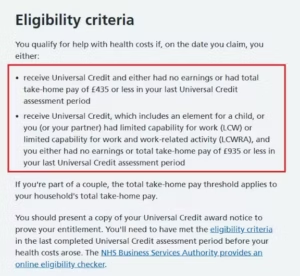
NHS guidance confirms the £435 and £935 Universal Credit earnings thresholds for help with NHS health costs.
Which Universal Credit Assessment Period Is Used?
Prescription eligibility is linked to a specific Universal Credit assessment period.
For prescriptions, NHSBSA says the relevant assessment period is the last full Universal Credit assessment period ending before the prescribed date.
This means the NHS does not normally look at your estimated annual income or simply use what you are earning today.
For example, suppose your latest relevant assessment period shows household take-home pay of £420. If you do not have a child element or LCW or LCWRA status, the £420 figure is within the standard £435 limit.
However, if the relevant assessment period shows £500, you would normally be above the standard limit unless you qualified for the higher £935 threshold.
This can be particularly important for people with variable earnings. Universal Credit is calculated monthly, so overtime, bonuses and changes in payday dates can affect the earnings recorded in individual assessment periods.
The wider rules around how much you can earn on Universal Credit in 2026 help explain why one month’s earnings can differ significantly from another.
How To Check Your Take-Home Pay On Your Universal Credit Statement?
You can check the figure used for prescription eligibility through your Universal Credit account.
NHSBSA says the relevant earnings figure appears on the statement as “Your total take-home pay for this period”.
Take-home pay for these purposes is broadly net earned income after deductions such as tax, National Insurance and pension contributions.
To check your statement:
- Sign in to your Universal Credit account
- Open the relevant payment statement
- Look for the section showing your total take-home pay
- Check whether a child or health-related element applies
- Compare the earnings figure with the £435 or £935 threshold
NHSBSA also advises claimants to check the “Other support you may be able to get” section of their Universal Credit statement.
For couples, remember that the NHS uses joint earnings. You cannot apply the threshold separately to each partner.
Can Your Free Prescription Eligibility Change Each Month?
Yes. Your entitlement can change because Universal Credit earnings are assessed over individual assessment periods.
A claimant might qualify during one assessment period but fail the earnings test during another if their income increases.
This can affect people who receive:
- Overtime Payments
- Bonuses
- Variable Working Hours
- Weekly Or Four-Weekly Wages
- Seasonal Earnings
- Changing Self-Employment Income
NHSBSA specifically recommends checking entitlement regularly where working hours or income change.
Do not assume that because you received a free prescription last month, you will automatically qualify again this month.
Self-employed claimants also need to take particular care. NHSBSA confirms that Universal Credit uses specific rules for calculating net earned income from self-employment.
How To Claim Free Prescriptions On Universal Credit?
Once you have checked that you meet the Universal Credit earnings conditions, you can declare your entitlement when collecting your prescription.
Which Box To Tick On The Prescription Form?
If the prescription form includes a Universal Credit option, eligible claimants should tick Box U.
Some older prescription forms may not include a Universal Credit box. NHSBSA says an eligible Universal Credit claimant should tick Box K, which is labelled for income-based Jobseeker’s Allowance, where no Universal Credit box is available.
This does not mean that income-based JSA itself still provides the same exemption.
NHSBSA now confirms that income-based Jobseeker’s Allowance, Income Support and income-related ESA have been abolished and no longer give entitlement on that basis.
What Proof Of Eligibility You May Need?
You may be asked to provide evidence showing that you met the Universal Credit conditions.
Useful evidence can include your Universal Credit statement showing:
- Assessment Period: The dates covered by the statement
- Take-Home Pay: Your total earnings for that period
- Relevant Elements: Child or limited capability information where applicable
- Universal Credit Award: Confirmation that you received a qualifying UC payment
NHS guidance recommends having a copy of your Universal Credit award notice available as evidence.
What If You Have Just Started Claiming Universal Credit?
New Universal Credit claimants can face a particular problem because there may not yet be a completed assessment period available to establish NHS entitlement.
NHSBSA says that if you have just applied and have not completed your first full assessment period, your prescription entitlement cannot immediately be calculated.
In this situation, you should normally pay the prescription charge and immediately ask for an FP57 refund form.
Keep both:
- FP57 Form
- Prescription Receipt
Once the first Universal Credit assessment period is complete, you may be able to claim the money back if your confirmed earnings place you within the qualifying threshold.
This situation is connected to the way Universal Credit is paid in arrears, as the first award is calculated only after the initial assessment period has ended.
You cannot normally return later and ask a pharmacy to issue an FP57 retrospectively, so ask for it when you pay.
NHSBSA also states that prescription refunds using an FP57 normally need to be claimed within three months.
What Happens If You Claim A Free Prescription By Mistake?
Do not tick the free prescription box simply because you receive Universal Credit.
NHSBSA checks claims and may ask you to provide evidence that you were entitled at the time.
If you cannot prove that you qualified, you may have to pay the original prescription charge plus a penalty charge of up to £100.
A common mistake is assuming that every benefit automatically gives free NHS prescriptions.
For example, Personal Independence Payment does not automatically provide free prescriptions. New Style ESA, New Style JSA and Attendance Allowance also do not automatically qualify someone for help with NHS health costs.
Another important situation involves sanctions. NHSBSA states that you cannot claim help through Universal Credit if you are not receiving a UC payment because of a sanction.
If you are uncertain, it is safer to check your eligibility before declaring that you are exempt.
What To Do If You Do Not Qualify For Free Prescriptions?
Being above the £435 or £935 Universal Credit threshold does not necessarily mean you have to pay the full cost of every prescription without other support.
NHS Low Income Scheme
People on a low income may qualify through the NHS Low Income Scheme even when Universal Credit itself does not provide free prescriptions.
A person awarded an HC2 certificate can receive full help with NHS prescription costs. An HC3 certificate provides partial help with certain NHS costs, but does not itself provide free prescriptions.
This can be particularly useful if your earnings place you just above the Universal Credit prescription threshold.
Prescription Prepayment Certificate
If you regularly need prescriptions but do not qualify for free treatment, a Prescription Prepayment Certificate could reduce the total amount you pay.
The current NHS prescription charge in England is £9.90 per item. NHSBSA currently lists the standard PPC prices as:
| Prescription Option | Current Cost |
| One Prescription Item | £9.90 |
| 3-Month PPC | £32.05 |
| 12-Month PPC | £114.50 |
A PPC covers all NHS prescriptions included within the certificate period. NHSBSA says it can save money if you need more than three prescription items over three months or more than 11 items over 12 months.
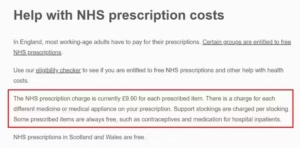
NHSBSA confirms the current £9.90 prescription charge and explains prescription refunds and prepayment certificates.
Conclusion
You can get free prescriptions on Universal Credit, but Universal Credit does not automatically qualify everyone.
For most claimants, the key question is how much household take-home pay was recorded during the relevant assessment period.
The usual threshold is £435 or less, rising to £935 or less if Universal Credit includes an element for a child or you or your partner meet the limited capability for work conditions.
Check your Universal Credit statement before claiming, particularly if your earnings change from month to month.
If you have only recently started a claim and your first assessment period has not finished, pay for the prescription and request an FP57 immediately so you may be able to claim a refund later.
Claimants receiving disability benefits should also avoid assuming that one benefit automatically gives entitlement to another form of support.
For example, PIP and Universal Credit operate as separate benefits, and PIP alone does not automatically provide free NHS prescriptions.
FAQs
Do You Automatically Get Free Prescriptions On Universal Credit?
No. You must meet the Universal Credit earnings conditions. Your household take-home pay normally needs to be £435 or less, or £935 or less where the higher threshold applies.
What Is The Universal Credit Earnings Limit For Free Prescriptions?
The standard limit is £435 or less in the relevant assessment period. The limit rises to £935 where your UC includes a child element or you or your partner have LCW or LCWRA.
Is The £435 Or £935 Limit Per Person Or Per Household?
It is a household limit. If you claim Universal Credit as a couple, the combined take-home pay of both partners is used.
Can You Get Free Prescriptions If You Work And Claim Universal Credit?
Yes. Working does not automatically prevent you from qualifying. What matters is whether your household take-home pay in the relevant assessment period is within the applicable earnings threshold.
Does LCWRA Qualify You For Free Prescriptions?
LCWRA can allow the higher £935 earnings threshold to apply, but you still need to meet the other Universal Credit eligibility conditions.
Can You Claim A Refund If You Paid For A Prescription?
Yes, if you were entitled when you paid and obtained an FP57 refund form at the time. NHSBSA says the refund normally needs to be claimed within three months.
Does PIP Give You Free Prescriptions?
No. Personal Independence Payment does not automatically entitle you to free NHS prescriptions. You may still qualify through Universal Credit, another exemption or the NHS Low Income Scheme.