
Do You Have to Pay Back Universal Credit?
No, you do not normally have to pay back Universal Credit that you were correctly entitled to receive.
However, you may have to repay money if you received a Universal Credit advance, were overpaid, received a Budgeting Advance or recoverable hardship payment, or have another debt that the Department for Work and Pensions can recover.
This distinction is important because Universal Credit itself is a benefit, not a loan. Receiving your normal monthly entitlement does not create a debt that has to be repaid later.
Problems usually arise when the DWP decides that too much money was paid, an advance needs to be recovered, or an existing benefit debt is being collected through Universal Credit.
The repayment method and amount depend on what you owe.
You can normally see deductions in the Payments section of your Universal Credit account, while a more detailed explanation of money taken off Universal Credit payments can help identify whether the deduction relates to an advance, overpayment or another debt.
This article mainly covers the DWP Universal Credit system in England, Scotland and Wales. Separate rules and guidance apply in Northern Ireland.
Which Universal Credit Payments Can DWP Recover?
Not every payment connected with Universal Credit is treated in the same way.
The DWP can recover certain payments because they were provided as an advance, paid above your entitlement or classified as a recoverable form of financial support.
The main types are:
- Universal Credit Advances: Money borrowed before a payment or following certain changes normally has to be repaid.
- Universal Credit Overpayments: Money paid above the amount you were entitled to can usually be recovered.
- Budgeting Advances: These are interest-free advances for certain one-off costs and must normally be repaid.
- Recoverable Hardship Payments: These may be available following a sanction or fraud penalty and normally have to be repaid.
- Other Benefit Debts: Certain Tax Credit, Housing Benefit or other DWP debts can sometimes be recovered through Universal Credit.
Normal Universal Credit payments that were correctly calculated and paid do not suddenly become repayable simply because your circumstances later improve or you stop claiming the benefit.
A Budgeting Advance is different because it is effectively an interest-free loan.
The rules around eligibility, available amounts and repayments are covered separately in applying for a Budgeting Advance on Universal Credit.
Recoverable hardship payments can also create a debt.
GOV.UK states that a hardship payment received because Universal Credit was reduced by a sanction or fraud penalty has to be paid back after the sanction or penalty ends.
Do You Have to Repay a Universal Credit Overpayment?
In most cases, yes. A Universal Credit overpayment happens when you receive more money than you were entitled to for a particular assessment period.
An overpayment can arise because your earnings were later corrected, your savings changed, household information was incorrect, a change of circumstances was reported late or information used to calculate the award was wrong.
The DWP should normally notify you through your Universal Credit journal or by letter and explain the amount it believes has been overpaid.
What If the DWP Made the Mistake?
Universal Credit has particularly strict overpayment rules.
DWP recovery guidance states that Universal Credit overpayments are recoverable under legislation, which means an overpayment can still be recovered even where the incorrect payment resulted from an official error.
That does not mean you have to accept an incorrect calculation.
An overpayment decision should set out information including the period involved, the amount, how the amount was calculated and who the DWP considers liable for repayment. If those details appear wrong, you can challenge the underlying decision or amount.
If your statement shows a deduction relating to another benefit rather than Universal Credit itself, it may appear as an other DWP benefits recovery deduction.
Older Tax Credit and Housing Benefit debts can, in some circumstances, be recovered from current Universal Credit payments.
DWP guidance also has a general Small Overpayment Limit of £65. Normally, overpayments at or below this level are not put through the full recovery process because recovery may not be cost-effective.
However, there are exceptions, including some fraud-related cases, and an existing recoverable debt that is later reduced below £65 can remain recoverable.
How Much Can DWP Deduct From Universal Credit?
The normal overall limit on deductions for debt is now 15% of your Universal Credit standard allowance.
The Fair Repayment Rate reduced the normal maximum from 25% to 15% from 30 April 2025.
GOV.UK confirms that this remains the normal maximum for debt deductions. Certain exceptions can apply, particularly with last-resort deductions.
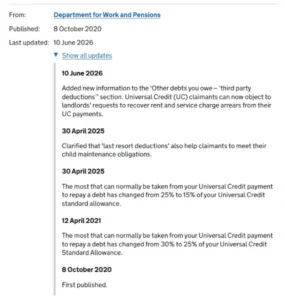
GOV.UK confirms that the normal maximum amount taken from Universal Credit to repay debts was reduced from 25% to 15% of the standard allowance.
Based on the official 2026/27 Universal Credit rates, the normal 15% maximum is:
| Claim Type | 2026/27 Standard Allowance | 15% Maximum |
|---|---|---|
| Single And Under 25 | £338.58 | £50.79 |
| Single And 25 Or Over | £424.90 | £63.74 |
| Couple Both Under 25 | £528.34 | £79.25 |
| Couple One Or Both 25 Or Over | £666.97 | £100.05 |
These figures apply to the standard allowance rather than your entire Universal Credit award. The official 2026/27 benefit rates list the overall maximum deduction rate at 15% and give the corresponding amounts shown above.
The amount actually taken can be lower. Your Universal Credit statement should show deductions separately so you can identify what is reducing the payment.
There are also circumstances where deductions connected with essential obligations can operate differently.
GOV.UK describes certain payments as last-resort deductions, and deductions for ongoing utilities do not count towards the normal 15% maximum in the same way.
Can You Challenge a Universal Credit Overpayment?
Yes. If you believe the DWP has calculated an overpayment incorrectly, you can ask for the decision to be reconsidered.
Start by checking the overpayment notice carefully. Compare the dates, earnings, household information, savings and other circumstances used in the calculation with your own records.
You can usually request a mandatory reconsideration if you believe a benefit decision is wrong.
GOV.UK says this normally needs to be requested within one month of the decision date, although a late request may sometimes be accepted where there is a good reason.
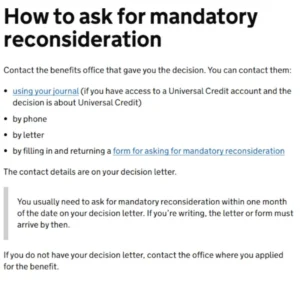
GOV.UK explains how to request a mandatory reconsideration and confirms that it normally needs to be requested within one month of the benefit decision.
For Universal Credit, you can request reconsideration through your journal, by phone or in writing. Explain precisely which part of the decision you believe is wrong and provide supporting evidence where possible.
Useful evidence may include payslips, bank statements, tenancy documents, evidence showing when a change was reported or copies of previous journal messages.
If the mandatory reconsideration does not change the decision, there may then be a right to appeal to an independent tribunal.
One important point is that Universal Credit overpayment recovery does not normally stop simply because a mandatory reconsideration has been requested.
DWP’s recovery guidance specifically distinguishes Universal Credit from some other benefits on this issue.
This makes it important to challenge an incorrect decision promptly while also contacting DWP if the ongoing deduction is causing financial difficulty.
What If You Cannot Afford to Pay Universal Credit Back?
You should not ignore a debt simply because the repayment amount is unaffordable. Contact Universal Credit or DWP Debt Management and explain your financial circumstances.
Depending on the type of debt and your circumstances, the DWP may consider reducing the recovery rate or temporarily suspending recovery.
If deductions are already reducing your monthly Universal Credit, check your statement first to establish exactly what is being recovered. This is especially useful because a reduced payment can also result from earnings, sanctions, advances and other deductions.
For example, someone whose payment has fallen after failing to meet a claimant commitment may actually be dealing with a sanction rather than an overpayment.
Checking how to tell if you have been sanctioned on Universal Credit can help distinguish the two situations.
Can Universal Credit Debt Be Written Off?
It is possible for DWP to waive some or all of a debt, but waivers are exceptional rather than automatic.
DWP guidance says waiver may be considered where there are specific and compelling circumstances. Factors can include serious and prolonged financial hardship, welfare concerns and other exceptional circumstances.
A person does not have to still be receiving benefits for a waiver to be considered. Evidence of income, expenditure, debts and the effect that recovery is having on the household may be required.
A waiver should therefore not be treated as the normal solution for an unaffordable deduction. A reduced repayment rate or temporary suspension may be more appropriate where financial circumstances could improve.
What Happens If You Stop Claiming Universal Credit?
Stopping Universal Credit does not automatically cancel an outstanding advance or overpayment.
If you move onto another benefit, deductions may continue from that benefit where the rules allow it.
If you stop receiving benefits altogether, DWP Debt Management can contact you to arrange another repayment method.
This could involve making regular payments directly rather than having the money deducted from Universal Credit.
For a Universal Credit advance, GOV.UK specifically states that the advance still has to be repaid after the claim ends.
If you move to another benefit, deductions will usually continue. If you leave benefits, DWP Debt Management can arrange repayment.
If no suitable repayment arrangement is made and the person is employed through PAYE, DWP can in some cases use a Direct Earnings Attachment.
This allows DWP to instruct an employer to make deductions directly from wages.
DWP guidance says a Direct Earnings Attachment is normally considered where a debtor has failed to agree an appropriate voluntary repayment arrangement, rather than simply because someone genuinely cannot afford to pay.
Private-sector debt collection or civil recovery can also be considered in some cases where a person is no longer receiving benefits and has failed to arrange repayment.
How Are Universal Credit Advances Repaid?
Universal Credit advances are loans rather than normal benefit payments, so they normally have to be paid back.
A first-payment advance is usually repaid through deductions beginning with your first Universal Credit payment. GOV.UK currently states that this type of advance is normally repaid within 24 months.
For example, if you borrowed £240 and repaid it evenly over 24 months, the basic repayment would be £10 a month.
Different advance types can have different repayment arrangements.
A first-payment advance can currently be delayed for up to three months if you cannot afford the repayments.
GOV.UK also states that an advance for unexpected costs can normally be repaid over 24 months, with a repayment delay of up to six months available where the repayments are unaffordable.
You should use your Universal Credit journal, speak to your work coach or contact Universal Credit if an advance repayment is causing financial difficulty.
What Happens If You Do Not Repay Universal Credit?
Ignoring a recoverable Universal Credit debt does not normally make it disappear.
DWP can use different recovery methods depending on whether you are receiving benefits, employed or have agreed a repayment arrangement.
Possible action can include:
- Benefit Deductions: Money can be recovered from ongoing Universal Credit or certain other benefits.
- Direct Repayments: DWP Debt Management may agree monthly payments where benefits are no longer being received.
- Direct Earnings Attachment: Deductions can be taken through PAYE wages in qualifying cases.
- Debt Collection: Some unpaid debts can be referred to a private-sector debt collection agency.
- Civil Recovery: Court action can be considered where appropriate.
DWP guidance makes an important distinction between someone who will not pay and someone who cannot afford to pay.
Direct Earnings Attachments and private debt collection are primarily described as measures for cases where appropriate repayment arrangements have not been made.
Financial hardship can instead justify considering a lower rate, temporary suspension or, in exceptional cases, waiver.
If you receive an overpayment letter, do not assume the amount is automatically correct. Check what period the debt relates to, how it was calculated and whether the circumstances used by DWP match your records.
Challenge the decision promptly if something is wrong, or contact Debt Management if the debt is correct but the repayment amount is unaffordable.
Frequently Asked Questions
Do You Have to Pay Back Normal Universal Credit?
No. Ordinary Universal Credit that you were correctly entitled to receive is a benefit and does not normally need to be repaid. Repayment applies when there is an advance, overpayment or another recoverable debt.
Do You Have to Repay Universal Credit If DWP Made a Mistake?
A Universal Credit overpayment can generally still be recoverable even when it resulted from DWP error. You can challenge the amount or underlying decision if you believe it is incorrect.
How Much Can DWP Take From Universal Credit for Debt?
The normal overall maximum is currently 15% of your Universal Credit standard allowance. Certain last-resort deductions and other exceptions can operate differently.
Can You Refuse to Pay Back a Universal Credit Overpayment?
You can challenge an overpayment if you believe the decision or calculation is wrong, but simply refusing to repay a valid recoverable debt can lead to further recovery action.
Can DWP Take Universal Credit Debt From Your Wages?
Yes. If you are employed through PAYE and do not have an appropriate repayment arrangement, DWP may be able to use a Direct Earnings Attachment to recover the debt from your wages.
Does Universal Credit Debt Affect Your Credit Score?
A normal Universal Credit overpayment or deduction does not automatically appear like a conventional consumer loan on your credit report. However, separate court action or other unpaid financial commitments may have different consequences.
Can Universal Credit Debt Be Written Off?
DWP can waive some or all of a debt in exceptional circumstances, but this is not automatic. Strong evidence of serious hardship, welfare concerns or other compelling circumstances may be required.