
Can Both Parents Claim Universal Credit If Separated? Rules and Payments in 2026
Yes, both parents can claim Universal Credit if they are separated, provided each meets the eligibility requirements.
They can receive separate monthly payments based on their individual income, savings, housing costs and circumstances.
However, only one parent can receive the Universal Credit child element for the same child at a time, even when both parents share custody equally.
The Department for Work and Pensions (DWP) determines which parent has main responsibility for the child.
If the parents have more than one child, each parent may receive the child element for a different child, provided the DWP accepts their individual caring responsibilities.
How Does Universal Credit Work When Parents Separate?
When parents separate, Universal Credit treats them as individual claimants rather than a couple, provided they are no longer living together as partners.
Both parents can receive financial support independently, although their entitlement depends on their personal circumstances.
The main eligibility conditions include:
- Age Requirements: Claimants generally need to be aged 18 or over and below State Pension age, although exceptions apply.
- Income Requirements: Earnings and other income can reduce Universal Credit payments.
- Savings Limits: Claimants generally need to have £16,000 or less in savings and other countable capital.
- Residency Requirements: Claimants must satisfy the applicable UK residence and immigration conditions.
- Household Circumstances: Housing costs, children and caring responsibilities can affect the amount awarded.
A parent can qualify even if the other parent is employed or earns a high salary, because their finances are normally assessed separately after a permanent separation.
The wider Universal Credit eligibility requirements also apply to separated parents, including those who work part-time or have irregular earnings.
Importantly, separating does not automatically mean that both parents will receive the same amount.
One parent may qualify for additional child-related support while the other receives only the standard allowance and any other elements they qualify for.
Can Both Parents Claim Universal Credit With 50/50 Shared Custody?
Both parents can claim Universal Credit individually when they share custody equally. However, equal custody does not allow both parents to receive the child element for the same child.
Under Regulation 4 of the Universal Credit Regulations 2013, where a child normally lives with two people who are not a couple, only one can be treated as having main responsibility for that child.
Parents can jointly nominate who has main responsibility, but the DWP can make its own decision if they disagree or the nomination does not reflect the actual arrangements.
For example, if a child spends three or four nights a week with each parent, both adults may qualify for Universal Credit separately. However, the child element will only be included in one parent’s award.
The DWP may consider:
- Living Arrangements: Where the child normally lives and how time is divided between households.
- Daily Care: Who usually manages meals, clothing, school arrangements and medical appointments.
- Financial Responsibilities: Which parent meets the child’s everyday needs.
- Child Benefit Records: Who receives Child Benefit, alongside other relevant evidence.
- Care Agreements: Documents showing how parental responsibilities are divided.
Equal overnight care is not the only factor. The DWP may consider the overall arrangements when deciding which parent has main responsibility.
If parents have two or more children, it is possible for each parent to be treated as mainly responsible for a different child. However, this must reflect their actual living and caring arrangements rather than simply an agreement to divide benefit payments.
Which Parent Receives the Universal Credit Child Element?
The Universal Credit child element is normally paid to the parent whom the DWP recognises as mainly responsible for the child.
The decision depends on where the child normally lives and who takes responsibility for their daily care.
Receiving Child Benefit can provide useful evidence, but it does not automatically guarantee entitlement to the Universal Credit child element.
For example, one parent may receive Child Benefit while the other provides most of the child’s daily care. The DWP can examine the actual circumstances before deciding who should receive the UC child element.
How Does the DWP Determine Main Carer Status?
When responsibility is disputed, the DWP may request information about the child’s living arrangements and care.
Useful evidence can include:
- School Records: Information showing the child’s usual address and main contact.
- Medical Records: Details of the parent arranging appointments and managing healthcare.
- Parenting Agreements: Written arrangements explaining where the child lives.
- Childcare Records: Documents identifying who regularly arranges care.
- Financial Evidence: Records showing responsibility for everyday essentials.
- Care Schedules: Calendars identifying overnight stays and regular routines.
A court order or written agreement may support a claim, but the DWP considers the actual arrangements rather than relying solely on the document.
Parents should provide accurate information and avoid claiming the same child element in separate Universal Credit awards.
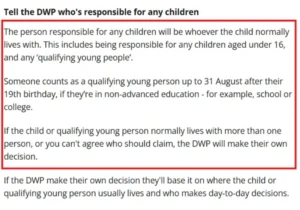
Citizens Advice explains how the DWP determines responsibility for children when parents separate or disagree over who should claim.
How Much Universal Credit Can Separated Parents Receive in 2026/27?
Universal Credit payments depend on each parent’s age, income, savings, housing costs and responsibility for children.
The DWP calculates the award using a standard allowance and any additional elements for which the claimant qualifies.
The following monthly rates apply during the 2026/27 financial year.
| Universal Credit Component | Monthly Amount |
|---|---|
| Single Claimant Under 25 | £338.58 |
| Single Claimant Aged 25 Or Over | £424.90 |
| First Child Born Before 6 April 2017 | £351.88 |
| First Child Born On Or After 6 April 2017 | £303.94 |
| Each Additional Eligible Child | £303.94 |
These figures represent the relevant standard amounts before deductions, earnings adjustments or any applicable benefit cap.
From 6 April 2026, the two-child limit was removed for Universal Credit assessment periods beginning on or after that date.
This means eligible households can receive the child element for third and subsequent qualifying children, subject to the remaining rules.
Example of Universal Credit Payments for Separated Parents
Consider two separated parents, both aged 30, who share responsibility for one child born after April 2017.
The DWP recognises Parent A as mainly responsible for the child.
| Universal Credit Component | Parent A | Parent B |
|---|---|---|
| Standard Allowance | £424.90 | £424.90 |
| Child Element | £303.94 | £0 |
| Total Before Adjustments | £728.84 | £424.90 |
Both parents may qualify for separate Universal Credit payments, but only Parent A receives the child element.
This example assumes neither parent has earnings or other income affecting the award, and neither receives additional housing, disability or caring-related elements.
The actual amount may differ considerably. Further details about how much Universal Credit is payable in 2026/27 help explain how the standard allowance combines with additional support.
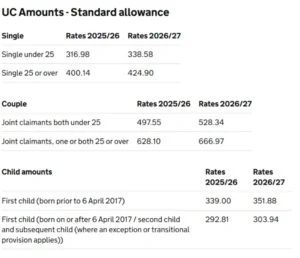
The DWP’s official 2026/27 benefit rates confirm the monthly Universal Credit standard allowances and child element amounts.
How Do Child Benefit and Child Maintenance Affect Universal Credit?
Child Benefit and child maintenance are separate from Universal Credit, although they can affect a family’s overall financial circumstances differently.
Child Benefit
Only one parent can receive Child Benefit for the same child. Where parents share custody, they may agree who should receive it, or HMRC may decide if there is a disagreement.
Parents with more than one child can potentially receive Child Benefit for different children.
Child Benefit does not normally reduce Universal Credit directly, although it can be relevant when the benefit cap applies.
Child Maintenance
Child maintenance is money paid towards a child’s upbringing, usually by the parent who does not have the child’s main day-to-day care.
Child maintenance received is not counted as income when calculating Universal Credit.
For example, a parent receiving £250 a month in child maintenance will not have their Universal Credit reduced by £250 simply because they receive that maintenance.
However, Universal Credit deductions can sometimes be made where a claimant owes child maintenance.
Parents should therefore distinguish between Child Benefit, child maintenance and the Universal Credit child element rather than treating them as the same payment.
Can Separated Parents Claim Housing and Childcare Support?
Separated parents may qualify for additional Universal Credit support towards housing and childcare expenses.
However, the amount depends on each parent’s individual circumstances and eligibility.
Housing Support
Both parents may qualify for housing costs through their separate Universal Credit claims if they are responsible for eligible rent payments.
The amount depends on several factors:
- Rental Costs: The eligible rent payable for each property.
- Property Type: Whether the claimant lives in private rented accommodation or social housing.
- Bedroom Entitlement: The number of bedrooms recognised under the relevant housing rules.
- Local Housing Allowance: The applicable limit for private tenants.
- Household Circumstances: Income, other residents and applicable reductions.
A parent whose child stays overnight but for whom they are not treated as mainly responsible does not automatically qualify for an additional bedroom because of those visits.
For private tenants, Universal Credit rent support for a single person depends on the relevant Local Housing Allowance rate and individual housing circumstances.
Childcare Support
Eligible working parents can receive help with registered childcare costs through Universal Credit.
During 2026/27, Universal Credit can reimburse up to 85% of qualifying childcare expenses, subject to these monthly maximums:
| Eligible Childcare Costs | Maximum Monthly Support |
|---|---|
| One Child | £1,071.09 |
| Two Or More Children | £1,836.16 |
Entitlement depends on the claimant meeting the childcare rules, including being responsible for the child and satisfying the relevant work conditions.
Shared custody alone does not establish entitlement to childcare support. Parents must report the actual arrangements and eligible costs to the DWP.
What Happens to a Joint Universal Credit Claim After Separation?
When a couple receiving Universal Credit jointly separates, they must inform the DWP about their relationship change.
Their existing Universal Credit claims can continue as single claims, with payments recalculated according to their individual circumstances.
This may affect the standard allowance, housing support, child elements and work-related requirements.
How to Report Separation to the DWP?
Parents should take the following steps:
- Sign In to Universal Credit: Access the online account used for the existing claim.
- Report the Relationship Change: Select the relevant change-of-circumstances option and update the details about living with a partner.
- Update Household Information: Report changes to addresses, rent, income, savings and responsibility for children.
- Provide Supporting Evidence: Supply any information requested by the DWP.
- Check the Revised Statement: Review the next payment breakdown to make sure the changes have been recorded correctly.
Parents should report separation as soon as it happens. Delayed reporting can lead to incorrect payments and recoverable overpayments.
A permanent separation can also be recognised where former partners temporarily remain at the same address, provided they genuinely live as separate households.
The DWP may examine whether they manage their finances independently and are no longer living together as a couple.
A reported separation does not normally mean an existing claimant must restart the entire Universal Credit application process. However, changes to household circumstances may require further checks before the revised award is calculated.
Where the separation creates essential one-off expenses, such as replacing necessary household furniture, an eligible claimant may also consider applying for a Universal Credit Budgeting Advance.
This is repayable financial assistance rather than an additional benefit payment.
What Happens if Both Parents Disagree Over Universal Credit Entitlement?
Disagreements can arise when both parents believe they have main responsibility for their child.
If they cannot reach an agreement, the DWP can decide which parent should be treated as responsible for Universal Credit purposes.
The department may consider where the child normally lives, who manages everyday care and the supporting evidence available.
Parents who disagree with the decision can request that it be reconsidered.
The usual process involves:
- Check the Decision: Review the DWP’s explanation of which parent has been recognised as responsible.
- Gather Evidence: Collect relevant school records, childcare arrangements and other documents.
- Request Mandatory Reconsideration: Usually ask the DWP to review the decision within one month of the date on the decision notice.
- Explain the Disagreement: Identify the information believed to be incorrect or incomplete.
- Consider an Appeal: If the decision remains unchanged, a tribunal appeal may be available.
Parents should not assume that receiving Child Benefit or having a particular custody arrangement automatically guarantees a successful challenge.
They should provide evidence showing why the DWP’s assessment does not reflect their actual responsibilities.
Changes in custody must also be reported promptly. If a child begins living mainly with the other parent, the child element may need to be reassessed.
Temporary visits or ordinary school-holiday arrangements do not necessarily change which parent has main responsibility.
Conclusion
Both separated parents can claim Universal Credit independently if they meet the eligibility requirements. However, only one parent can normally receive the child element for the same child, even where custody is shared equally.
The DWP considers the child’s actual living arrangements and parental responsibilities when deciding entitlement. Child Benefit, childcare support and housing costs are assessed under their own rules.
Parents should report separation and changes in custody promptly, provide accurate information and review their Universal Credit statements to avoid incorrect payments.
Frequently Asked Questions
Can Both Separated Parents Claim Universal Credit at the Same Time?
Yes. Both parents can receive separate Universal Credit payments if they qualify individually, but only one can receive the child element for the same child.
Can Both Parents Receive the Child Element With 50/50 Custody?
No. Equal shared custody does not permit two child element payments for the same child. The DWP recognises one parent as having main responsibility.
Can Both Parents Claim Universal Credit for Different Children?
Yes. Each parent may receive a child element for a different child if the DWP accepts that each has main responsibility for the child included in their claim.
Does Child Maintenance Reduce Universal Credit Payments?
No. Child maintenance received is not counted as income for Universal Credit, although deductions may be made if a claimant owes maintenance.
Can Separated Parents Claim Universal Credit While Living Together?
Yes, if they have permanently separated and genuinely live as separate households. The DWP may request evidence that they are no longer living as a couple.
Can One Parent Claim Universal Credit if the Other Parent Works?
Yes. After separation, the other parent’s earnings do not normally affect an individual’s Universal Credit entitlement, although their own income and circumstances still matter.
What Happens if Custody Arrangements Change?
Parents must report relevant changes to the DWP promptly. The department may reassess which parent has main responsibility and adjust the child-related payments accordingly.