DWP Universal Credit Deductions: How Much Can Be Taken?
If your Universal Credit payment seems lower than expected, DWP Universal Credit deductions could be the reason.
These deductions are automatic reductions taken from your monthly benefit payment to repay debts such as advance payments, rent arrears, council tax, utility bills, or benefit overpayments.
Since recent reforms, most deductions are capped at 15% of your standard allowance, although exceptions still apply in some cases.
Key highlights:
- Most deductions are limited to 15% of your standard allowance
- DWP can deduct money for up to three debts at once
- Rent arrears and utility debts can sometimes exceed the cap
- Around 3.3 million households currently face deductions
- You can ask the DWP to reduce repayments if they cause hardship
Understanding how these deductions work can help you manage your finances more effectively and avoid unexpected reductions in your monthly Universal Credit payment.
What Are DWP Universal Credit Deductions?
DWP Universal Credit deductions are amounts taken automatically from your monthly payment to repay debts owed to the DWP, HMRC, councils, landlords or utility providers.
Common deductions include Universal Credit advances, budgeting advances, benefit overpayments, rent arrears and fuel bills. Some are voluntary, while others can be enforced by the DWP.
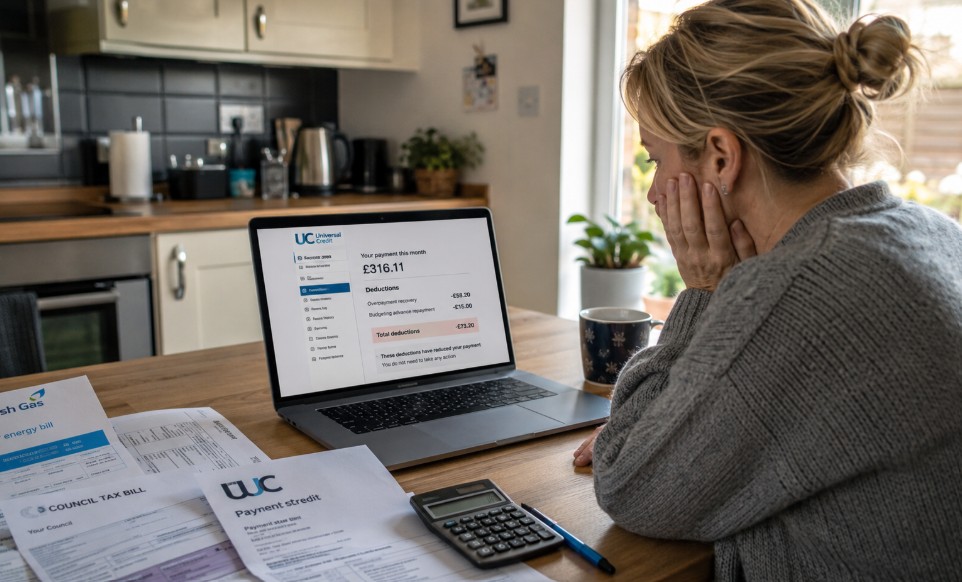
These deductions usually appear in your Universal Credit online journal and monthly statement, showing how much was taken and the reason for it.
“The Fair Repayment Rate was introduced to reduce pressure on low-income households while ensuring debts can still be repaid sustainably,” a DWP spokesperson previously stated following the 15% deduction cap reforms.
How Much Can DWP Take from Your Universal Credit?
If you receive Universal Credit, the DWP can take money from your monthly payment to repay certain debts. These deductions usually appear in your Universal Credit statement or online journal.
In most cases, deductions are limited by the Fair Repayment Rate. In 2026, the maximum amount normally taken for debt repayments is capped at 15% of your standard Universal Credit allowance.
The exact amount depends on:
- Your age
- Single or couple claim
- Type of debt
- Emergency deductions
- Number of debts being repaid
Some deductions may be paid directly to landlords, councils, utility companies or government departments before the remaining payment reaches your bank account.
Current Universal Credit Deduction Limits in 2026
In 2026, most Universal Credit debt deductions cannot exceed 15% of the standard allowance. This was reduced from the previous 25% cap under the Government’s Fair Repayment Rate reforms.
The 15% cap usually applies to:
- Advance payments
- Budgeting advances
- Benefit overpayments
- Tax credit overpayments
- Some third-party debts
However, some deductions can go above this limit, especially for:
- Rent arrears
- Gas or electricity arrears
- Water charges
- Court fines
- Child maintenance
These are treated as priority debts because they may help prevent eviction, utility disconnection or legal action.
Under DWP guidance:
- Up to 3 third-party debts can be deducted at once
- Most third-party deductions are 5% per debt
- Rent arrears deductions can be 10% to 15%
If deductions leave you unable to afford essentials, you can contact the DWP and ask for a lower repayment rate, although approval is not guaranteed.
Maximum Amounts for Single Claimants and Couples
The maximum deduction depends on your age and household type.
| Claimant Type | Approximate Maximum Monthly Deduction |
|---|---|
| Single claimant under 25 | Up to £51 |
| Single claimant aged 25 or over | Up to £64 |
| Couple both under 25 | Up to £79 |
| Couple where one or both are 25+ | Up to £100 |
These figures mainly apply to standard Universal Credit debt repayments. If you also owe rent arrears, utility debts or court fines, total deductions may be higher.
Many claimants only notice deductions when their payment is lower than expected, so it is important to check the payment breakdown in your Universal Credit account.
DWP statistics show that millions of households have deductions each month, with advance repayments among the most common reasons.
Why Has Money Been Deducted from Your Universal Credit Payment?

There are several reasons why money may be taken from your Universal Credit payment. Some deductions relate directly to government debt, while others involve third-party creditors.
Common reasons for deductions include:
- Universal Credit advance repayments
- Budgeting advance repayments
- Benefit overpayments
- Rent arrears
- Council Tax arrears
- Gas or electricity debts
- Water bill arrears
- Child maintenance payments
- Court fines
DWP deductions are taken in priority order, usually covering housing and energy debts first. Claimants can check the payment section of their Universal Credit account for details. In February 2026, around 46% of Universal Credit households had at least one deduction.
“Deductions for debt repayments routinely reduce the amount households actually receive, increasing hardship and financial instability,” Policy in Practice warned in its recent analysis of Universal Credit deductions.
Although deductions are intended to recover debts responsibly, welfare organisations continue to argue that some households are still struggling to cope financially.
What Is the 15% Universal Credit Deduction Cap?
The 15% deduction cap limits how much can normally be taken from your standard allowance for debt repayments. This policy replaced the previous 25% cap following government reforms aimed at reducing pressure on low-income households.
The change was introduced under the Fair Repayment Rate scheme after concerns that larger deductions were pushing claimants deeper into poverty.
Key details about the deduction cap:
| Rule | Current Position |
|---|---|
| Standard debt deduction cap | 15% of standard allowance |
| Previous deduction cap | 25% |
| Maximum third-party debts | 3 at once |
| Standard deduction per debt | 5% |
| Rent arrears deductions | 10%–15% |
The government estimated that reducing the cap would leave many households hundreds of pounds better off annually.
However, campaigners argue that even a 15% deduction can create budgeting problems for households already struggling with rent, food, and energy costs.
The deduction cap applies mainly to debt repayments, but some special deductions can exceed this amount under certain circumstances.
Can Universal Credit Deductions Go Above the 15% Cap?

Yes, Universal Credit deductions can go above the 15% cap in some cases. While most debt repayments are limited to 15% of your standard allowance, the DWP may take extra deductions for priority debts.
These can include rent arrears, utility debts, court fines or child maintenance. Such deductions are used to help prevent eviction, disconnection or legal action, but they can still leave households with lower monthly income.
Rent Arrears and Eviction Prevention Rules
Rent arrears are one of the main reasons deductions can go above the 15% cap. If you fall behind on rent, your landlord can request third-party deductions from your Universal Credit.
Under DWP guidance:
- 10% to 15% can be deducted for rent arrears
- Payments are usually sent directly to the landlord
- Deductions may continue until arrears are cleared
The DWP may approve this if it helps prevent eviction or homelessness. However, if other deductions are also running, your monthly Universal Credit payment can become much lower than expected. If this causes hardship, contact the DWP or your landlord to discuss repayment options.
Fuel Direct and Utility Bill Deductions
Universal Credit deductions can exceed the normal cap if you owe money for essential utilities. Through the Fuel Direct scheme, deductions can be taken to repay gas arrears, electricity arrears or water debts. An extra amount may also be deducted to cover ongoing usage.
These payments are sent directly to the supplier to help prevent disconnection, further debt or court action.
Because Fuel Direct is treated differently from standard debt repayments, it can push total deductions above the 15% cap. To stop it, contact the office managing your claim.
Exceptions to the Fair Repayment Rate
The Fair Repayment Rate reduced the standard deduction cap from 25% to 15%, but some exceptions still allow higher deductions.
These may include:
- Rent arrears
- Gas and electricity debts
- Water charges
- Court fines
- Child maintenance
- Fraud penalties or sanctions
The DWP prioritises these because they are linked to essential costs or legal obligations. As a result, some households may still lose a large part of their Universal Credit each month, even after the cap was reduced.
How Do Third-Party Deductions from Universal Credit Work?
Third-party deductions happen when organisations you owe money to ask the DWP to recover debts directly from your Universal Credit payment.
These organisations can include landlords, councils, water suppliers, and energy companies. The DWP normally agrees to deductions only after other attempts to recover the debt have failed.
For standard debts, around 5% of your standard allowance may be deducted per debt. Rent arrears usually involve higher deductions of between 10% and 15%.
Unlike ordinary debt collection, third-party deductions are intended to protect essential services and prevent situations such as eviction or disconnection.
Real-life Claimant Insights:
I recently spoke to a claimant named Sarah from Manchester who noticed her Universal Credit payment had dropped by nearly £70 per month. After checking her online journal, she discovered deductions had been added for a budgeting advance and rent arrears.
Although the repayments helped reduce her debt, the lower monthly payment made it harder for her to manage food and energy costs.
After contacting the DWP, she successfully arranged a lower repayment rate for the advance payment, easing some of the pressure.
Cases like this show why checking your Universal Credit statement regularly is essential.
How Many Debts Can Be Taken from Universal Credit at Once?

The DWP can normally deduct money for up to three third-party debts simultaneously. This means several repayments may be active at the same time, significantly reducing the amount you receive each month.
Priority order for deductions:
- Rent arrears
- Child maintenance
- Court fines
- Utility debts
- Council Tax arrears
- Benefit overpayments
The priority system exists because some debts carry more immediate risks than others. Housing and energy debts are often treated urgently because they affect essential living conditions.
Even with the 15% cap, multiple deductions can still place pressure on household finances. Claimants moving from legacy benefits onto Universal Credit have contributed to the growing number of deductions seen across the UK.
Where Can You See Your Universal Credit Deductions?
You can check your deductions through your Universal Credit online account. Each monthly statement normally includes a full breakdown showing:
- The type of deduction
- The amount taken
- Who received the payment
- The remaining balance, if applicable
If deductions are added or changed, you may also receive a message in your Universal Credit journal or a letter explaining the adjustment.
Checking your account regularly is important because deductions can sometimes change without much warning, especially when new debts are added.
Reviewing your payment statement each month helps you spot errors early and understand exactly why your Universal Credit payment has changed.
What Can You Do If Universal Credit Deductions Are Too High?
If deductions are causing financial hardship, you may be able to ask the DWP to reduce the repayment amount. While reductions are not guaranteed, claimants experiencing severe difficulty may receive temporary adjustments.
You can also contact the organisation receiving the deductions, especially for utility or rent arrears, to discuss alternative payment arrangements.
Ways to manage deductions:
- Contact the DWP through your journal
- Request a lower repayment rate
- Ask for a budgeting review
- Speak to debt advice charities
- Negotiate directly with creditors
Some energy suppliers may also stop Fuel Direct deductions if alternative payment arrangements are agreed.
If you believe the deduction decision is wrong, you can request a mandatory reconsideration.
Can You Challenge or Reduce DWP Universal Credit Deductions?

Claimants have the right to challenge certain deduction decisions if they believe the amount is incorrect or unaffordable.
In many cases, the first step is requesting a mandatory reconsideration through the DWP. This asks the department to review the decision again.
You may also need to provide evidence showing why the deductions are causing hardship. Supporting information could include rent statements, utility bills, or evidence of financial vulnerability.
Although deductions can sometimes be reduced temporarily, the DWP usually expects debts to continue being repaid over time.
Seeking support from Citizens Advice or debt charities can also help you understand your options and negotiate repayment arrangements more effectively.
How Do Universal Credit Deductions Affect UK Claimants?
The number of claimants affected by deductions has risen sharply in recent years. According to recent DWP figures, approximately 3.3 million households experienced at least one deduction during February 2026.
The increase has largely been linked to the continued migration from legacy benefits onto Universal Credit.
Many charities and welfare experts argue that deductions can create budgeting instability, particularly for households already dealing with rising food, rent, and energy costs.
Despite the government’s reduction of the deduction cap from 25% to 15%, concerns remain over how deductions affect vulnerable claimants, especially families with children and disabled households.
For many people, deductions reduce the gap between surviving financially and falling into further debt.
Final Thoughts on DWP Universal Credit Deductions
DWP Universal Credit deductions affect many households across Britain. Although the 15% cap has reduced repayment pressure for some claimants, deductions for debts, rent arrears or utilities can still lower monthly payments.
Understanding why deductions happen and what support is available can help. If deductions cause hardship, contact the DWP or seek independent debt advice.
FAQs About DWP Universal Credit Deductions
Why has DWP taken money from my Universal Credit?
The DWP may deduct money to repay advances, overpayments, rent arrears, utility debts, court fines, or child maintenance.
What is the maximum Universal Credit deduction?
Most deductions are capped at 15% of your standard allowance, although some exceptions can exceed this limit.
Can Universal Credit deductions be stopped?
Some deductions can be reduced or stopped temporarily if they cause severe financial hardship, but approval is not guaranteed.
Can rent arrears be deducted from Universal Credit?
Yes, landlords can request deductions for rent arrears, usually between 10% and 15% of your standard allowance.
What does Fuel Direct mean on Universal Credit?
Fuel Direct allows gas or electricity debts and ongoing energy bills to be paid directly from your Universal Credit payment.
Can DWP take money for old benefit overpayments?
Yes, the DWP can recover previous benefit overpayments through deductions from your Universal Credit payment.
How do I ask DWP to lower my deductions?
You can contact the DWP through your Universal Credit journal or phone service and explain your financial situation.
Can I appeal a Universal Credit deduction?
Yes, you can request a mandatory reconsideration if you believe the deduction is incorrect or unfair.