
Can I Get Free Glasses On Universal Credit? NHS Eligibility, Voucher Values And How To Claim
Yes, you can get help towards the cost of glasses or contact lenses while receiving Universal Credit, but Universal Credit does not automatically make every claimant eligible for free glasses.
You must meet the NHS earnings conditions. If you qualify, you can receive a free NHS sight test and an NHS optical voucher towards your glasses or contact lenses.
Your glasses will only be completely free if their cost is covered by the value of your voucher.
This distinction is important because a free NHS eye test and a voucher towards glasses are separate forms of support.
A voucher may cover the entire price of a basic pair of glasses, while someone choosing frames or lenses costing more than the voucher will need to pay the difference.
Universal Credit claimants should also check their earnings for the relevant assessment period before claiming.
The amount of Universal Credit you receive can change when your wages change, and understanding how much you can earn and still get Universal Credit can help distinguish the general UC earnings rules from the separate NHS health-cost thresholds.
Who Qualifies For NHS Optical Help While Receiving Universal Credit?
Receiving Universal Credit by itself is not enough. The NHS looks at your household’s take-home pay during your most recent completed Universal Credit assessment period.
You normally qualify for help with NHS health costs if you are receiving a Universal Credit payment and your take-home pay was:
| Universal Credit Circumstances | Maximum Take-Home Pay |
|---|---|
| No Child Element And No LCW Or LCWRA | £435 Or Less |
| Universal Credit Includes A Child Element | £935 Or Less |
| You Or Your Partner Have LCW | £935 Or Less |
| You Or Your Partner Have LCWRA | £935 Or Less |
The £935 threshold can therefore apply to households receiving a child element or where the claimant or their partner has Limited Capability for Work or Limited Capability for Work and Work-Related Activity.
Someone with health-related Universal Credit support may also want to understand how Limited Capability for Work affects Universal Credit, as LCW and LCWRA can affect different parts of a UC claim even though both can be relevant to the higher NHS health-cost earnings threshold.
For a couple making a joint Universal Credit claim, the NHS does not apply a separate threshold to each partner. Their combined household take-home pay is considered against the applicable £435 or £935 limit.
Dependants aged 19 or under who are included in a qualifying Universal Credit award can also receive the same help with NHS health costs.
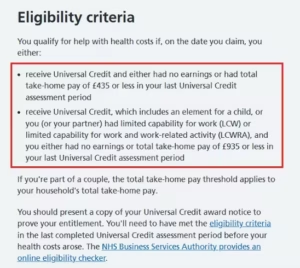
The NHS confirms the £435 and £935 Universal Credit take-home pay limits used to determine eligibility for help with health costs.
How Is Take-Home Pay Checked?
Your relevant earnings are shown on your Universal Credit statement as “Your total take-home pay for this period”.
The NHS generally looks at the most recently completed assessment period before the health cost arose. You can also check the “Other support you may be able to get” section of your Universal Credit statement.
These figures should not be confused with the Universal Credit work allowance or Administrative Earnings Threshold. They are separate NHS eligibility limits specifically used to determine entitlement to help with healthcare costs.
If your earnings vary from month to month, your entitlement can also change. NHSBSA specifically advises claimants whose working hours or income change to check their eligibility regularly.
How Much Can You Get Towards Glasses On Universal Credit?
Qualifying claimants receive an NHS optical voucher rather than a fixed “Universal Credit glasses payment”.
There are currently 10 main optical voucher values. The amount depends primarily on the strength and type of lenses prescribed. Current values range from £42.40 to £233.56.
| NHS Voucher | Type | Maximum Value |
|---|---|---|
| A | Single Vision | £42.40 |
| B | Single Vision | £64.26 |
| C | Single Vision | £94.14 |
| D | Single Vision | £212.40 |
| E | Bifocal Or Varifocal | £73.10 |
| F | Bifocal Or Varifocal | £92.72 |
| G | Bifocal Or Varifocal | £120.48 |
| H | Bifocal Or Varifocal | £233.56 |
| I | Hospital Eye Service | £217.58 |
| J | Hospital Eye Service | £61.77 Per Lens |
Your optician will determine the voucher that applies from your prescription.
If clinical reasons mean you require certain tints, prisms or other qualifying additions, supplements may also increase the voucher value.
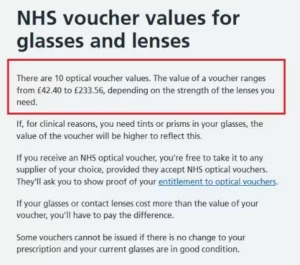
The NHS lists the current optical voucher values, which range from £42.40 to £233.56 depending on the lenses prescribed.
When Are Glasses Completely Free?
An NHS voucher does not guarantee that every pair of glasses in an optician will be free.
If your chosen glasses cost the same as or less than your voucher value, the voucher can cover the full cost. If the glasses cost more, you will normally pay the difference yourself.
For example, if your voucher is worth £64.26 and you choose qualifying glasses costing £60, you would generally have no remaining glasses cost. If you choose a pair costing £100, you would need to cover the amount above the voucher value.
You are also free to use an NHS optical voucher with another supplier that accepts NHS vouchers. You do not have to purchase glasses from the same optician that conducted your eye test.
How To Claim Free Glasses On Universal Credit?
There is not normally a separate Universal Credit application specifically for glasses.
Instead, you should establish that you meet the NHS eligibility rules and provide evidence when obtaining your NHS sight test or optical voucher.
The usual process is:
- Check Your Earnings: Look at the take-home pay shown for your latest completed Universal Credit assessment period
- Check Your UC Elements: Confirm whether your award includes a child element, LCW or LCWRA if you are relying on the £935 threshold
- Take Your Award Notice: The NHS advises Universal Credit claimants to provide a copy of their award notice as evidence
- Tell the Optician: Let the optical practice know that you believe you qualify for NHS help with optical costs
- Complete Your Sight Test: Your prescription will determine the appropriate voucher value
- Choose Your Glasses: Apply the voucher to glasses or contact lenses and pay any amount above its value
The NHS states that an optical voucher can be issued immediately after the eye test where the patient can prove their entitlement.
The higher health-cost threshold is particularly relevant to families whose award contains a child element. Wider Universal Credit child element rates from April 2026 affect the amount included in UC awards, but the separate NHS optical eligibility test continues to use the £435 and £935 take-home pay thresholds.
What Happens Once Your Eligibility Is Confirmed?
Once the optician confirms your entitlement, the next stage depends on the results of your sight test and prescription.
After the eye examination, you must be given your optical prescription or a statement confirming that you have been referred for further assessment. Where you can prove that you qualify for an NHS optical voucher, the voucher can also be issued.
The voucher can then be put towards:
- Prescription Glasses: Including qualifying single-vision, bifocal or varifocal lenses
- Contact Lenses: Where the optical voucher is used towards eligible contact lenses
- Clinical Supplements: Additional amounts may apply where prescribed tints or prisms are clinically necessary
- Complex Lenses: Separate complex-lens support may apply where the prescription meets the NHS criteria
The NHS defines complex lenses as lenses with a power of -10/+10 dioptres or more, or prism-controlled bifocal lenses. Current complex-lens contributions are £15.81 for single-vision lenses and £40.57 for bifocals.
Your voucher does not restrict you to expensive or premium frames. Choosing a pair priced within the voucher allowance is the most straightforward way to avoid having to make an additional payment.
Timeline Of Universal Credit Help With NHS Optical Costs
Universal Credit-related optical help has existed since the early rollout of Universal Credit, although the eligibility rules have changed.
| Date | Development |
|---|---|
| 29 April 2013 | Universal Credit recipients were brought into NHS sight-test and optical-voucher eligibility arrangements during the early UC rollout |
| December 2016 | The NHS implemented the £435 and £935 earnings thresholds for Universal Credit claimants |
| April 2026 | Updated NHS help-with-health-costs guidance continued to use the £435 and £935 thresholds |
| October 2026 | The thresholds remain in use for qualifying Universal Credit claimants |
Government material from 2013 confirms that Universal Credit was added to optical eligibility arrangements, while later DWP guidance states that the current earnings thresholds were implemented in December 2016.
Universal Credit itself has continued to change substantially since then.
The wider changes to Universal Credit in 2026 include changes to payment rates and child-related and health-related support, but these should not be confused with the NHS optical voucher rules.
Current Rules And Future Plans
As of 30 October 2026, current NHS and NHSBSA guidance continues to state the £435 and £935 limits. There is no current official announcement confirming a replacement threshold or the end of optical support for qualifying Universal Credit claimants.
The scheme should therefore be treated as ongoing under the current rules unless the Department of Health and Social Care or NHS updates the eligibility criteria.
Because Universal Credit policy and NHS charges can change separately, claimants should check their current assessment-period earnings and NHS eligibility at the point they need treatment rather than relying on entitlement from a previous month.
What If You Do Not Meet The Universal Credit Income Limit?
Being above the £435 or £935 earnings limit does not necessarily mean you have no way of receiving help with optical costs.
The NHS Low Income Scheme can provide support based on your wider financial circumstances.
An HC2 certificate gives full help with qualifying NHS health costs, while an HC3 certificate can provide partial help. People named on a valid HC3 certificate may receive help towards the cost of glasses, contact lenses or a private sight test.
This can be particularly important for working Universal Credit claimants whose earnings are just above the automatic UC health-cost threshold.
If you are unsure whether you qualify, NHS guidance says you should normally pay the charge and keep the required receipt rather than incorrectly declaring an exemption. If your entitlement is later confirmed, a refund may be possible.
Can You Get Help With Replacement Glasses Or A Refund?
There are separate rules for repairing or replacing lost or damaged glasses.
Children under 16 can receive an NHS optical repair or replacement voucher where qualifying glasses or contact lenses are lost or damaged.
For someone aged 16 or over, NHS help with repair or replacement normally requires both of the following:
- Voucher Eligibility: You must qualify for an NHS optical voucher
- Illness-Related Damage: An illness must have caused the loss or damage
The glasses or contact lenses must also not already be covered by a warranty, insurance policy or after-sales service.
Can You Claim Back Money If You Already Paid?
If you paid for a sight test, glasses or contact lenses before discovering that you qualified for help, you may be able to claim a refund using an HC5(O) form.
For England, the claim normally needs to be received within three months of the payment date. For a glasses or contact-lens refund, you will generally need your receipt and optical prescription.
The maximum refund for glasses or contact lenses is normally limited to the NHS voucher value that corresponds with your prescription rather than automatically refunding the entire amount you spent.
Free Eye Tests Vs Free Glasses On Universal Credit
A free NHS sight test and help buying glasses are two separate entitlements.
If your Universal Credit circumstances meet the NHS criteria, you can qualify for a free NHS-funded sight test and an optical voucher towards glasses or contact lenses.
Someone can also qualify for a free NHS sight test for reasons unrelated to Universal Credit.
In England, this includes people aged 60 or over, children under 16, some young people in full-time education, people diagnosed with diabetes or glaucoma and certain other eligible groups.
However, qualifying for a free eye test because of age or a medical condition does not automatically mean the NHS will pay for your glasses. Optical-voucher eligibility is assessed separately.
This is why the answer to “Can I get free glasses on Universal Credit?” depends on both the claimant’s Universal Credit circumstances and the cost of the glasses compared with the NHS voucher value.
Conclusion
Universal Credit claimants can get valuable help with eye care, but simply receiving Universal Credit does not automatically guarantee completely free glasses.
The key figures are £435 of take-home pay or less, or £935 or less where the Universal Credit award includes a child element or the claimant or their partner has LCW or LCWRA. Couples are assessed using their combined take-home pay.
If eligible, you can receive a free NHS sight test and an optical voucher worth between £42.40 and £233.56 under the main voucher categories.
Glasses can be completely free when their cost falls within the voucher value, while more expensive options require you to pay the difference.
Claimants who do not meet the UC earnings test may still be able to get support through the NHS Low Income Scheme, and anyone who has already paid should check quickly whether an HC5(O) refund is available because the normal claim window is three months.
FAQs
Do You Automatically Get Free Glasses On Universal Credit?
No. Universal Credit does not automatically provide free glasses. You must meet the NHS earnings conditions and qualify for an optical voucher.
What Is The Universal Credit Earnings Limit For Free Glasses?
The limit is generally £435 or less in take-home pay, rising to £935 or less where UC includes a child element or you or your partner have LCW or LCWRA.
How Much Is An NHS Glasses Voucher In 2026?
The 10 main NHS optical voucher values currently range from £42.40 to £233.56 depending on the strength and type of prescription.
Can I Get Free Glasses At Specsavers On Universal Credit?
If the optician accepts NHS optical vouchers and you meet the NHS eligibility conditions, you can use your voucher towards qualifying glasses. Whether there is anything left to pay depends on the price of the glasses compared with your voucher value.
Can My Child Get Free Glasses If I Receive Universal Credit?
Dependants aged 19 or under who are included in a qualifying Universal Credit award can receive the same help with NHS health costs. Children may also qualify independently through age or education rules.
Can I Get A Refund If I Already Paid For My Glasses?
Potentially. In England, an HC5(O) optical refund claim normally needs to be received within three months of the date you paid, together with the required receipt and prescription.
Can I Still Get Help If My Universal Credit Earnings Are Above The Limit?
Yes, potentially. You may qualify through the NHS Low Income Scheme, which can provide full help through an HC2 certificate or partial help through an HC3 certificate depending on your financial circumstances.