
If I Pay Off My Budgeting Advance – Can I Get Another One on Universal Credit in 2026?
Yes, you can apply for another Budgeting Advance on Universal Credit after fully repaying your previous one.
The Department for Work and Pensions (DWP) allows eligible claimants to receive another advance when they need financial assistance with an essential one-off expense.
However, paying off your existing advance does not automatically guarantee another payment. You must still meet the current eligibility requirements, including the earnings limits, qualifying benefit rules and repayment affordability checks.
Under the 2026 rules, claimants can borrow between £100 and £812, depending on their household circumstances and financial needs. Only one Budgeting Advance can remain outstanding at a time.
How Soon Can I Get Another Budgeting Advance After Paying It Off?
There is no published fixed waiting period between fully repaying one Budgeting Advance and applying for another.
This means you may be able to request another advance as soon as the DWP has recorded your previous loan as fully repaid.
However, the time at which your final repayment is processed and reflected in your Universal Credit records may affect when your new application can be assessed.
Before applying again, consider the following:
- Outstanding Balance: Your previous Budgeting Advance must be fully repaid.
- Updated Repayment Records: The DWP needs to recognise that your previous advance has been cleared.
- Current Eligibility: You must satisfy the requirements applying to your new application.
- Qualifying Expenses: The money must be needed for an eligible one-off expense.
- Repayment Affordability: The DWP must consider whether you can afford another advance.
For example, if you have £80 remaining on a previous advance and make a final repayment, you can contact Universal Credit to confirm that the balance has been cleared before requesting another.
Paying early may remove the outstanding-advance restriction, but it does not automatically establish eligibility.
What Are the Eligibility Requirements for a Second Budgeting Advance?
The DWP applies the standard Budgeting Advance eligibility conditions when considering another application.
Claimants must generally have received Universal Credit, Employment and Support Allowance or Pension Credit for at least six months.
However, this six-month requirement may not apply if the money is needed to start a new job or remain in employment.
Other important eligibility conditions include:
- Previous Repayments: Any earlier Budgeting Advance must be fully repaid.
- Six-Month Earnings: A single claimant must not have earned more than £2,600 during the preceding six months.
- Couples’ Earnings: Couples must not have earned more than £3,600 combined during the preceding six months.
- Financial Need: The requested advance must cover an eligible one-off expense.
- Repayment Ability: Existing financial commitments and available resources can influence the amount offered.
Savings and other capital can also affect how much you receive. Having more than £1,000 in capital may reduce the amount available.
For example, an applicant with £1,200 in relevant capital may have their potential advance reduced by £200.
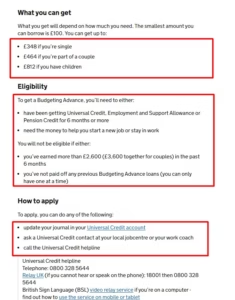
Official GOV.UK guidance confirms the six-month eligibility requirement, earnings thresholds and rule preventing claimants from having two outstanding Budgeting Advances.
How Can I Pay Off My Universal Credit Budgeting Advance Early?
A Budgeting Advance is an interest-free loan, normally repaid through deductions from monthly Universal Credit payments.
Under the current rules, repayment is usually spread over 24 months. However, claimants who want to clear their outstanding balance sooner can contact Universal Credit to discuss early repayment.
Follow these steps:
- Check Your Outstanding Balance: Review your Universal Credit payment statements and contact Universal Credit to confirm the amount still owed.
- Request Early Repayment: Explain through your online journal or to a Universal Credit adviser that you want to pay the remaining balance.
- Confirm the Payment Method: Ask for the correct instructions and reference details before making a payment.
- Make the Final Payment: Pay the agreed amount using the method confirmed by Universal Credit.
- Verify the Repayment: Ask for confirmation that the previous advance is fully cleared before requesting another.
The GOV.UK benefit debt repayment service cannot be used to manage advances from a current Universal Credit claim. Claimants should contact Universal Credit directly instead.
It is also important to consider whether paying off the balance early will leave enough money for rent, food and other essentials.
How Do Repayments Affect Universal Credit Payments?
Budgeting Advance repayments are normally deducted automatically from future Universal Credit payments.
For example, a £240 Budgeting Advance repaid over 24 months would normally involve deductions of £10 per month.
The usual overall limit for deductions to repay debts is 15% of the Universal Credit standard allowance, although certain last-resort deductions can exceed this limit.
Understanding how Universal Credit payments are calculated and adjusted can help claimants work out how repayments affect their household income.
If repayments are causing financial hardship, claimants can ask for Budgeting Advance deductions to be delayed for up to six months. Approval depends on their circumstances.
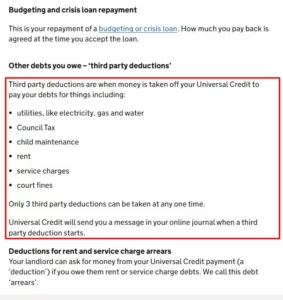
DWP guidance confirms that most debt deductions are normally limited to 15% of the Universal Credit standard allowance, subject to specified exceptions.
How Long Does It Take for a Budgeting Advance Repayment to Clear?
The time required for a final Budgeting Advance repayment to appear as cleared can vary depending on the payment method and administrative processing.
There is no universally published DWP processing period guaranteeing that every early repayment will be recorded within a particular number of working days.
Claimants should avoid assuming that making the payment means their account will immediately show a zero balance.
If the repayment is not reflected in your records:
- Check the Payment Date: Confirm when the payment was made.
- Keep Payment Evidence: Retain the transaction reference or payment confirmation.
- Contact Universal Credit: Ask whether the payment has been allocated to your previous advance.
- Request Balance Confirmation: Confirm that no outstanding amount remains.
- Avoid Duplicate Payments: Check the balance before making another repayment.
This is especially important if you want to apply for another advance immediately.
How Can I Check If My Previous Budgeting Advance Is Fully Repaid?
Your Universal Credit account is the first place to check whether repayments are still being deducted.
You can find information about deductions through your online payment statements.
To check:
- Sign in to your Universal Credit account.
- Open the Payments section.
- Select your latest payment statement.
- Find the section labelled What We Take Off – Deductions.
- Review any repayments relating to advances.
- Contact Universal Credit if you need confirmation of the remaining balance.
A deduction disappearing from a monthly statement does not necessarily provide real-time confirmation that a recent early repayment has cleared.
If you cannot establish the balance, use your Universal Credit journal or contact the helpline on 0800 328 5644.
Can I Get Another Budgeting Advance If My Circumstances Have Not Changed?
Yes, another Budgeting Advance may still be possible even if your household circumstances have not changed.
The DWP does not specify that claimants must experience a major change in their personal circumstances every time they request another Budgeting Advance.
However, you must have an eligible reason for requesting the new payment.
For example, someone who previously received an advance to replace a broken fridge might later need financial support to repair their home.
A further application would be assessed according to the new expense, current financial position and applicable eligibility rules.
A previous approval does not guarantee another one, even when your income and household circumstances remain similar.
How Much Can I Borrow With a Second Budgeting Advance?
The amount available for a second Budgeting Advance depends on your household composition, essential financial needs and repayment affordability.
The maximum amounts available in 2026 are:
Household Circumstances Maximum Budgeting Advance
Single Claimant Without Children £348
Couple Without Children £464
Claimant or Couple With Children £812
Minimum Borrowing Amount £100
These limits apply to a new application and do not mean that the amounts from every previous advance are added together into a lifetime borrowing limit.
For example, a single claimant who previously borrowed and fully repaid £300 is not automatically restricted to borrowing only £48 on their next application.
Their new request is assessed against the current maximum of £348 and other eligibility conditions.
However, receiving the maximum amount is not guaranteed.
The DWP may offer a lower amount depending on the expense, available capital and ability to repay.
It is also important to understand that borrowing money through a Budgeting Advance does not permanently increase your benefit entitlement.
Your regular Universal Credit payment amount will usually be reduced by repayments until the new advance is cleared.
What Expenses Can I Use Another Budgeting Advance For?
A Budgeting Advance is intended to help claimants meet qualifying one-off costs that they cannot reasonably cover using their regular income.
The DWP distinguishes between essential occasional expenses and everyday living costs.
Expenses a Budgeting Advance May Cover Expenses It Cannot Cover
Essential Household Furniture Regular Food Shopping
Replacement Washing Machine or Cooker Monthly Gas and Electricity Bills
Essential Clothing and Footwear Regular Rent Payments
Home Repairs and Security Repayment of Existing Debts
Funeral Expenses General Ongoing Living Costs
Tenancy Deposits and Removal Costs Credit Card Debt Repayments
Certain Essential Family Items Routine Household Bills
For example, a claimant whose washing machine has broken down may qualify for financial assistance towards a replacement.
However, requesting another advance simply to cover normal grocery shopping or monthly electricity bills would not meet the scheme’s intended purpose.
When making an application, explain what needs to be purchased, why it is necessary and how much it will cost.
What Are the Reasons a Universal Credit Budgeting Advance Could Be Cancelled?
A Budgeting Advance application may be withdrawn, stopped before payment or refused where the required conditions have not been met.
However, cancellation and refusal are not the same thing, and there is no single published GOV.UK list establishing automatic cancellation rules for every circumstance.
Potential situations where an application or proposed payment may not proceed include:
- Application Withdrawal: The claimant asks to withdraw the request before payment.
- Eligibility Problems: New information establishes that the applicant does not meet the rules.
- Outstanding Previous Advance: An earlier Budgeting Advance has not been fully repaid.
- Incorrect Application Details: Information provided is inaccurate or needs verification.
- Non-Qualifying Expense: The requested payment is intended for costs excluded by the scheme.
- Financial Assessment Problems: The DWP determines that the requested advance is not affordable.
These circumstances may result in refusal or further checks rather than cancellation of an existing loan.
Importantly, an advance that has already been paid does not simply disappear because a Universal Credit claim closes.
Any outstanding balance normally remains repayable.
Why Would Universal Credit Refuse Another Budgeting Advance After Repayment?
Paying off an existing Budgeting Advance removes one important eligibility barrier, but it does not guarantee that another application will be successful.
The DWP may refuse a second advance for several reasons.
1. Earnings Exceed the Permitted Threshold
Applicants whose earnings exceed the relevant six-month threshold cannot qualify under the standard Budgeting Advance rules.
2. Insufficient Qualifying Benefit History
Claimants who have not received a qualifying benefit for six months may be ineligible unless the advance is needed to start or remain in work.
3. The Requested Expense Is Not Eligible
Applications involving food, ongoing rent, utility bills or existing debt repayments do not meet the normal permitted uses.
4. An Earlier Advance Is Still Outstanding
Even a small unpaid balance can prevent another Budgeting Advance from being awarded.
5. Insufficient Repayment Affordability
Existing deductions, debts and financial responsibilities may affect whether a further advance is considered affordable.
If your application is refused, ask Universal Credit to explain the reason and check whether the information used in the assessment is correct.
What Happens If My Budgeting Advance Is Cancelled or Refused?
The outcome depends on whether you are dealing with an application that has not yet been paid or an advance already received.
If a new application is refused, you will not receive the requested payment. If you believe the decision was made using incorrect information, you can ask the DWP to review it.
A Budgeting Advance refusal generally does not carry the same right to appeal to an independent tribunal as many other Universal Credit entitlement decisions.
If the request is withdrawn before payment, clarify its status with Universal Credit.
If an advance has already been paid, closing your Universal Credit claim does not cancel the repayment obligation.
Claimants who stop receiving benefits may be contacted by DWP Debt Management to arrange repayment.
Where deductions are causing hardship, it may be possible to request a temporary repayment delay rather than trying to cancel an existing loan.
How Do I Apply for Another Budgeting Advance on Universal Credit?
Once your previous Budgeting Advance has been fully repaid, you can request a new payment through the usual Universal Credit contact channels.
There are three main application methods.
Apply Through Your Universal Credit Journal
Sign in to your Universal Credit account and explain that you want to apply for another Budgeting Advance.
Include the amount requested, the purpose of the payment and confirmation that your previous advance has been repaid.
Contact Your Work Coach or Jobcentre
You can speak with your work coach or a Universal Credit contact at your local Jobcentre Plus office.
They can explain the application process and the information needed to assess your request.
Call the Universal Credit Helpline
You can contact Universal Credit directly:
Contact Method Details
Universal Credit Helpline 0800 328 5644
Welsh Language Helpline 0800 328 1744
Relay UK 18001 then 0800 328 5644
Opening Hours Monday to Friday, 8 am to 6 pm
Applicants should be prepared to provide details of the expense, household circumstances, savings, earnings and existing repayments.
The process for applying for a Budgeting Advance on Universal Credit is generally the same whether it is your first application or a later request.
What Should I Do If I Cannot Get Another Budgeting Advance?
If another Budgeting Advance is unavailable, there may be other ways to obtain help with essential expenses.
The most appropriate alternative depends on the type of financial difficulty and where you live.
Local Authority Crisis Support
Councils and devolved administrations may provide emergency assistance with essential items and living costs. Schemes and eligibility requirements vary by location.
Charitable Grants
Organisations such as Turn2us can help claimants search for charitable grants based on their household circumstances and needs.
Food Banks and Essential Support
Food banks and local community organisations may help households facing difficulties purchasing food or other essentials.
Some households may also qualify for local assistance through supermarket voucher support schemes, depending on the arrangements available in their area.
Repayment Hardship Assistance
If existing Budgeting Advance deductions are creating financial hardship, contact Universal Credit about the possibility of delaying repayments for up to six months.
Other Universal Credit Support
Different forms of Universal Credit financial assistance may be available depending on the reason for needing help.
These include support when waiting for an initial payment, certain work-related expenses and hardship payments in qualifying circumstances.
A different form of support should not be treated as automatically available simply because another Budgeting Advance has been refused.
Conclusion
Paying off your Budgeting Advance can allow you to apply for another Universal Credit Budgeting Advance, provided the previous balance has been fully cleared and you meet the current eligibility requirements.
There is no published fixed waiting period between repayment and a new application, but the DWP must recognise that the earlier advance has been repaid.
Before requesting another payment, check your six-month earnings, confirm the expense qualifies and consider whether future deductions will be affordable.
If your application is refused, you can ask for the decision to be reviewed or explore other financial support.
Frequently Asked Questions
Can I Apply for Another Budgeting Advance Immediately After Paying Off My First?
Yes, you may be able to apply once the DWP has recorded your previous advance as fully repaid. There is no published fixed waiting period, but you must meet the eligibility requirements.
Does Paying Off a Budgeting Advance Guarantee Another One?
No. Full repayment removes the outstanding-advance restriction, but the DWP must still assess your earnings, financial circumstances, eligible expense and repayment affordability.
Can I Get Another Budgeting Advance If I Still Have Other Universal Credit Deductions?
Possibly. Other deductions do not automatically prevent an application, but they may affect the DWP’s assessment of whether another advance is affordable.
How Many Budgeting Advances Can I Receive on Universal Credit?
There is no published lifetime numerical limit. However, only one Budgeting Advance can remain outstanding at a time, and every new application must meet the eligibility rules.
Can I Get a Second Budgeting Advance for the Same Expense?
A second application must involve a genuine eligible one-off need. The rules do not impose a universal ban on similar expense categories, but approval is not guaranteed.
Will Paying Off My Budgeting Advance Early Affect My Universal Credit Payments?
Once the balance has cleared, deductions for that advance should stop. Other deductions or changes in entitlement may still affect your monthly Universal Credit payment.
Can I Apply Again If My Second Budgeting Advance Is Cancelled or Refused?
You can ask Universal Credit to look at a refusal again and provide corrected or additional information. You may also make another application when you meet the eligibility conditions.