
DWP Targeted Case Reviews AI: New Universal Credit Checks, Risks and Claimant Rights
The Department for Work and Pensions (DWP) has confirmed that artificial intelligence is being tested to help identify Universal Credit claims that may require further investigation.
The development forms part of the department’s Targeted Case Review (TCR) programme, which checks whether benefit recipients are receiving the correct payments.
The announcement has raised questions about how DWP Targeted Case Reviews AI technology identifies claims, whether automated systems could unfairly target vulnerable people, and what the changes mean for Universal Credit payments.
In a letter dated 26 October 2026, DWP Permanent Secretary Dame Sarah Healey confirmed that a limited live trial of a machine learning model was underway.
The technology helps prioritise potential reviews, but officials remain responsible for decisions affecting claimants.
Our analysis of the government’s announcement, official review statistics and independent research explains how the system works, which claimants could be affected, and what to do if the DWP contacts you.
What Are DWP Targeted Case Reviews and Why Is AI Being Introduced?
Targeted Case Reviews are investigations into the accuracy of existing Universal Credit awards. Introduced in 2022, the programme identifies potential overpayments, underpayments and incorrect information affecting benefit entitlement.
The DWP uses these reviews to examine cases where the information held about someone’s financial or personal circumstances may be inaccurate.
The new AI trial is intended to improve how the department prioritises cases for human review rather than automatically identifying claimants as fraudulent.
The trial has three principal objectives:
- Improve the identification of Universal Credit claims potentially containing errors.
- Help review agents concentrate on cases requiring additional verification.
- Reduce unnecessary expenditure while protecting legitimate benefit entitlement.
DWP officials believe advanced analytics could make the programme more effective. However, the department has acknowledged that the model must undergo evaluation before its wider usefulness can be established.
People wondering why their benefits are being checked more frequently can also examine why the DWP reviews claims, including how routine checks differ from suspected fraud investigations.
How Does the New DWP AI Case Review System Work?
The technology uses machine learning, a form of artificial intelligence that analyses information and identifies statistical patterns.
Instead of requiring employees to manually prioritise every claim from a large caseload, the model helps identify cases that may warrant closer examination.
However, the DWP has not publicly disclosed the specific data fields, risk indicators or model features used in the trial.
The distinction between recommendations produced by technology and decisions made by officials is particularly important.
| Review activity | AI model | DWP staff |
|---|---|---|
| Identify potential cases for review | Supports prioritisation | Consider which cases proceed |
| Examine submitted evidence | Not the final decision-maker | Review relevant information |
| Decide benefit entitlement | No | Yes |
| Change Universal Credit payments | No | Yes |
| Suspend or close a claim | No | Yes |
| Determine review outcome | No | Yes |
According to the DWP’s official letter to Parliament, human assessment remains central throughout the process.
This means an AI-generated indication of risk does not automatically establish that someone has committed benefit fraud.
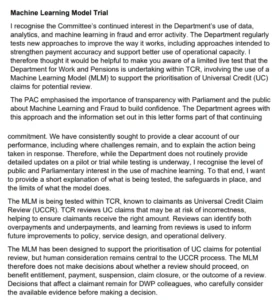
DWP confirms that its AI trial supports the prioritisation of Universal Credit reviews but does not independently determine benefit entitlement.
How Many Universal Credit Claims Are Being Reviewed?
The scale of the Targeted Case Review programme has increased considerably since its introduction.
According to the DWP’s October 2026 parliamentary correspondence, the department completed almost 1.2 million reviews during the 2025–26 financial year, identifying approximately 250,000 incorrect awards and delivering £1.1 billion in estimated expenditure savings.
Earlier official figures show how quickly the programme expanded.
| Financial year | Completed reviews | Claims with inaccuracies |
|---|---|---|
| 2022–23 | 24,180 | 7,630 |
| 2023–24 | 202,130 | 48,180 |
| 2024–25 | 923,630 | 187,800 |
| Total to March 2025 | 1,149,940 | 243,600 |
Across those three years, approximately 21% of reviewed claims contained inaccuracies. The remaining 79% had no identified payment error through the review process.
Importantly, these statistics concern the wider review programme, not the accuracy of the newly introduced AI model.
The DWP has not yet published sufficient results to establish whether the AI trial improves case selection or reduces unnecessary reviews.
Who Could Be Selected for a DWP AI Targeted Case Review?
Anyone receiving Universal Credit could potentially have their existing claim reviewed.
Reviews generally concern whether the information used to calculate entitlement remains accurate. The department may examine matters such as savings, employment income, housing costs and household composition.
However, it would be misleading to claim that the new AI model automatically targets people with particular characteristics.
The DWP has not disclosed the exact criteria used by its new machine learning system.
Areas commonly examined during Universal Credit reviews include:
- Undeclared or incorrectly reported savings.
- Changes in earnings or self-employment income.
- Changes to rent or housing arrangements.
- Changes involving a partner or household members.
- Missing information about childcare or other relevant circumstances.
These are established eligibility considerations, not confirmed AI risk indicators.
Claimants concerned about their financial information should understand what counts as savings for Universal Credit.
Equally, receiving a review notification does not necessarily mean the DWP suspects deliberate wrongdoing.
What Happens When the DWP Selects Your Universal Credit Claim?
The government’s existing Universal Credit review procedure remains in place during the AI trial.
According to official GOV.UK guidance on Universal Credit reviews, a DWP review agent contacts the claimant through their online Universal Credit journal.
The process normally involves the following stages.
- Review notification: A message appears in your journal explaining that your claim is being reviewed.
- Document request: You are asked to provide bank statements and potentially other evidence concerning your circumstances.
- Telephone appointment: A review agent discusses your claim, documents and any information requiring clarification.
- Evidence assessment: DWP staff check whether your recorded circumstances match the evidence provided.
- Review outcome: Your payments may remain unchanged, increase or decrease depending on the findings.
Claimants should provide complete, unedited documents as requested. If statements are unavailable or an appointment cannot be attended, they should contact their review agent promptly.
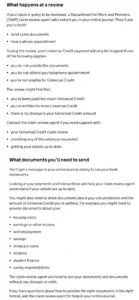
GOV.UK explains the documents, appointments and potential outcomes involved in a Universal Credit claim review.
Can DWP AI Stop or Reduce Your Universal Credit Payments?
The new machine learning model cannot independently reduce, suspend or terminate Universal Credit entitlement.
Dame Sarah Healey explicitly confirmed that decisions affecting claimants remain the responsibility of DWP employees.
Nevertheless, an ordinary review can still result in payment changes when the evidence establishes that the claimant is receiving an incorrect amount.
Under existing procedures, payments may be stopped where a claimant fails to provide requested documents, misses their required telephone appointment or is found ineligible.
It is also important to distinguish three different outcomes:
| Outcome | What it means |
|---|---|
| Payment correction | DWP changes an award after identifying incorrect entitlement |
| Payment suspension | Payment is temporarily stopped under applicable review procedures |
| Benefit sanction | A separate reduction generally linked to failure to meet claimant responsibilities without good reason |
An AI referral does not automatically trigger any of these outcomes.
If an overpayment is identified, the DWP may seek recovery, including where the error was unintentional. Claimants can find additional guidance on what happens when the DWP overpays benefits by mistake.
Why Are Experts Concerned About Bias in DWP Artificial Intelligence?
The introduction of machine learning has prompted questions about discrimination, transparency and the reliability of automated risk assessments.
Mark Bennett, a law lecturer at the University of Liverpool associated with the Administrative Fairness Lab, has raised concerns about the system.
Bennett described the introduction of machine learning into case selection as a potential significant change and questioned whether the DWP could prevent problems experienced with earlier technology.
His concerns relate partly to a separate AI system used to assess Universal Credit advance requests. Previous assessments identified disparities affecting certain claimant groups, including differences associated with age, disability and nationality.
These findings do not establish that the new Targeted Case Review model is discriminatory. They demonstrate why independent scrutiny is important.
The risks are particularly significant when incorrect referrals place additional administrative pressure on vulnerable claimants.
Research by the Administrative Fairness Lab, drawing on 35 interviews with claimants and welfare advisers, also identified stress, difficulties providing evidence and challenges disputing decisions within the wider review programme.
Jed Meers, the lab’s co-director, has highlighted the burden placed on people whose claims ultimately prove accurate.
The central issue is whether improved fraud detection can be achieved without generating disproportionate scrutiny of legitimate claimants.
Is the New AI Trial Connected to DWP Bank Account Checks?
Although both initiatives involve identifying possible benefit inaccuracies, the AI Targeted Case Review trial and the DWP’s bank eligibility verification measures are separate mechanisms.
The AI trial helps prioritise Universal Credit claims for potential examination.
Bank eligibility verification arrangements involve financial institutions identifying specified indicators relevant to benefit eligibility and providing permitted information to the DWP.
A separate Universal Credit Advances machine learning system is also used to identify potentially high-risk advance requests.
These activities should not be treated as one integrated AI system without supporting evidence.
The distinction matters because the information available, statutory safeguards and operational purposes differ between processes.
For a fuller explanation of financial information checks, see whether the DWP can check your bank account without permission.
How Can Universal Credit Claimants Prepare for a Targeted Case Review?
The most practical response is to ensure that information held by the DWP is accurate and that relevant documents can be obtained when requested.
Claimants should regularly check their Universal Credit journal and report changes in circumstances when they occur.
Useful preparation includes maintaining accessible bank statements, recording earnings accurately and keeping documentation relating to rent, savings or household changes.
Those with disabilities, health conditions or communication difficulties should explain any additional support they require.
The DWP has confirmed that reasonable adjustments and existing protections for vulnerable claimants continue during the AI trial.
Claimants should also verify unexpected messages through their official Universal Credit account rather than supplying sensitive financial information through unfamiliar links.
An automated recommendation should never be interpreted as a formal finding of fraud.
Can You Challenge a Decision Made Following an AI-Selected Review?
Yes. The introduction of machine learning does not remove existing rights to challenge benefit decisions.
If a review results in an incorrect entitlement calculation, overpayment decision or another challengeable decision, claimants can generally request a mandatory reconsideration.
This usually needs to be requested within one month of the decision, although late requests may be accepted in certain circumstances.
Where appropriate, claimants can subsequently appeal to an independent tribunal after receiving the mandatory reconsideration outcome.
When disputing a decision, explain precisely what is incorrect and provide supporting evidence.
It is useful to retain copies of journal messages, financial records and correspondence with review agents.
Claimants experiencing difficulties should consider assistance from Citizens Advice or an independent welfare rights adviser.
The fact that AI may have helped prioritise a review does not, by itself, demonstrate that the resulting benefit decision was unlawful.
What Happens Next With DWP Targeted Case Reviews AI?
The DWP has not announced a confirmed timetable for nationwide deployment of the new model.
Its October 2026 letter states that the limited live trial will be monitored for effectiveness, proportionality and equality impacts.
The department has also acknowledged that alternative approaches may be considered if the technology does not perform as expected.
Separately, Targeted Case Review operations are moving towards fully in-house delivery under DWP management.
The important unanswered questions concern the accuracy of AI-generated referrals, how frequently legitimate claims are selected, and whether the technology improves outcomes without increasing unnecessary administrative burdens.
Further government reporting will be needed before those questions can be answered conclusively.
Frequently Asked Questions
Is DWP using AI to investigate Universal Credit claimants?
Yes. The DWP is conducting a limited live trial of machine learning to help prioritise Universal Credit claims for potential review. Human officials remain responsible for individual decisions.
Does a DWP targeted case review mean I am suspected of fraud?
No. A review checks whether benefit entitlement is accurate. An incorrect payment can result from an administrative mistake or an unreported change rather than deliberate fraud.
Can DWP AI automatically cancel my Universal Credit?
No. The new model does not independently cancel claims, suspend payments or determine benefit entitlement. Such decisions remain subject to human consideration.
Will everyone receiving Universal Credit face an AI review?
Not necessarily. Universal Credit claims can be reviewed, but the DWP has not announced that every claimant will undergo screening through the new AI trial.
What should I do if I receive a Universal Credit review message?
Read the notification in your official journal, provide the requested documents and attend the appointment. Contact your review agent if you need additional time or assistance.
Can I refuse a Universal Credit review because AI was involved?
The use of AI does not automatically remove your obligation to cooperate with a lawful claim review. Failure to provide required information could affect payments. Seek advice if you believe a request is unreasonable.