
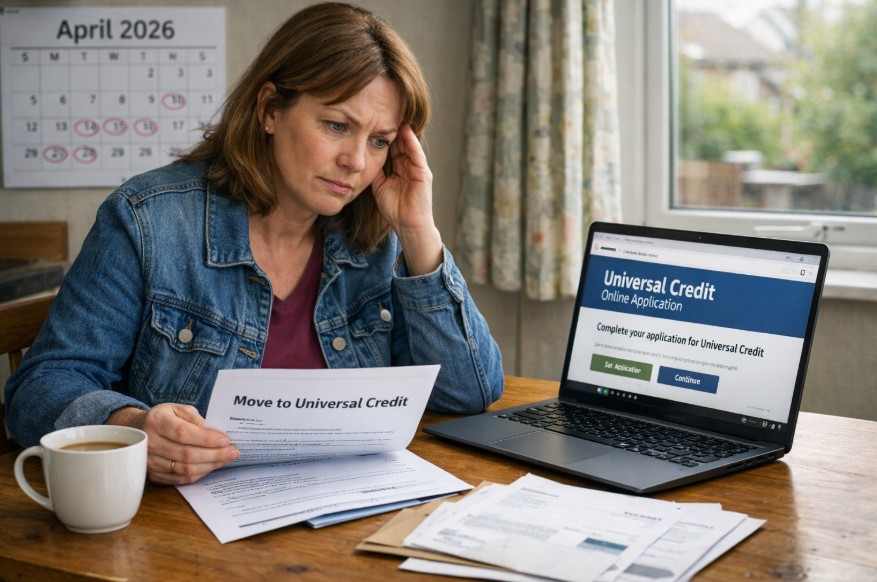
DWP Stops Two Benefits: What Action Is Needed to Move to Universal Credit?
The Department for Work and Pensions (DWP) has ended Income Support and income-related Jobseeker’s Allowance (JSA) from 1 April 2026.
If you receive either benefit, you must move to Universal Credit to continue getting support, and the switch is not automatic.
You need to follow the instructions in your migration notice and submit a new claim before the deadline, usually within three months. Missing this deadline could stop your payments and you may lose transitional protection.
Key points:
- Income Support and income-related JSA have now ended
- You must apply for Universal Credit yourself
- The migration notice usually gives you three months
- Missing the deadline may stop your payments
- Transitional protection may be lost if you apply late
Act on your migration notice as soon as possible to avoid losing your benefits.
Why Has DWP Stopped Two Benefits in April 2026?

The DWP stopped Income Support and income-related JSA as part of the government’s long-term plan to replace older “legacy benefits” with Universal Credit.
The move began in 2022 and has already transferred more than 1.9 million claimants onto the new system.
Universal Credit is now intended to be the main benefit for working-age people. The government says it is simpler, easier to manage online and more closely linked to employment support.
“Our Move to Universal Credit campaign has been successful in moving over 1.9 million people from legacy benefits to the modern Universal Credit system,” said Sir Stephen Timms, Minister for Social Security and Disability.
The two benefits closed on 1 April 2026 because the DWP believes they no longer fit the modern benefits system. Around 135,000 people claiming Income Support or income-related JSA have already been moved to Universal Credit.
These older benefits have now ended, and anyone affected will need to move to Universal Credit, which is becoming the main support system for working-age people in the UK.
Which Two Benefits Have Stopped and Who Is Affected?
The two benefits that have ended are Income Support and income-related Jobseeker’s Allowance. You are affected if you were still receiving either of these payments before April 2026.
The following groups are most likely to have received a migration notice:
- People claiming Income Support
- People receiving income-related JSA
- Claimants still on other legacy benefits who have not yet moved
- Households receiving linked support such as Housing Benefit
Not everyone is affected in the same way. Some people claiming income-related Employment and Support Allowance (ESA) or Housing Benefit have been given extra time because they may need more support.
What Action Is Needed to Move to Universal Credit?

You must make a completely new claim for Universal Credit. The DWP will not transfer you automatically, even if you already receive another benefit.
Step-by-Step Process to Move to Universal Credit
When you receive your migration notice, follow the instructions carefully. In most cases, you will need to:
- Read the deadline shown in your letter
- Create a Universal Credit account online
- Submit your claim before the deadline
- Provide any requested identity or financial details
- Attend an interview if the DWP asks you to
What to Do if You Have Lost the Letter?
If you no longer have your migration notice, contact the DWP immediately. Do not wait for your payments to stop. The DWP can confirm whether you need to move and can send another notice if required.
| What You Need | Why It Matters |
|---|---|
| Migration notice | Shows your deadline and next steps |
| National Insurance number | Needed for your Universal Credit claim |
| Bank details | Required for payments |
| Identification documents | Used to verify your claim |
A DWP spokesperson said:
“The move to Universal Credit is not automatic. Customers must make a new claim to continue receiving support and protect their entitlement.”
What Is a Migration Notice and Why Does It Matter?
A migration notice is the official letter sent by the DWP telling you to move from your old benefit to Universal Credit.
This is the most important document in the process because it explains exactly what you need to do and when.
The letter includes:
- Your personal deadline
- Instructions for claiming Universal Credit
- Information about transitional protection
- Contact details if you need help
The deadline is usually three months from the date on the letter. If you miss it, your old benefit can stop completely.
Many claimants wrongly assume they will automatically move across. That is one of the biggest reasons why people lose money during the transition.
I recently spoke to a claimant called Martin, who had been receiving income-related JSA. He said:
“I thought the DWP would move me over automatically, so I ignored the letter for weeks. When I finally read it, I only had a few days left to apply.”
His claim was submitted in time, but he admitted the delay caused unnecessary stress.
How Long Do You Have to Claim Universal Credit After Receiving the Letter?
Most migration notices give you three months to make a Universal Credit claim. However, the exact deadline is written in your letter, so you should always check the date carefully.
Your old benefit entitlement usually ends shortly after the deadline passes. If you have not claimed Universal Credit by then, your payments may stop.
| Stage | Typical Timeframe |
|---|---|
| Migration notice received | Day 1 |
| Deadline to claim Universal Credit | Around 3 months later |
| Old benefit stops | Usually within 2 weeks after deadline |
What Happens if You Miss the Migration Deadline?

Missing the deadline can have serious consequences. Your existing benefit may stop, and you could lose important financial protection.
If you do not claim Universal Credit in time:
- Income Support or income-related JSA will stop
- You may have a gap in payments
- You may lose transitional protection permanently
- You may have to start a new claim with lower payments
This matters because many people moving to Universal Credit would normally receive less money. Transitional protection is designed to cover the difference, but you only qualify if you move before your deadline.
One claimant, Sandra from Birmingham, described what happened after she missed her deadline:
“I ignored the migration notice because I was worried about using the online system. When my payments stopped, I had to borrow money from family while I sorted everything out.”
Her experience highlights why it is important to ask for help straight away if you are struggling.
Can You Get Transitional Protection When Moving to Universal Credit?
Transitional protection is an extra payment that can be added if your Universal Credit amount is lower than your previous benefit.
For example, if you were receiving £600 each month under your old benefit but only qualify for £450 through Universal Credit, the DWP may add an extra £150 so that you are not worse off.
| Previous Benefit Amount | Universal Credit Amount | Transitional Protection |
|---|---|---|
| £600 | £450 | £150 |
| £500 | £500 | £0 |
| £400 | £480 | Not needed |
However, transitional protection only applies if you move within the deadline shown on your migration notice. If you apply late, you usually lose the extra payment.
“Many people will receive the same amount or more on Universal Credit, but transitional protection exists to support those whose payments would otherwise fall,” a DWP official explained.
Can You Ask for More Time to Move to Universal Credit?
Yes. If you are unable to make your claim before the deadline, you can ask the DWP for an extension. This is particularly important if you are unwell, have caring responsibilities or need more time because of a disability.
The request must usually be made before the original deadline passes. There is no fixed limit on the number of extensions you can ask for, although the DWP can refuse if it believes there is not a good reason.
Reasons the DWP May Grant More Time
The DWP is more likely to approve an extension if:
- You are seriously ill
- You have difficulties using the internet
- You need support because of a disability
- You did not receive the migration notice
- You are waiting for help from an adviser
Extra Time for ESA and Housing Benefit Claimants
The government has already extended deadlines for some people receiving income-related ESA and Housing Benefit. This is because some vulnerable claimants may need extra support to make the move.
Working-age Housing Benefit can still continue in temporary or supported accommodation.
What Support Is Available if You Are Struggling to Make a Claim?

The DWP has introduced extra help for claimants who find the process difficult. You do not have to manage the move alone.
Support available includes:
- The Move to UC Helpline
- Help at your local Jobcentre
- Home visits for vulnerable claimants
- The Enhanced Support Journey for people who have not responded
- Guidance with online forms and identity checks
Jobcentres can also provide one-to-one support and advice about work, training and budgeting once you move onto Universal Credit.
More than 65,000 people have already used new Pathways to Work advisers, which are designed to help people with health conditions or limited capability for work.
What Happens After You Apply for Universal Credit?
After you submit your claim, the DWP checks your details and confirms your entitlement. Most people receive their first Universal Credit payment after around five weeks.
You may also be asked to attend a Jobcentre appointment or verify your identity online. Once your claim is active, you can manage everything through your Universal Credit account.
The new system may feel different at first because payments are made monthly and managed online. However, many claimants say they find it easier once they are used to it.
One former ESA claimant explained:
“The migration to UC was straightforward, and I’ve been able to see my payments in advance, which helps me budget each month.”
Why Is DWP Moving People from Legacy Benefits to Universal Credit?
The government says Universal Credit is designed to simplify the benefits system by replacing six older benefits with a single monthly payment.
The six benefits being replaced include:
- Income Support
- Income-related JSA
- Income-related ESA
- Housing Benefit
- Working Tax Credit
- Child Tax Credit
The aim is to create a system that is easier to manage and more closely linked to work and training support. The government has also committed billions of pounds to employment programmes designed to help more people into work.
Final Thoughts
If your Income Support or income-related JSA has stopped, the most important thing is to act quickly. Check whether you received a migration notice and look carefully at the deadline.
Do not assume the DWP will move you automatically. You must make a new Universal Credit claim yourself. If you are worried, struggling with the process or have lost your letter, contact the DWP or your local Jobcentre immediately.
Acting before the deadline could protect your payments and make sure you do not lose transitional protection.
Frequently Asked Questions
What is the deadline to move from Income Support to Universal Credit?
Most people have three months from the date on their migration notice to make a Universal Credit claim.
Is income-related JSA automatically moved to Universal Credit?
No. You must make a new Universal Credit claim yourself. The DWP will not transfer you automatically.
What happens if I ignore a DWP migration notice?
Your existing benefit may stop and you could lose transitional protection, leaving you with lower payments.
Can I still get transitional protection if I apply late?
Usually not. Transitional protection is normally only available if you apply before the deadline in your migration notice.
Who can ask for extra time to claim Universal Credit?
Anyone who has a good reason, such as illness, disability or difficulty using the online system, can ask the DWP for an extension.
What help is available if I cannot manage the claim online?
You can contact the Move to UC Helpline, visit a Jobcentre or request additional support, including home visits in some cases.
Are all Housing Benefit claimants moving to Universal Credit now?
No. Some people in temporary or supported accommodation may continue to receive Housing Benefit.
Will I get the same amount of money on Universal Credit?
Many people receive the same amount or more. If you would receive less, transitional protection may make up the difference.