

How Much Universal Credit Will I Get If I Earn £1,000 a Month?
Are you currently earning £1,000 each month and wondering how much Universal Credit you’ll actually receive? With various factors such as housing, children, savings, and government taper rates coming into play, it can be difficult to calculate your entitlement precisely.
However, understanding how your income interacts with Universal Credit rules can help you get a fairly accurate estimate and ensure you’re not missing out on valuable support.
This article will explore what Universal Credit is, how income affects it, what the taper rate means, and how different elements like housing and savings influence your final payment. We’ll also walk through examples to show you exactly what to expect if you’re working and earning £1,000 per month.
What is Universal Credit and Who Can Get It?

Universal Credit is a monthly payment from the UK government designed to support people who are on a low income or out of work.
It has replaced six legacy benefits, including Income Support, Housing Benefit, Working Tax Credit, and Child Tax Credit.
The idea behind Universal Credit is to simplify the benefits system by combining several forms of support into a single monthly payment.
To qualify for Universal Credit, you must be aged 18 or over (with some exceptions for 16-17 year olds), live in the UK, and have less than £16,000 in savings or other forms of capital.
Whether you’re employed, self-employed, or unemployed, you may still be eligible, although your income and circumstances will determine the amount you receive.
It’s important to note that if you’re new to the benefits system, applying for Universal Credit before April 2026 might result in a more favourable payment due to changes announced by the government that take effect from that date.
What Changes Are Coming to Universal Credit in 2026?
On 18 March 2025, the UK government announced significant changes to the Universal Credit system that are expected to come into force from April 2026. These changes will affect how Universal Credit is calculated and paid.
If you’re not currently claiming any benefits, applying before the 2026 rule change could mean receiving a higher award.
On the other hand, if you’re receiving legacy benefits, it’s often better to wait for a migration notice from the Department for Work and Pensions (DWP), as switching prematurely might lead to a reduced entitlement.
Each case is different, so it’s important to seek advice or use a calculator to model both scenarios.
How Do You Work Out How Much Universal Credit You’ll Get?

Although it’s difficult to calculate an exact figure without assessing every part of your financial and personal situation, there is a structured way to get a fairly close estimate of your potential Universal Credit payment. This process involves five key steps:
- Identifying your standard monthly amount, which is based on your age and relationship status.
- Adding in any additional elements for things like children, housing, disability, or caring responsibilities.
- Deducting income and capital, including your wages and savings.
- Checking if the Benefit Cap applies to your situation.
- Subtracting any sanctions, overpayments, or other deductions such as advance payments or child maintenance.
Let’s look at each step in more detail, especially through the lens of someone earning £1,000 a month.
What is Your Standard Universal Credit Amount?
Your Universal Credit payment starts with a standard allowance, which varies based on your age and whether you live with a partner. This forms the core of your monthly payment, before any extra support is added or deductions made.
| Circumstances | Monthly Standard Amount |
| Single and under 25 | £316.98 |
| Single and 25 or over | £400.14 |
| Living with a partner, both under 25 | £497.55 |
| Living with a partner, one or both over 25 | £628.10 |
If you live with a partner, you’ll receive a joint payment covering both people. Changes in your relationship, such as moving in with someone or separating, must be reported to DWP as they directly impact your entitlement.
What Extra Elements Can Be Added to Universal Credit?

On top of your standard amount, you may be eligible for additional elements, depending on your circumstances. These are designed to reflect the added financial responsibilities that some claimants face.
You may receive extra amounts if:
- You have children
- You pay rent or housing costs
- You require support for childcare
- You are a carer
- You have a health condition or disability
- You’re part of the managed migration from legacy benefits
Each element is added to your base payment and will be considered before any deductions for income or capital are applied.
How is the Housing Element Calculated if I Earn £1,000 a Month?
Your housing costs are a significant factor in your Universal Credit entitlement. If you’re a tenant, whether in a private rental or a housing association property, the housing element can help pay part or all of your rent.
Let’s look at two typical scenarios:
Council or Housing Association Tenant Example
Campbell earns £1,000 a month and rents a three-bedroom flat from the council at a cost of £433.33 per month. Their room allowance is for two bedrooms, and they live with their 30-year-old son.
- A 14% reduction applies due to one spare bedroom: £60.67
- A further £93.02 is deducted because of the adult non-dependant son
- Final housing element: £279.64 per month
Private Renter Example
Lisa also earns £1,000 a month and lives in a private 2-bedroom flat with her partner and 25-year-old daughter. Her monthly rent is £1,200.
- Local Housing Allowance (LHA) for her area: £1,058.64
- One non-dependant deduction of £93.02
- Final housing element: £965.62 per month
The LHA cap limits the housing support available, even if the actual rent is higher.
How Does Earning £1,000 a Month Affect Universal Credit Through the Taper Rate?
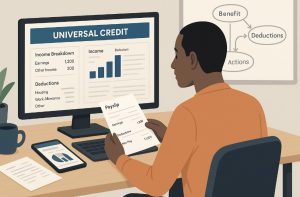
When you earn income from work, your Universal Credit does not stop immediately. Instead, it’s reduced gradually through a system known as the taper rate.
The taper rate is currently 55%, meaning your award is reduced by 55p for every £1 you earn above your work allowance.
The work allowance is the amount you can earn before any deduction applies and depends on whether you also receive housing support:
| Your Circumstances | Monthly Work Allowance |
| Receive housing support | £411 |
| Do not receive housing support | £684 |
Hannah’s Example
Hannah earns £1,000/month, qualifies for housing support, and has one child. Her work allowance is £411.
- Earnings above allowance: £1,000 – £411 = £589
- Taper reduction: £589 × 0.55 = £323.95
- If her base UC award is £1,400, final payment: £1,076.05
Even with a steady income, UC is adjusted every month based on what’s reported via payroll or through the online journal if self-employed.
Do Savings and Capital Reduce Universal Credit?
If you have over £6,000 in savings, your Universal Credit will begin to reduce. For every £250 over £6,000, £4.35 is deducted monthly from your UC.
Evie’s Example
Evie earns £1,000/month and has £7,700 in savings.
- Capital above the threshold: £1,700
- Number of £250 increments: 7
- Deduction: 7 × £4.35 = £30.45
- Monthly UC reduction: £30.45
Capital over £16,000 generally disqualifies you from Universal Credit unless you’re protected under managed migration.
Does the Benefit Cap Apply if I Earn £1,000 a Month?
The Benefit Cap limits the total benefits a household can receive. If you or your partner earn less than £846/month after tax, the cap could apply. Earning £1,000/month means you’re exempt, provided this is net income.
| Household Type | Outside London | Inside London |
| Single, no children | £1,229.42 | £1,413.92 |
| Couple or with children | £1,835.00 | £2,110.25 |
However, elements like childcare support are not subject to the Benefit Cap, even if your total UC exceeds the cap limit.
What Other Deductions or Sanctions Might Apply?

Universal Credit can also be reduced due to:
- Budgeting or advance payment recovery
- Overpayments
- Benefit fraud penalties
- Sanctions for not meeting claimant commitments
- Third-party debt repayments such as for rent or utility arrears
If your payment is reduced to £0, your claim will end, but you may be able to reopen it if your income falls again within the next five months.
Frequently Asked Questions
Will I still get Universal Credit if I earn £1,000 a month?
Yes. Your entitlement will be reduced but not eliminated, depending on your work allowance, other income, and additional elements.
How does rent affect my UC at £1,000/month income?
You’ll still receive support through the housing element, though it will be reduced if you have spare bedrooms or non-dependants.
Is £1,000/month enough to avoid the Benefit Cap?
Yes. Provided it’s net income, earning £1,000 makes you exempt from the Benefit Cap.
How do savings impact UC if I earn £1,000?
Savings over £6,000 reduce UC, while savings over £16,000 usually disqualify you.
What if I’m self-employed and earning £1,000/month?
Self-employed claimants are subject to the Minimum Income Floor and must report monthly profits. UC will adjust accordingly.
Can UC be backdated if my income dropped suddenly?
Usually, UC is not backdated. However, if your income drops soon after a claim closes, the DWP may keep your case open temporarily.
Should I apply now or wait for managed migration?
If you’re not on any benefits, applying before 2026 could offer better financial outcomes. If you’re on legacy benefits, wait for DWP guidance.
READ MORE:
- DWP £299 Cost of Living Payment – What You Need to Know in 2025?
- What is a First Commitments Appointment Universal Credit?
- DWP PSCS Payment After Death: What Happens and How to Handle It?
- What Are the Universal Credit Advance Payment Reasons?
- Universal Credit Advance Payment – How Long Does It Take to Go in Bank?