
Cost of Living Payment 2026: What Has Changed Since 2025?
Neither 2025 nor 2026 introduced a new national Cost of Living Payment. The main change is to local hardship support in England, where the Crisis and Resilience Fund replaced the Household Support Fund in April 2026.
- Support in 2025: England’s Household Support Fund provided locally managed help with essential costs, including food and energy bills.
- Support in 2026: The Crisis and Resilience Fund provides crisis assistance, housing support and services aimed at improving longer-term financial stability.
- Payment Amounts and Dates: Local awards vary. Neither year has a new nationwide Cost of Living Payment schedule.
- Which Is Better? The 2026 programme has a broader scope, but it does not guarantee more money for every household.
- Outside England: Scotland, Wales and Northern Ireland have separate emergency support schemes.
- Available Support: England has the Crisis and Resilience Fund, while Scotland, Wales and Northern Ireland offer separate emergency assistance.
- Next Step: Check your local council’s support options. Eligibility, payment amounts and application requirements vary.
Last Updated: 02.09.2026
Is a Cost of Living Payment Confirmed for 2026?
No new Cost of Living Payment has been confirmed for 2026. The current GOV.UK cost of living guidance states that there will be no Cost of Living Payment in 2026 and that no more payments are planned.
This means there is no national payment date, qualifying period or confirmed amount for people receiving Universal Credit, Pension Credit, tax credits, PIP or other benefits.
The earlier Cost of Living Payment scheme was a temporary response to rapidly rising energy, food and household costs.
Payments were issued between 2022 and 2024 to people who met specific benefit entitlement conditions.
Some websites and social media posts continue to publish predicted payment dates or reuse dates from earlier rounds.
A regular benefit payment, local council grant or delayed historical payment should not be presented as a new national Cost of Living Payment.
Cost of Living Support 2025 vs 2026: What Has Changed?
Neither 2025 nor 2026 introduced a new nationwide Cost of Living Payment.
Households continued to receive their normal benefits, pensions and other entitlements, but these should not be confused with an additional DWP lump-sum payment.
The main change in 2026 concerns local hardship assistance in England.
The Household Support Fund ended on 31 March 2026, and the Crisis and Resilience Fund began on 1 April 2026. Scotland, Wales and Northern Ireland continue to operate their own emergency support arrangements.
Support Area Position in 2025 Position in 2026
National Cost of Living Payment No new national payment No payment scheduled
Local Hardship Help in England Household Support Fund Crisis and Resilience Fund
Housing Assistance in England Discretionary Housing Payments Housing Payments within the new fund
Main Programme Focus Help with immediate essential costs Crisis help, housing assistance and financial resilience
Payment Amounts Varied by council and circumstances Continue to depend on assessed needs and local rules
Application Process Council application, referral or targeted award Council application, referral or local assessment
Repayment Grants generally did not require repayment Depends on the particular form of assistance
What New Support Was Introduced in 2026?
England’s Crisis and Resilience Fund runs from 1 April 2026 to 31 March 2029.
Local authorities use the funding to assist low-income households facing a financial shock and to provide services intended to improve longer-term financial stability.
The fund contains different types of support. Crisis Payments are intended to provide immediate assistance, while Housing Payments may help eligible households facing a shortfall in their housing costs.
Resilience Services can include benefit checks, debt support, budgeting assistance and help that reduces the risk of another financial crisis.
The exact help available is determined locally. One council may provide cash payments, while another may offer vouchers, essential appliances, food assistance or direct help with particular bills.
There is no standard nationwide award amount.
Is Cost of Living Support Better in 2026 Than in 2025?
The 2026 system has a broader focus because it combines immediate crisis assistance with housing help and longer-term financial support.
This could be useful for people who need more than a single emergency payment.
However, the new programme does not guarantee that every household will receive a higher award. Eligibility, available funding, covered expenses and application arrangements can still vary between councils.
Whether support is better in 2026 therefore depends on where a person lives, what help they need and whether they meet their council’s conditions.
Receiving a Household Support Fund award in 2025 does not create an automatic entitlement to a Crisis and Resilience Fund award in 2026.
When Was the Last Cost of Living Payment Paid?
The last national means-tested benefits Cost of Living Payment was worth £299. It was paid to most eligible DWP claimants between 6 and 22 February 2024.
People who received only qualifying tax credits from HMRC generally had a different payment window, running from 16 to 22 February 2024.
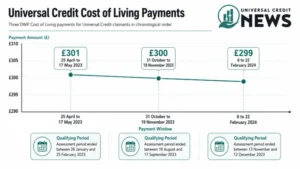
The three payments provided under the 2023 to 2024 programme were worth a combined £900.
Payment Universal Credit Qualifying Period DWP Payment Window
£301 Assessment period ended between 26 January and 25 February 2023 25 April to 17 May 2023
£300 Assessment period ended between 18 August and 17 September 2023 31 October to 19 November 2023
£299 Assessment period ended between 13 November and 12 December 2023 6 to 22 February 2024
These dates are historical. They do not indicate when another payment will be made, and they should not be reused as predicted dates for 2026.
Who Qualified for the Previous Payments?
A person generally needed to have been entitled to one of the qualifying means-tested benefits or tax credits during the relevant qualifying period.
Qualifying benefits included:
- Universal Credit
- Income-Based Jobseeker’s Allowance
- Income-Related Employment and Support Allowance
- Income Support
- Pension Credit
- Child Tax Credit
- Working Tax Credit
New Style ESA, contribution-based ESA and New Style JSA did not qualify by themselves.
For Universal Credit claimants, entitlement was normally based on whether they received a payment for an assessment period ending during the qualifying window.
A nil award could prevent entitlement, although specific exceptions applied in some circumstances.
Those rules belonged to the previous payment programme. Receiving one of these benefits in 2026 does not qualify someone for a new Cost of Living Payment because no new payment has been announced.
Will Universal Credit, PIP or Pension Credit Claimants Get Extra Money in 2026?
People receiving benefits may see changes to their regular payments because of annual uprating, changes in income or changes in household circumstances.
These are part of the normal benefits system and do not amount to a separate Cost of Living Payment.
Universal Credit Payments and Annual Increases
Universal Credit continues to be paid according to each claimant’s normal payment schedule.
The amount can be affected by earnings, housing costs, children, health-related elements, savings, deductions and other household circumstances.
Claimants should check their monthly Universal Credit statement before assuming that a different payment amount is a bonus.
The statement shows the elements included in the award, income-related reductions and any deductions.
An advance may be available in certain situations, but advances normally have to be repaid through future Universal Credit payments. They should not be described as grants or Cost of Living Payments.
PIP and Other Disability Benefits
PIP, Disability Living Allowance, Attendance Allowance and other disability benefits continue under their normal rules.
Receiving one of these benefits does not establish eligibility for a new 2026 Cost of Living Payment.
The previous programme included separate Disability Cost of Living Payments for eligible claimants.
Those payments were temporary and have ended. They are different from a person’s continuing disability benefit award.
Pension Credit and Winter Support
Pension Credit remains an important source of support for people over State Pension age who have a low income.
It can also provide access to other forms of assistance, depending on individual circumstances.
Pension Credit, the State Pension and Winter Fuel Payment are separate schemes.
A payment under one of these programmes should not automatically be described as a Cost of Living Payment.
How Do Cost of Living Payments Differ From Other Financial Support?
Several forms of support can appear in a person’s bank account or benefit statement.
Understanding the differences can prevent confusion about whether a new national payment has been introduced.
Type of Support Main Purpose Who Provides It? Is an Application Needed? Must It Be Repaid?
Historical Cost of Living Payment Temporary national help with rising costs DWP or HMRC No, payments were automatic No
Regular Benefit Payment Ongoing support based on entitlement DWP, HMRC or devolved authority A benefit claim is required No
Local Council Grant Help during financial hardship Local authority Usually, although referrals may be accepted Usually no
Energy Hardship Support Help with energy debt or bills Energy supplier or charity Usually Usually no
Universal Credit Advance Early or emergency access to money DWP Yes Normally yes
Charitable Grant Help with specific needs or circumstances Charity or trust Yes No
A council payment made in 2026 may be valuable cost of living support, but it is not the same as the former national Cost of Living Payment.
What Financial Support Is Available Across the UK in 2026?
Emergency financial support differs across England, Scotland, Wales and Northern Ireland. Applicants should use the scheme for the nation where they live and check the latest local rules.
England: Crisis and Resilience Fund
People in England should check their local council’s Crisis and Resilience Fund arrangements.
The programme may help with financial emergencies, housing-cost shortfalls, food, energy, essential household items and longer-term financial resilience.
Councils decide how residents apply and what evidence is needed. Support may be delivered through cash, bank transfers, vouchers, goods or payments made directly to a supplier.
Applicants should not assume that every council provides the same amount or covers the same expenses.
Scotland: Scottish Welfare Fund
The Scottish Welfare Fund offers Crisis Grants and Community Care Grants through local councils. A Crisis Grant can help someone on a low income who is facing an emergency or disaster.
A Community Care Grant can help a person establish or maintain a settled home, live independently or manage exceptional pressure.
Applications are assessed by the relevant Scottish local authority.
Wales: Discretionary Assistance Fund
The Welsh Government’s Discretionary Assistance Fund provides Emergency Assistance Payments and Individual Assistance Payments.
Emergency Assistance Payments may help with essential costs such as food, gas, electricity, heating oil or emergency travel when someone is facing extreme financial hardship.
Individual Assistance Payments can help eligible people live independently in their home or in a property they are moving into.
Northern Ireland: Discretionary Support
People in Northern Ireland who are facing an extreme or exceptional situation may be able to receive Discretionary Support.
Depending on the applicant’s circumstances, assistance may be offered as an interest-free loan or a non-repayable grant.
Northern Ireland also has separate support for people waiting for their first full Universal Credit award. Eligibility and repayment conditions depend on the payment being claimed.
Other Help With Essential Household Costs
Other support may include:
- Council Tax Reduction
- Energy Supplier Hardship Funds
- Charitable Grants
- Benefit Entitlement Checks
- Housing-Cost Assistance
- Food Bank Referrals
- Free School Meals
- Help With Health Costs
- Universal Credit Advances
- Budgeting Support
Not every option is available to every household. Some forms of support are grants, while others are loans that must be repaid.
How Can You Check Local Grant Eligibility and Payment Dates?
Local councils set their own application arrangements, so the most reliable starting point is the official website of the council responsible for the applicant’s address.
Before applying:
- Check That the Scheme Is Open
- Read the Residency and Income Conditions
- Confirm Which Expenses Are Covered
- Prepare Evidence of Income and Savings
- Collect Recent Bank Statements
- Provide Details of the Financial Emergency
- Check Whether a Previous Award Affects Eligibility
- Confirm How the Council Delivers Successful Awards
Applicants may be asked to show why they cannot meet the expense from their normal income, savings or another available source.
Processing times can vary according to the council, the type of request and the urgency of the situation. Applicants should keep confirmation emails, reference numbers and copies of supporting evidence.
What Should You Do About a Missing Historical Payment?
Someone who believes they qualified for a historical Cost of Living Payment should first check the relevant qualifying period and review their benefit statements.
They should then look through bank, building society or credit union statements for a separate payment from DWP or HMRC. The payment may not have arrived on the same date as the person’s regular benefit.

A payment could have arrived later if the qualifying benefit was awarded retrospectively or if a benefit decision was changed. However, this would be a delayed historical entitlement rather than a new 2026 payment.
Anyone who still believes a historical payment is missing should contact the office responsible for the qualifying benefit or tax credits.
They should avoid using unofficial websites that request bank details or charge a fee to recover a payment.
How Can You Spot False Payment Announcements and Scams?
False payment announcements often use familiar DWP terminology, old payment amounts or urgent application deadlines to appear convincing.
Common warning signs include:
- Claims That Everyone Will Receive the Same Amount
- Unverified Payment Dates With No Government Announcement
- Requests for Bank Details by Text or Email
- Links to Unfamiliar Application Websites
- Demands for an Application or Processing Fee
- Messages Creating Pressure to Act Immediately
- Social Media Posts Using Dates From Previous Payment Rounds
The previous national payments were issued automatically to eligible people.
Local hardship schemes may require an application, but the application should be made through an official council, government or recognised support organisation.
Frequently Asked Questions
Is There a Confirmed Cost of Living Payment Date for 2026?
No. There is no national Cost of Living Payment scheduled for 2026, so there is no confirmed payment date or qualifying period.
Will Universal Credit Claimants Receive an Automatic Extra Payment?
Universal Credit claimants will continue to receive their normal awards. No separate automatic 2026 Cost of Living Payment has been announced.
Does Receiving PIP Qualify Me for a New Cost of Living Payment?
No. Receiving PIP does not qualify someone for a new payment because no national Cost of Living Payment is scheduled for 2026.
Can I Receive Council Support Without Claiming Benefits?
Possibly. Some local schemes consider household income, essential costs and the nature of the financial emergency rather than requiring a particular benefit. The rules vary locally.
Is a £300 Council Grant Available to Everyone?
No. There is no universal £300 council grant for every UK household. Award amounts and eligibility depend on the relevant scheme and individual circumstances.
Could a Payment Received in 2026 Relate to an Earlier Entitlement?
Yes. A payment could relate to a backdated benefit award or a corrected historical decision. This would not mean that a new 2026 Cost of Living Payment had started.
Where Should I Check for Official Payment Updates?
Check GOV.UK, the relevant devolved government website and the official website of the local council. Avoid relying on predicted dates published without a supporting government announcement.