

Savings Limit for Housing Benefit for Pensioners in 2026/27: Rules, Thresholds and Exceptions
The savings limit for Housing Benefit for pensioners in 2026/27 is £16,000, with savings above £10,000 potentially reducing the amount of financial support available.
Pensioners with £10,000 or less in countable savings are not affected by the capital tariff-income calculation, while those with more than £16,000 are normally ineligible unless they receive Pension Credit Guarantee Credit.
For savings between £10,000 and £16,000, every £500, or part of £500, above the lower threshold is treated as £1 in assumed weekly income. This is added to other assessable income when calculating Housing Benefit.
The rules are designed to help pensioners with limited financial resources meet their rental costs.
However, eligibility also depends on pension income, household circumstances, eligible rent and whether the person qualifies to make a Housing Benefit claim.
How Much Savings Can Pensioners Have Before Housing Benefit Is Reduced?
Pensioners can have savings without automatically losing Housing Benefit. The amount they hold determines whether those savings are disregarded, treated as additional income or prevent entitlement.
The three main thresholds for 2026/27 are:
| Total Countable Savings | Effect On Housing Benefit |
|---|---|
| £10,000 Or Less | No Tariff Income Is Added |
| More Than £10,000 Up To £16,000 | Assumed Weekly Income Is Calculated |
| More Than £16,000 | Housing Benefit Normally Stops Or Cannot Be Claimed |
| More Than £16,000 With Guarantee Credit | The Standard Upper Savings Limit Does Not Apply |
Having less than £10,000 does not automatically mean that the full rent will be covered. Councils must still consider other income, eligible rental costs and household circumstances.
The £16,000 restriction also has an important exception for people receiving the Guarantee Credit element of Pension Credit.
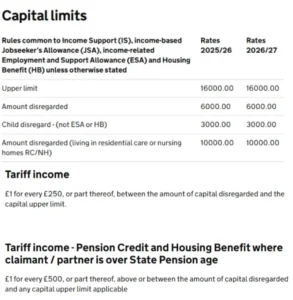
The government’s 2026/27 benefit rates confirm the £10,000 pension-age capital disregard, the standard £16,000 upper limit and the tariff-income calculation.
What Counts As Savings And Capital For Housing Benefit?
Housing Benefit calculations consider more than money held in an ordinary savings account. Councils assess different forms of capital, including investments and certain property assets.
The following types of savings and capital are generally included:
- Bank and Building Society Accounts: Money held in current accounts, savings accounts and fixed-term deposits.
- Cash ISAs: Savings held in tax-free Cash ISA accounts.
- Stocks And Shares ISAs: The value of investments held within these accounts.
- Premium Bonds: The value of Premium Bonds owned by the claimant.
- Stocks and Investments: Shares, investment funds and other financial assets.
- Cash Savings: Money kept at home or elsewhere outside a bank.
- Additional Properties: Property or land that is not the claimant’s main home, subject to specific exemptions.
A common misunderstanding is that tax-free savings accounts are excluded from benefit calculations. Although Cash ISAs provide tax advantages, they are generally still counted as capital for Housing Benefit.
For example, a pensioner with £7,000 in a savings account and £5,000 in a Cash ISA would normally have £12,000 of countable savings.
The council would assess the combined amount rather than treating the ISA separately.
How Is Housing Benefit Calculated For Pensioners With Savings?
Housing Benefit uses a calculation known as tariff income to determine how savings above £10,000 affect entitlement.
The council does not assume that the pensioner earns actual interest at this rate. Instead, it adds a fixed amount of assumed income to the claimant’s other assessable income.
The calculation follows three steps:
- Identify Total Countable Savings: Add together savings and investments that are not disregarded.
- Subtract the £10,000 Allowance: Calculate how much capital exceeds the lower threshold.
- Apply the Tariff Income Rate: Add £1 in assumed weekly income for each £500, or part of £500, above the threshold.
Housing Benefit Savings Limits And Tariff Income Table
| Total Savings | Amount Above £10,000 | Assumed Weekly Income |
|---|---|---|
| £8,000 | £0 | £0 |
| £10,000 | £0 | £0 |
| £10,500 | £500 | £1 |
| £11,000 | £1,000 | £2 |
| £12,500 | £2,500 | £5 |
| £13,000 | £3,000 | £6 |
| £14,500 | £4,500 | £9 |
| £15,000 | £5,000 | £10 |
| £16,000 | £6,000 | £12 |
| £16,001 | Above Upper Limit | Normally Ineligible |
These amounts represent assumed weekly income, not direct deductions from Housing Benefit payments.
Examples Of Housing Benefit Calculations
Example 1: A Pensioner With £12,500 In Savings
A pensioner has £12,500 in countable savings.
- Total Savings: £12,500
- Disregarded Amount: £10,000
- Remaining Capital: £2,500
- Assumed Weekly Income: £5
The council adds £5 to the pensioner’s other assessable weekly income when working out Housing Benefit.
Example 2: A Pensioner With £15,250 In Savings
Another pensioner has £15,250 in savings.
- Total Savings: £15,250
- Disregarded Amount: £10,000
- Remaining Capital: £5,250
- Assumed Weekly Income: £11
Because the remaining capital includes part of an additional £500, it is rounded up for the tariff-income calculation.
The council treats the pensioner as having an additional £11 in weekly income.
The final Housing Benefit amount depends on the claimant’s total assessable income, applicable amount and eligible rent. Therefore, two pensioners with identical savings may receive different Housing Benefit payments.
Can Pensioners With More Than £16,000 In Savings Claim Housing Benefit?
Pensioners with more than £16,000 in countable savings are generally ineligible for Housing Benefit. However, receiving the Guarantee Credit element of Pension Credit removes the standard upper capital restriction.
Pension Credit is designed to support older people on lower incomes. It has two elements, Guarantee Credit and Savings Credit, which have different eligibility rules.
For 2026/27, Guarantee Credit can top up weekly income to:
| Claimant Type | Standard Minimum Guarantee |
|---|---|
| Single Pensioner | £238 Per Week |
| Couple | £363.25 Per Week |
Additional amounts may be available for people with disabilities, caring responsibilities or other qualifying circumstances.
A pensioner receiving Guarantee Credit may qualify for Housing Benefit even if their savings exceed £16,000.
However, receiving Savings Credit alone does not provide the same exemption.
Savings above £10,000 can also affect Pension Credit calculations because assumed income from capital is considered when deciding Guarantee Credit eligibility.
Pensioners who are unsure about their entitlement should check the conditions for qualifying for Pension Credit, particularly where savings, property ownership and retirement income affect their circumstances.
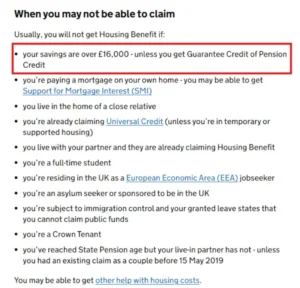
GOV.UK confirms that savings above £16,000 normally prevent Housing Benefit entitlement unless the claimant receives Pension Credit Guarantee Credit.
Which Savings And Assets Are Disregarded For Housing Benefit?
Not every asset owned by a pensioner is included when calculating Housing Benefit.
Certain possessions, payments and property interests can be disregarded either permanently or for a specified period.
Common examples include:
- Main Residential Property: The value of the home normally occupied by the claimant is disregarded.
- Personal Possessions: Household furniture, clothing and ordinary personal belongings are generally excluded.
- Certain Compensation Payments: Some personal injury and other qualifying compensation payments can be disregarded under specific rules.
- Certain Trust Funds: Money held in qualifying trusts may be excluded from capital calculations.
- Life Insurance Policies: The value of certain life insurance policies is disregarded.
- Certain Property Sale Proceeds: Money intended for purchasing another home may receive temporary protection where the relevant conditions are met.
The treatment of compensation payments depends on their nature and the applicable rules. Receiving compensation does not automatically mean that every payment is permanently disregarded.
Likewise, a pensioner’s main home may be excluded from capital calculations, but Housing Benefit is primarily intended to assist with eligible rent rather than mortgage repayments.
Pensioners who own their homes may need to consider other forms of financial assistance, such as Support for Mortgage Interest.
How Do Savings Limits Apply To Married Couples And Mixed-Age Couples?
Housing Benefit normally considers the combined savings of married couples, civil partners and unmarried couples living together as partners.
This means that both partners’ savings are taken into account, even when the money is held in separate accounts.
For example, consider a pensioner couple with the following savings:
| Savings Holder | Amount |
|---|---|
| First Partner | £7,000 |
| Second Partner | £6,000 |
| Combined Savings | £13,000 |
The couple has £3,000 above the £10,000 threshold, creating assumed weekly income of £6.
The savings limit is not doubled simply because two people are claiming together.
What Happens If One Partner Is Below State Pension Age?
Mixed-age couples face additional eligibility restrictions.
Under rules introduced on 15 May 2019, most couples where one partner is below State Pension age cannot make a new pension-age Housing Benefit claim.
Instead, they may need to claim Universal Credit, unless they fall within an exception or have protected existing entitlement.
Universal Credit has different savings rules, including a £6,000 lower capital threshold and a £16,000 upper capital limit, subject to specific exceptions.
The differences become particularly important when comparing how much savings you can have on Universal Credit with the rules applying to pension-age Housing Benefit.
Couples should confirm which benefit system applies before making a claim, especially if one partner is approaching retirement age.
Do Private Pensions, Pension Withdrawals And Inheritance Affect Housing Benefit?
Private pensions, pension withdrawals and inheritance payments can affect Housing Benefit, but their treatment depends on how the money is received and held.
Private Pensions And Pension Withdrawals
Regular income from a workplace pension or private pension is normally considered when calculating means-tested benefits.
However, money remaining inside a pension fund can be treated differently from money already withdrawn.
When someone reaches Pension Credit qualifying age, the benefit authorities may also consider notional income from pension funds that have not been used to provide retirement income.
The treatment generally depends on the circumstances:
- Regular Pension Payments: Normally assessed as income.
- Pension Lump Sums: Money withdrawn as a cash lump sum can be treated as capital.
- Untouched Pension Funds: Special rules apply, including possible notional pension income.
- Flexible Pension Withdrawals: The treatment depends on whether withdrawals are assessed as income or capital.
A pensioner planning a substantial withdrawal should check how it may affect their Housing Benefit and Pension Credit before accessing the money.
Inheritance And Lump-Sum Payments
Receiving an inheritance can increase the amount of countable capital held by a pensioner.
For example, a pensioner with £8,000 in savings who receives a £10,000 cash inheritance could have £18,000 in countable capital.
If no exemption applies and the pensioner does not receive Guarantee Credit, the increase may mean they no longer qualify for Housing Benefit.
An inherited property may also count as capital, although specific property disregards can apply.
Pensioners should report inherited money or property and provide relevant information about the amount received.
Can Giving Away Savings Affect Housing Benefit Eligibility?
Giving away money or transferring assets to qualify for Housing Benefit can lead to a rule known as deprivation of capital.
This applies where someone deliberately reduces their savings to obtain benefits or increase their entitlement.
The council may decide that the claimant should still be treated as possessing the money, even though it has been transferred or spent.
Situations that may require investigation include:
- Giving Away Large Amounts: Transferring substantial savings to relatives to qualify for benefits.
- Transferring Property: Giving ownership of valuable assets to another person.
- Unreasonable Spending: Making unusually large purchases primarily to reduce countable capital.
- Deliberately Reducing Savings: Moving money elsewhere to avoid the savings limit.
However, spending savings does not automatically amount to deprivation of capital.
Reasonable expenditure on everyday living costs, necessary home repairs, debt repayment or essential purchases may be legitimate.
The council must consider the individual circumstances and the person’s reasons for disposing of the money.
Pensioners should retain receipts, bank statements and supporting documents for significant transactions, especially where their savings are close to the £16,000 threshold.
What Happens If A Pensioner’s Savings Increase Or Decrease?
Housing Benefit entitlement can change if a pensioner’s savings increase or decrease after a claim has been approved.
Councils require claimants to report relevant changes in their financial circumstances.
An increase in savings may result from receiving an inheritance, selling investments, receiving a lump-sum pension payment or selling another property.
A decrease may occur when savings are used for normal living expenses, medical costs, household repairs or other reasonable expenditure.
Depending on the amount involved, these changes may affect the claimant’s entitlement.
Changes That Should Be Reported Include:
- Savings Increasing: Notify the council when capital changes in a way that could affect entitlement.
- Receiving An Inheritance: Report newly acquired cash, investments or property.
- Selling Property: Declare sale proceeds and any relevant changes in assets.
- Receiving Pension Payments: Report changes in regular pension income or lump-sum withdrawals.
- Savings Falling: Inform the council if reduced capital may increase Housing Benefit entitlement.
A pensioner whose savings previously exceeded £16,000 may become eligible again if their countable capital genuinely falls within the permitted limit.
However, a new claim may be necessary if the previous claim has ended.
The authority may also examine how the savings were spent before deciding whether entitlement can be restored.
How Can Pensioners Apply For Housing Benefit?
Eligible pensioners can normally apply for Housing Benefit through their local council or as part of a Pension Credit claim.
The application involves providing information about household circumstances, rental costs, income and savings.
Check Housing Benefit Eligibility
Before applying, pensioners should confirm that they meet the relevant age, residence and rental conditions.
They should also consider whether they receive Guarantee Credit and whether their savings exceed the standard capital limits.
Pensioners who receive disability-related benefits may have additional circumstances affecting their entitlement.
For example, Personal Independence Payment and other qualifying benefits may affect how certain benefit premiums and household deductions are considered.
Prepare The Required Documents
Applicants may need to provide:
- Proof Of Identity: Passport, driving licence or other accepted identification.
- National Insurance Number: Details needed to identify the claimant.
- Bank Statements: Evidence of savings, investments and account balances.
- Pension Statements: Information about State Pension and private pension income.
- Tenancy Agreement: Evidence of rent and housing arrangements.
- Benefit Award Letters: Details of Pension Credit or other benefits received.
The council may request additional documents where the claimant has jointly owned assets, inherited property or other complicated financial arrangements.
Submit The Application
Eligible applicants can contact their local council or apply for Housing Benefit as part of a Pension Credit claim.
The government has also been developing a more joined-up Pension Credit and pensioner Housing Benefit application service, starting with a limited group of invited applicants from autumn 2026. Existing application routes remain available.
Pensioners should apply as soon as they become eligible because delaying a claim can affect the amount of financial support they receive.
Housing Benefit claims can sometimes be backdated, depending on the applicable rules and individual circumstances.
If a claim is refused or the amount awarded appears incorrect, the claimant can request a review of the council’s decision or appeal.
The distinction between pension-age Housing Benefit and the wider Universal Credit rollout is important because the replacement of working-age benefits does not mean pension-age Housing Benefit has disappeared.
Conclusion
The savings limit for Housing Benefit for pensioners remains an important factor in determining eligibility during 2026/27.
Pensioners can hold up to £10,000 in countable savings without those savings creating tariff income, while amounts between £10,000 and £16,000 can reduce entitlement.
Savings exceeding £16,000 normally prevent Housing Benefit entitlement unless the claimant receives Pension Credit Guarantee Credit.
However, the amount of savings alone does not determine the final payment. Income, rent, household circumstances, pension withdrawals and the treatment of particular assets can all influence the calculation.
Pensioners should check which assets count, report relevant financial changes and seek guidance from their council or Pension Service before making significant decisions involving savings or retirement funds.
Frequently Asked Questions
Can Pensioners Get Housing Benefit With £10,000 In Savings?
Yes. Savings of £10,000 or less do not create tariff income under pension-age Housing Benefit rules, although other eligibility conditions must still be met.
Can You Claim Housing Benefit With £15,000 In Savings?
Yes, potentially. Savings of £15,000 create assumed weekly income of £10, which is considered alongside other assessable income when calculating entitlement.
Does Pension Credit Override The £16,000 Savings Limit?
Receiving Pension Credit Guarantee Credit removes the standard £16,000 Housing Benefit capital limit. Receiving Savings Credit alone does not provide this exemption.
Do Cash ISAs And Premium Bonds Count As Savings?
Yes. Cash ISAs and Premium Bonds are normally included as countable capital when determining Housing Benefit eligibility.
Does An Inheritance Affect Housing Benefit For Pensioners?
Yes. Inherited money or property can increase countable capital and reduce or end entitlement, although certain statutory disregards may apply.
Can Pensioners Claim Housing Benefit If They Own Their Home?
Housing Benefit generally supports eligible rental costs rather than mortgage payments. The value of the home a claimant normally lives in is disregarded as capital.
Do Pensioners Have To Report Changes In Their Savings?
Yes. Pensioners should promptly report relevant increases or decreases in savings, investments and property to their council, as these can affect Housing Benefit entitlement.