WASPI Compensation DWP £2950: What Is the Latest Position in 2026?
The WASPI Compensation DWP £2950 issue remains unresolved in 2026 despite years of investigations, campaigning and legal challenges.
The £2,950 figure is not a confirmed payment from the Department for Work and Pensions. It comes from the Parliamentary and Health Service Ombudsman’s recommended Level 4 financial remedy range of £1,000 to £2,950.
The Government reconsidered its previous decision after concerns were raised about evidence that had not been considered.
However, on 29 January 2026, it again decided that a financial compensation scheme should not be established. The dispute has since returned to the courts through a new judicial review challenge.
As of October 2026, there is therefore no approved £2,950 payment, no official compensation application form and no confirmed payment date.
Is the DWP Paying £2,950 in WASPI Compensation in 2026?
No. The DWP is not currently making £2,950 compensation payments to WASPI women.
The £2,950 amount has become closely associated with the dispute because it is the upper end of the Ombudsman’s Level 4 compensation range. It should not be interpreted as a fixed payment that every affected woman has been awarded.
The Government reviewed its position again following the discovery that relevant evidence had not been considered during its earlier decision-making.
After that reconsideration, Work and Pensions Secretary Pat McFadden announced on 29 January 2026 that the Government would still not introduce financial compensation.
This means that currently:
- No £2,950 Payment Has Been Approved
- No WASPI Compensation Scheme Is Open
- No Official Claim Form Is Available
- No DWP Payment Schedule Has Been Published
- No Final Eligibility Rules Exist
Future developments could depend partly on the continuing legal challenge, but judicial review does not itself create a compensation scheme.
When Was the WASPI Compensation Case Last Updated?
There are two useful dates to understand because the official Government position and the campaign’s legal challenge are separate developments.
The latest major official DWP action-plan update was published on 25 June 2026.
It set out how the department intends to improve State Pension communications and complaints handling following the Ombudsman investigation. The plan is scheduled to run through to April 2027.
The latest accessible WASPI legal campaign update reviewed for this article was dated 17 August 2026. At that stage, WASPI said its new judicial review application was waiting to be considered by a High Court judge, who would decide whether permission should be granted for the case to proceed.
The Government had previously confirmed in June 2026 that WASPI was seeking permission from the High Court to challenge its latest response to the Ombudsman.
Therefore, the compensation question remains legally contested, even though the current Government policy is not to introduce a compensation scheme.
What Does the WASPI Compensation Campaign Mainly Aim to Address and Improve?
The WASPI dispute does not primarily concern whether Parliament was legally entitled to increase women’s State Pension age.
Instead, it focuses on how changes to women’s State Pension age were communicated, particularly to women born in the 1950s.
The Ombudsman investigation identified maladministration connected with the timing and handling of communications.
The Government has accepted that failures in decision-making led to a 28-month delay in beginning to send individual letters to affected women.
The wider issue therefore focuses on areas such as:
- Timely Communication About major State Pension changes
- Clear Personal Information For people approaching retirement
- Better Retirement Planning By giving people sufficient notice
- Accountability When public bodies make administrative mistakes
- Improved Complaint Handling When people challenge Government decisions
- Learning From Past Failures So similar communication problems are less likely to happen again
The compensation campaign seeks financial redress for the injustice campaigners say resulted from those communication failures.
Separately, DWP’s 2026 action plan focuses on improving future communications and complaints procedures rather than providing financial compensation.
Why Did the WASPI Compensation Issue Begin?
The roots of the WASPI dispute stretch back decades.
Historically, women could receive the State Pension at age 60 while men generally reached State Pension age at 65. Legislation introduced a process to equalise State Pension ages.
The central WASPI argument developed because many women born in the 1950s said they did not receive sufficiently clear or timely personal notification about when they would actually become eligible for their State Pension.
This became particularly important because retirement decisions are often made years in advance.
A person expecting State Pension income at 60 could have made decisions involving:
- Leaving Employment
- Reducing Working Hours
- Using Private Savings
- Providing Unpaid Care
- Planning Housing Costs
- Supporting Family Members
When State Pension income became available later than some women expected, campaigners argued that the communication failures reduced the time available to adapt financially.
The Ombudsman’s investigation eventually concluded that maladministration had occurred in aspects of DWP’s communication decision-making.
What Is the Timeline of the WASPI Compensation Case From the Beginning to 2026?
1995 To 2011: Changes To Women’s State Pension Age
The Pensions Act 1995 provided for women’s State Pension age to rise gradually from 60 to 65 to equalise it with men’s State Pension age.
Later legislation accelerated parts of the timetable and moved both men and women towards a State Pension age of 66.
These changes affected retirement planning for millions of women born in the 1950s.
2005 To 2007: Problems With DWP Communication
The period between 2005 and 2007 became particularly important in the Ombudsman’s investigation.
The Government now accepts that maladministration in decision-making between August 2005 and December 2007 resulted in a 28-month delay in starting individual letters to 1950s-born women about changes to State Pension age.
The Government has apologised for not sending those individual letters earlier.
2018 To 2024: Investigation And Compensation Recommendation
Complaints eventually reached the Parliamentary and Health Service Ombudsman.
After a lengthy investigation, the Ombudsman concluded that maladministration had caused injustice and recommended action to provide redress.
The compensation amount most frequently associated with the case came from Level 4 of the Ombudsman’s financial remedy scale, which covered £1,000 to £2,950.
This did not mean that the Government had approved a £2,950 payment for every woman.
December 2024: Government Rejects A Compensation Scheme
On 17 December 2024, the Government announced that it would not establish a financial compensation scheme.
Ministers accepted that communication failures had occurred but disagreed with important elements of the Ombudsman’s conclusions about injustice and redress.
This decision triggered further political debate and legal action.
November 2025: Government Agrees To Reconsider Its Decision
The Government later discovered that relevant historical evidence had not been considered when the December 2024 decision was taken.
As a result, it agreed to make the decision again after reviewing the additional material.
This development reopened the compensation question but did not guarantee that payments would follow.
January 2026: Government Rejects Financial Compensation Again
On 29 January 2026, the Government announced the result of its reconsideration.
It again decided that it would not introduce a financial compensation scheme.
This became the Government’s new formal position on the communication-related compensation question.
2026: Judicial Review Challenge Continues
WASPI subsequently launched another legal challenge.
By June 2026, the Government confirmed that WASPI was seeking permission from the High Court to bring a judicial review concerning its latest response.
An August 2026 campaign update stated that the case was still waiting for a High Court judge to make the permission decision.
What Impact Did the State Pension Age Changes Have When They Were Introduced?
The impact varied considerably between individuals.
The State Pension age changes themselves were established through legislation, but campaigners have focused on whether some women had enough warning to change their retirement plans.
Women who knew about the changes well in advance may have had more time to alter savings, employment and retirement decisions.
Those who became aware later could have had less time to respond.
Possible impacts reported during the wider WASPI dispute have included:
- Working Longer Than Expected To replace anticipated pension income
- Using Savings Earlier While waiting to reach State Pension age
- Changing Retirement Plans At relatively short notice
- Seeking Benefits Or Other Income During the gap before State Pension eligibility
- Changing Caring Arrangements Because retirement plans had altered
- Experiencing Financial Uncertainty While adjusting household budgets
It is important not to assume that every woman experienced the same consequences. Circumstances differed according to employment, savings, family responsibilities, awareness of the legislation and other sources of income.
How Did Late Or Inadequate Communication Affect 1950s-Born Women?
Communication is at the centre of the dispute because major retirement decisions usually require advance planning.
The Government has accepted that there was maladministration resulting in a 28-month delay in beginning individual letters to women affected by the State Pension age changes.
For some women, receiving information later could have reduced the amount of time available to make decisions about employment and finances.
The Ombudsman considered issues including lost opportunities to make informed decisions and diminished control over retirement planning.
However, this should not be interpreted as evidence that every affected woman suffered an identical financial loss.
That distinction has become one of the most important points in the compensation debate.
Where Did the £2,950 WASPI Compensation Figure Come From?
The £2,950 figure originated from the Parliamentary and Health Service Ombudsman’s approach to financial remedies.
The recommended level associated with the WASPI investigation was Level 4, which has a financial range of £1,000 to £2,950.
Therefore, £2,950 represents the upper end of a recommended compensation range.
It is not:
- A Confirmed DWP Payment
- A Universal £2,950 Entitlement
- An Amount Automatically Owed To Every 1950s-Born Woman
- A Payment Currently Being Processed
- An Approved Government Compensation Scheme
This distinction is particularly important because references to “DWP £2950” can give the impression that an actual payment has already been announced.
As of October 2026, it has not.
Why Did the Government Reject WASPI Compensation Again in 2026?
When the Government reconsidered the case, it reviewed further evidence but still decided against establishing a compensation scheme.
Its published reasoning included questions about how many women had actually experienced the particular injustice identified by the Ombudsman and whether it would be possible to design a fair and proportionate scheme.
The Government also considered difficulties involved in determining what individuals knew many years earlier and whether receiving information sooner would have caused them to make different decisions.
These are the Government’s stated reasons for rejecting compensation.
Campaigners dispute the Government’s interpretation of the evidence and are challenging aspects of the decision through judicial review.
The current situation therefore involves two distinct positions.
The Government maintains that a financial compensation scheme is not appropriate.
WASPI maintains that the maladministration caused injustice requiring meaningful redress.
What Changed After the Missing 2007 DWP Evidence Was Reviewed?
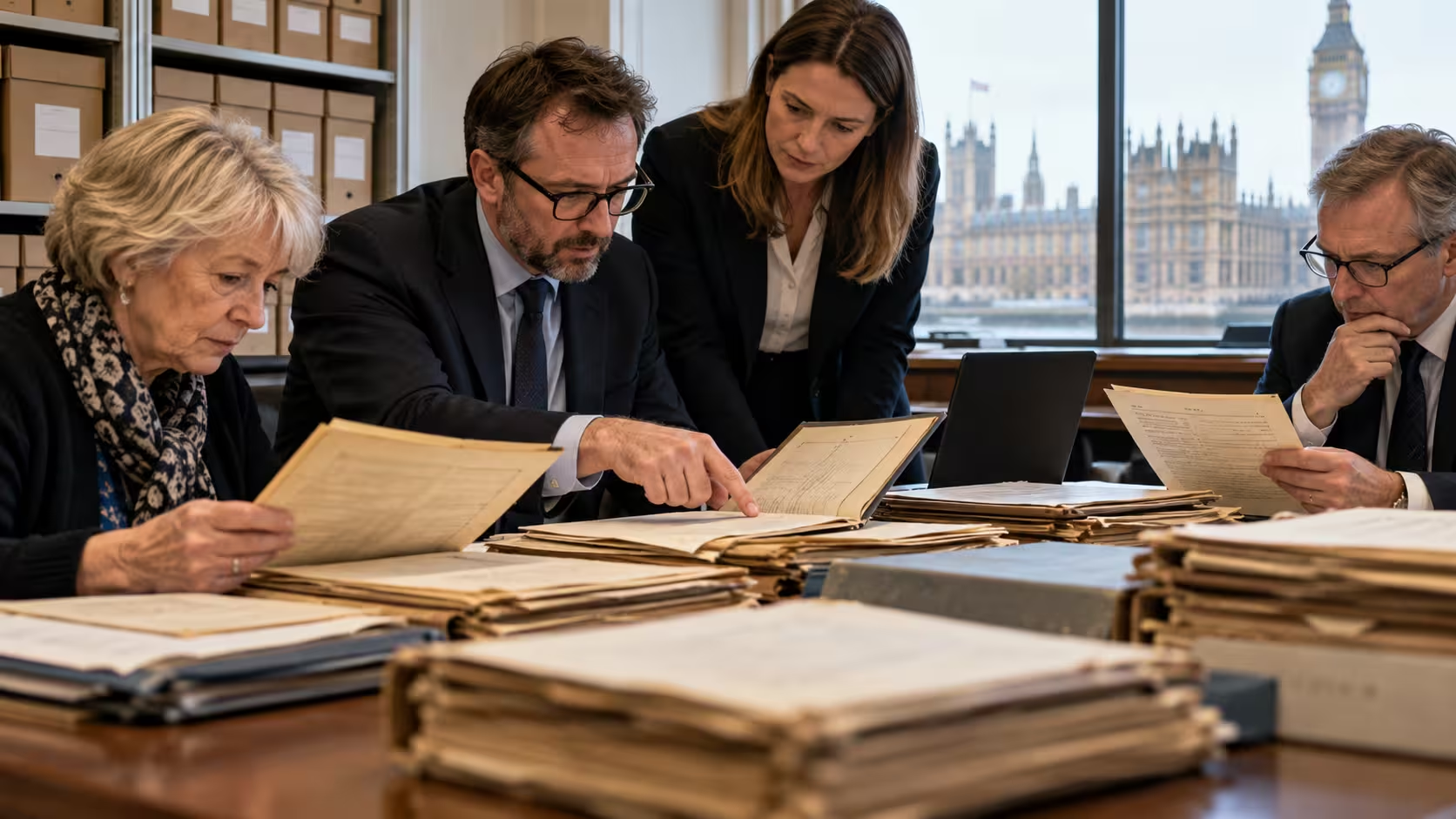
The previously overlooked 2007 evidence became important because it raised concerns about whether the original compensation decision had been made using all relevant information.
That led the Government to reconsider the December 2024 decision.
However, reconsideration should not be confused with approval of compensation.
After reviewing the additional evidence and wider historical material, the Government announced its new decision on 29 January 2026 and again declined to create a financial compensation scheme.
The overlooked material therefore had a major procedural impact because it resulted in the decision being taken again.
It did not ultimately produce a different compensation outcome.
Who Is Affected by the WASPI Compensation Dispute?
The dispute primarily concerns women born in the 1950s who were affected by increases to women’s State Pension age.
However, being born within a particular period should not be treated as evidence of an existing compensation entitlement.
There is currently no DWP compensation scheme and therefore no final official compensation eligibility criteria.
Different women also had different levels of awareness of the pension changes and different financial circumstances.
Any future compensation scheme, if one were ever introduced, would require the Government to establish clear rules covering who qualifies, what evidence is necessary and how payment amounts would be determined.
No such scheme currently exists.
Is There a WASPI Compensation Application Form or Payment Date?
No official DWP WASPI compensation application process currently exists.
There is also no confirmed payment date.
This is because the Government’s current decision is not to introduce financial compensation.
Women should therefore be cautious about claims suggesting that they must urgently register to receive £2,950.
At present:
- There Is No Official £2,950 Claim Form
- There Is No Government Compensation Portal
- There Is No Confirmed Claims Deadline
- There Is No Confirmed Payment Month
- There Is No Published Payment Schedule
If the Government’s position changes in the future, an official process would need to be announced before applications or payments could begin.
What Is Happening With the WASPI Judicial Review in 2026?
The latest legal challenge concerns the Government’s new January 2026 decision.
In June 2026, the DWP told Parliament that WASPI was seeking permission from the High Court to bring a judicial review. The court had not yet made its permission decision at that stage.
An update published by WASPI’s legal fundraising campaign on 17 August 2026 said the claim was still waiting to be considered by a High Court judge.
Judicial review examines whether a public authority made a decision lawfully.
It is not simply another opportunity for a court to decide whether compensation would be desirable.
If a legal challenge succeeds, the Government could potentially have to reconsider its decision again depending on the court’s judgment.
A successful judicial review would not automatically mean that every affected woman receives £2,950.
Could WASPI Compensation Still Be Reconsidered in the Future?
Yes, the issue could be reconsidered again, but compensation should not be presented as expected or guaranteed.
Several developments could potentially affect the position.
- Court Proceedings Could affect the legal validity of the Government’s decision
- A Future Government Decision Could alter existing policy
- Further Parliamentary Scrutiny Could keep the issue under consideration
- New Evidence Could potentially influence future discussions
However, the position as of October 2026 remains that the Government has decided against financial compensation.
Any future change would require a new official decision or another legally significant development.
What Is the DWP Doing to Improve State Pension Communications and Complaints Handling?
Although the Government rejected financial compensation, it has accepted the need to learn from the communication and complaint-handling failures identified during the investigation.
On 25 June 2026, DWP published an action plan covering State Pension age communications and complaints handling.
The plan aims to improve how people receive and understand State Pension information.
Key areas include:
- Developing A New State Pension Communications Strategy
- Encouraging People To Check Their State Pension Age
- Using More Targeted And Accessible Communication
- Improving Feedback From Complaints
- Working With External Organisations And Stakeholders
- Monitoring Awareness Of State Pension Age
- Improving Internal Accountability And Oversight
The overall action plan is due for completion by April 2027. An initial State Pension communications strategy is expected to cover the period from April 2027 to 2030, with its first iteration expected in November 2026.
This is one of the clearest practical outcomes of the Ombudsman investigation even though financial redress has not been adopted.
What Should WASPI Women Watch for Next?
The High Court proceedings are now one of the most important developments to monitor.
The key question is whether WASPI’s latest judicial review challenge receives permission to proceed and, if it does, how the court assesses the legality of the Government’s January 2026 decision.
Women following the issue should also watch for:
- Any High Court Permission Decision
- A Possible Full Judicial Review Hearing
- Further Government Responses To Court Proceedings
- Updates To DWP’s State Pension Communications Action Plan
- The First Version Of The New Communications Strategy
- Any Official Change To The Compensation Position
Unless an official decision changes, claims that £2,950 payments have started should be treated cautiously.
The most important point remains that the £2,950 figure is an Ombudsman compensation-range figure rather than an approved DWP payment.
Frequently Asked Questions
Has WASPI Compensation Been Approved in 2026?
No. The Government reconsidered the case but announced on 29 January 2026 that it would not introduce a financial compensation scheme.
Is £2,950 a Confirmed DWP Payment?
No. £2,950 represents the upper end of the Ombudsman’s Level 4 financial remedy range. It is not a confirmed DWP payment.
Will Every WASPI Woman Receive £2,950?
No. There is currently no compensation scheme, so there is no automatic £2,950 entitlement for every affected woman.
Can Women Apply for WASPI Compensation Now?
No official DWP WASPI compensation application process is currently open because financial compensation has not been approved.
When Was the Latest WASPI Compensation Update?
The latest major official DWP action-plan publication was issued on 25 June 2026. The latest accessible WASPI legal campaign update reviewed here was dated 17 August 2026, when the judicial review application was still waiting for a High Court permission decision.
Could the Government’s Decision Change Again?
It is possible for the position to change through future Government decisions or legal developments. However, as of October 2026, no compensation scheme has been approved and no £2,950 payment date has been announced.