

Supermarket Vouchers Universal Credit – Who Is Eligible and How to Apply?
With the rising cost of living in the UK, many households struggle to cover essentials like food, toiletries, and energy bills. For Universal Credit claimants, these pressures can be particularly challenging. Supermarket vouchers can provide short-term financial relief, though they are not issued directly by Universal Credit.
Instead, support comes through government-backed or locally administered schemes, primarily the Household Support Fund and the Healthy Start Scheme for eligible families.
This guide explains what supermarket vouchers are, who can access them, how the schemes work, and how to apply, helping claimants understand their options and take informed action to ease financial strain.
What Are Supermarket Vouchers for Universal Credit Claimants?
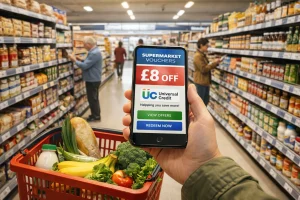
Supermarket vouchers are a form of non-cash support that help people buy food and essential items from participating retailers. Instead of receiving money into a bank account, eligible individuals or families are given vouchers or prepaid cards that can be used in supermarkets or local shops.
For Universal Credit claimants, these vouchers are usually offered as short-term or emergency assistance rather than ongoing support. They are intended to help during periods of financial strain, such as unexpected expenses or rising living costs, and are often issued electronically by text or email.
Vouchers can typically be used for:
- Groceries and basic food items
- Baby essentials and household goods
- Energy or fuel costs in some local schemes
They are designed to provide immediate relief, not replace regular income. Importantly, they are not meant to replace regular income but to provide immediate relief when budgets are under pressure.
Are Supermarket Vouchers Part of Universal Credit?
Supermarket vouchers are not an official part of Universal Credit. Universal Credit is a monthly payment that helps with living costs and replaces several older benefits, but it does not include vouchers as a standard feature. This often causes confusion among claimants.
That said, being on Universal Credit can make someone more likely to qualify for other support schemes that do provide supermarket vouchers. Many councils and organisations use receipt of means-tested benefits as a way to identify households on low incomes or at risk of financial hardship.
In effect, Universal Credit acts as a gateway rather than a provider. Understanding this difference helps claimants know where to seek additional help and avoids unrealistic expectations about what Universal Credit alone offers.
Who Is Eligible for Supermarket Vouchers on Universal Credit?

Eligibility for supermarket vouchers on Universal Credit is not the same across the UK, as many schemes are run locally by councils.
While receiving Universal Credit can support an application, eligibility is usually based on overall financial need rather than benefit status alone. Councils assess individual circumstances to decide who qualifies.
Common Factors Considered:
- Household income and available savings
- Whether the applicant receives means-tested benefits
- Presence of children or dependent family members
- Pensioners on low or fixed incomes
- People facing illness, caring duties, or sudden income loss
- Short-term financial crises or unexpected hardship
Councils may adjust criteria depending on demand and available budgets. For this reason, checking your local council’s website regularly is essential to stay informed about current support and application options.
What Is the Household Support Fund and How Does It Help?
The Household Support Fund is one of the main ways supermarket vouchers are distributed to people on Universal Credit and other low-income households. It is funded by central government but administered by local councils, giving them flexibility to respond to the specific needs of their communities.
How the Household Support Fund Works?
The Household Support Fund provides councils with funding to help residents struggling with living costs. Support often includes supermarket vouchers for food and essentials, though some councils also assist with energy bills.
As the scheme is locally run, eligibility, application processes, and voucher values vary by council and household circumstances.
Who the Fund Is Aimed At?
The Household Support Fund is designed to support vulnerable residents. This often includes people on Universal Credit, but it can also extend to others who are not claiming benefits but are still experiencing hardship.
Councils may prioritise families with children, disabled people, carers, or those facing exceptional circumstances.
Typical Support Provided
While each council decides how to use its funding, supermarket vouchers are commonly offered as e-vouchers or prepaid cards. These can usually be redeemed at major supermarket chains and sometimes at local retailers.
Examples of support may include:
- One-off supermarket vouchers to help cover food costs
- Vouchers issued during school holidays for families with children
- Combined support packages covering food and energy costs
The table below gives a general idea of how Household Support Fund assistance may vary, although exact details depend on the local authority.
| Aspect | Typical Approach |
|---|---|
| Administration | Managed by local councils |
| Eligibility | Low-income or vulnerable households |
| Type of support | Supermarket vouchers, essentials, energy help |
| Frequency | Usually one-off or short-term |
| Impact on benefits | Does not affect Universal Credit |
How Can You Apply for Household Support Fund Supermarket Vouchers?

Applying for supermarket vouchers through the Household Support Fund usually involves contacting your local council directly. While each council sets its own process, the overall approach is broadly similar across the UK.
The application process usually involves:
- Checking your local council’s cost of living or financial support page
- Completing an online form or contacting council support services
- Providing basic details about your household and financial situation
- Submitting evidence such as proof of address or Universal Credit entitlement
Once an application is approved, vouchers are often issued electronically. These e-vouchers are typically sent by text message or email and can be redeemed at participating supermarkets.
In some cases, support workers or local advice services can help individuals apply if they are unable to do so online.
What Is the Healthy Start Scheme and Who Can Claim It?
In addition to local council support, some Universal Credit claimants may be eligible for help through the Healthy Start Scheme. This is a national programme aimed specifically at improving nutrition for pregnant women and young children in low-income families.
Purpose of the Healthy Start Scheme?
The Healthy Start Scheme provides support to help families access healthy food during crucial stages of pregnancy and early childhood. Rather than general supermarket vouchers, it focuses on specific items that contribute to a balanced diet.
Who Is Eligible?
Eligibility is based on both circumstances and income. Typically, the scheme is open to pregnant women and families with children under a certain age who are receiving qualifying benefits, including Universal Credit. Income thresholds may apply, and these are assessed as part of the application process.
What Support Is Provided?
Eligible families receive a prepaid card that can be used to buy items such as milk, fruit, vegetables, and infant formula. The scheme also provides access to free vitamins for pregnant women and young children.
The table below highlights key differences between the Household Support Fund and the Healthy Start Scheme.
| Feature | Household Support Fund | Healthy Start Scheme |
|---|---|---|
| Scope | General cost of living support | Nutrition-focused support |
| Administration | Local councils | National scheme |
| Eligible groups | Vulnerable households | Pregnant women and families with young children |
| Type of help | Supermarket vouchers, essentials | Prepaid card for specific foods |
| Duration | Usually short-term | Ongoing while eligible |
Do Supermarket Vouchers Affect Universal Credit Payments?

One of the most common concerns among claimants is whether receiving supermarket vouchers will reduce their Universal Credit. In general, supermarket vouchers do not affect Universal Credit payments.
This is because vouchers provided through schemes like the Household Support Fund or Healthy Start are classed as discretionary or welfare support rather than income. They are intended to help meet specific needs and are not treated as earnings or savings for benefit calculations.
As a result, claimants can usually accept vouchers without worrying about their Universal Credit being reduced or reassessed. This reassurance is important, as it encourages people to seek help when they need it rather than avoiding support out of fear of financial consequences.
What Other Food and Cost of Living Support Is Available?
Supermarket vouchers are not the only form of help available to Universal Credit claimants struggling with food costs. A range of additional support options may be available locally or nationally, depending on individual circumstances.
Other forms of food and cost of living support may include:
- Food banks providing emergency food parcels through referral systems
- Community pantries or food hubs offering low-cost groceries
- Local welfare assistance schemes run by councils
- Referrals from advice services or Jobcentre staff to local support organisations
These options are designed to work alongside schemes like supermarket vouchers, helping households cope during periods of financial difficulty. While they may not provide long-term solutions, they can play a crucial role in preventing immediate hardship.
What Should Universal Credit Claimants Do If They Are Struggling with Food Costs?

For Universal Credit claimants finding it hard to afford food, taking early action can make a significant difference. The first step is often to check what local support is available, as this can vary widely depending on location and timing.
Contacting the local council is usually a good starting point, as they can provide information about Household Support Fund vouchers and other assistance. It may also be helpful to speak to advice services that can review finances, identify gaps in support, and suggest practical steps.
Claimants should not hesitate to ask for help. Supermarket vouchers and other forms of assistance exist precisely to support people during difficult periods. Making use of them can help stabilise a household’s situation and provide breathing space while longer-term solutions are explored.
Conclusion
Supermarket vouchers offer valuable short-term support for Universal Credit claimants struggling with the rising cost of living.
While not part of Universal Credit itself, schemes like the Household Support Fund and Healthy Start provide practical help to ease household budgets. Understanding eligibility, application processes, and available support is essential, as much of it is delivered locally.
Importantly, receiving vouchers usually does not affect Universal Credit payments, allowing claimants to access aid safely. Exploring these schemes can help manage immediate pressures and maintain stability.
Frequently Asked Questions
Can you get supermarket vouchers without being on Universal Credit?
Yes, some local schemes are open to people who are not receiving Universal Credit but are still on a low income or facing hardship. Eligibility depends on local criteria.
How long does it take to receive food vouchers after applying?
This varies by council, but many applicants receive vouchers within a few days or weeks once their application is approved.
Are supermarket vouchers issued every month?
In most cases, vouchers are provided as a one-off or temporary measure rather than a monthly payment.
Which supermarkets usually accept council food vouchers?
Vouchers are often accepted by major supermarket chains, although acceptance can vary depending on the scheme and location.
Can a household receive more than one voucher?
Some councils may provide additional support if circumstances change or hardship continues, but this is assessed on a case-by-case basis.
What documents are usually required to apply for vouchers?
Applicants are often asked for proof of identity, address, and income or benefits, such as a Universal Credit statement.
What should you do if your council has closed applications?
If applications are closed, it is worth checking again later, seeking advice from support organisations, or exploring alternative help such as food banks or community schemes.